
Author: Corporate

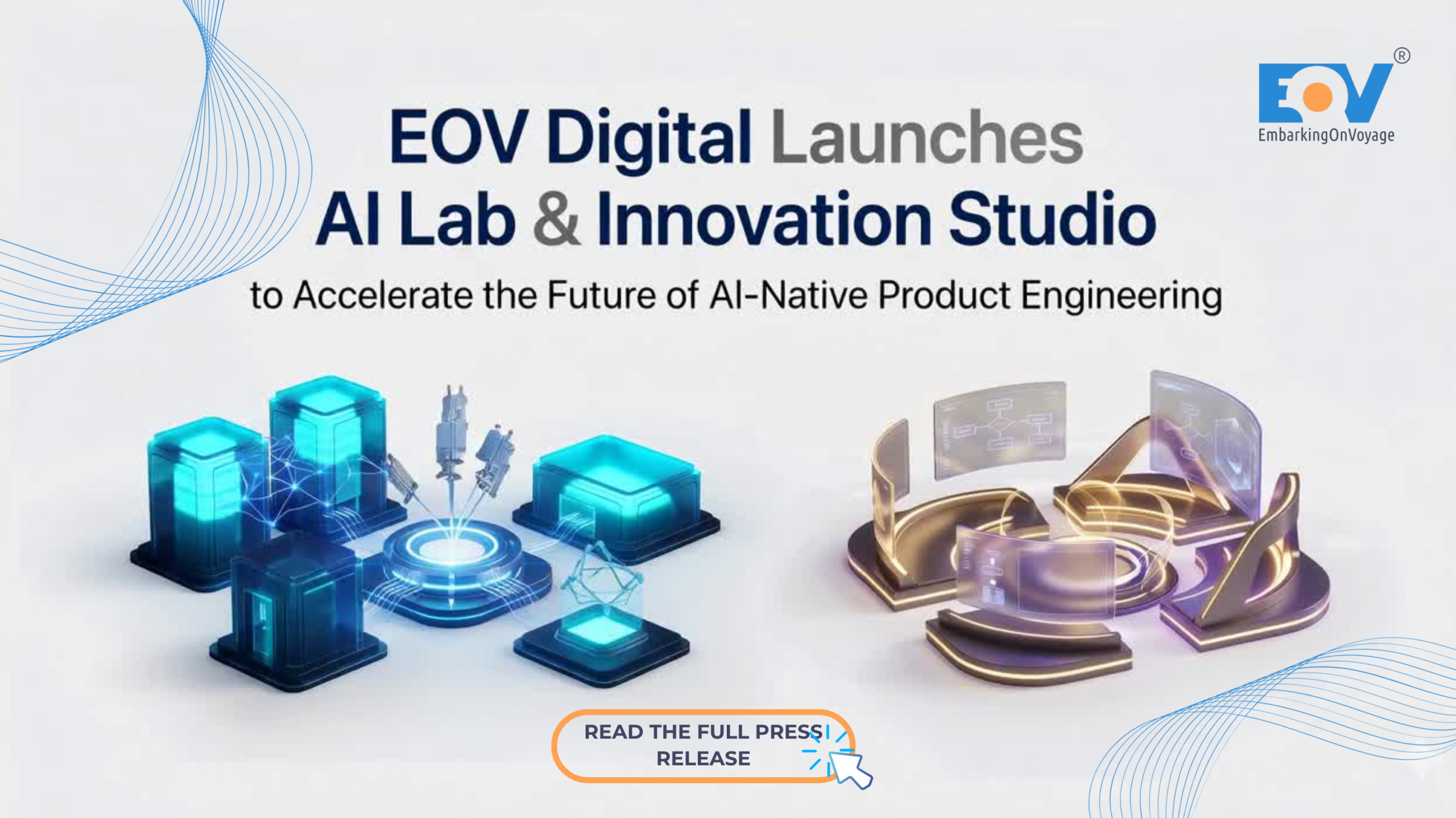
  • EOV Digital Launches AI Lab & Innovation Studio to Accelerate the Future of AI-Native Product Engineering

    EOV Digital Launches AI Lab & Innovation Studio to Accelerate the Future of AI-Native Product Engineering

    Pune, India [15.05.2026] – As global demand for AI-native software products, autonomous enterprise platforms, and intelligent digital systems continues to rise, EmbarkingOnVoyage Digital Solutions (EOV Digital) today announced the launch of its dedicated AI Lab & Innovation Studio, focused on building next-generation AI-native products, Agentic AI systems, and rapid enterprise innovation prototypes across industries.

    The launch comes at a time when the technology landscape is rapidly evolving from traditional Generative AI experimentation toward more operational and autonomous AI ecosystems powered by Agentic AI, intelligent orchestration, and human-in-the-loop decision systems.

    According to EOV Digital, enterprises are no longer looking at AI as just a productivity layer or chatbot capability. Organizations across fintech, healthcare, retail, travel, hospitality, SaaS, and enterprise technology are increasingly exploring how AI-native systems can:

    • Automate workflows,
    • Orchestrate operations,
    • Improve decision intelligence and create adaptive digital ecosystems.

    AI is moving beyond prompts and copilots. We are entering an era where enterprise software itself will become increasingly intelligent, contextual, and operationally autonomous,” Our AI Lab & Innovation Studio is designed to help transform innovative ideas into scalable AI-native enterprise products faster.” – Abhishek Nag CEO & Founder

    EOV’s AI Lab will operate with agile, cross-functional engineering teams focused on:

    • Rapid AI prototype development,
    • Agentic AI experimentation,
    • Enterprise AI workflow design,
    • AI-native product modernization,
    • LLM benchmarking,
    • Intelligent automation and human-centred AI experiences.

    The company plans to work closely with early startups, enterprises, product innovators, and domain specialists to fast-track proof-of-concepts and innovation cycles across multiple industries.

    As part of the initiative, EOV Digital also opened innovation and incubation approach aimed at bringing together:

    • Industry veterans,
    • AI data scientists,
    • Enterprise architects,
    • AI enthusiasts,
    • Product thinkers and innovation-led engineering talent

    From all across the globe who believe AI will fundamentally reshape industries over the coming decade.

    “We are actively looking for people who feel their ideas can genuinely disrupt existing industries through AI-native thinking,” EOV leadership added. “Whether someone comes from fintech, healthcare, retail, logistics, travel, or enterprise operations, we want to collaborate with individuals who see AI as a transformational layer for the future of business.”

    Through the AI Lab & Innovation Studio, EOV plans to support promising ideas and innovation teams by offering:

    • Technical mentoring,
    • Engineering acceleration,
    • Product strategy support,
    • Enterprise-grade product development guidance,
    • Cloud-native architecture expertise, and access to enterprise ecosystems for showcasing AI-native solutions jointly with EOV.

    The company believes many breakthrough AI-native products of the future will emerge not from large organizations alone, but from smaller and emerging agile teams capable of combining domain understanding, operational insight, and intelligent engineering.

    EOV Digital’s broader AI-first strategy focuses on becoming a niche AI-native product engineering company specializing in:

    • Agentic AI engineering,
    • AI-native software product development,
    • Autonomous workflows,
    • Enterprise AI modernization,
    • Intelligent operational platforms, and scalable AI-first digital ecosystems.

    Backed by experienced enterprise product engineering leadership and modern Microsoft and cloud-native engineering expertise, EOV aims to help organizations accelerate the transition from traditional software systems toward intelligent AI-native enterprise platforms.

    About EOV Digital

    EmbarkingOnVoyage Digital Solutions (EOV Digital) is a Pune-based AI-native product engineering and co-development company helping ISVs, digital agencies, startups, and enterprises build intelligent enterprise platforms, scalable digital products, and autonomous AI-native systems.

    The company specializes in:

    • AI-native product development,
    • Agentic AI engineering,
    • Full stack product engineering,
    • Enterprise modernization,
    • Intelligent workflow orchestration,
    • AI-native UX engineering, and cloud-native digital platforms for global businesses.

    Press Contact: 

    EOV Digital Solutions

    marketing@embarkingonvoyage.com 

    Maruti Millennium Tower, Office # 712 & 713, Level 7, Mumbai Pune Expressway, Baner, Pune 

    Phone: +91 – 20 – 6723 5802 

    Latest Press Release Highlights: https://embarkingonvoyage.com/press-release/eov-digital-accelerates-globally-ai-first-vision-with-strategic-investments-in-ai-engineering-microsoft-copilot-ecosystem-and-claude-powered-enterprise-innovation/
  • EOV Digital Accelerates globally AI-First Vision with Strategic Investments in AI-native Engineering, Microsoft Copilot Ecosystem, and Claude-Powered Enterprise Innovation

    EOV Digital Accelerates globally AI-First Vision with Strategic Investments in AI-native Engineering, Microsoft Copilot Ecosystem, and Claude-Powered Enterprise Innovation

    Pune-based AI-native product engineering company strengthens its focus on Agentic AI, autonomous enterprise platforms, and intelligent software product development

    Pune, India  [12.05.2026] — EmbarkingOnVoyage Digital Solutions (EOV Digital), an emerging AI-native product engineering company, today announced a strategic expansion of its AI-first engineering vision through focused investments in enterprise AI development capabilities, modern AI engineering ecosystems, and next-generation AI-assisted product delivery frameworks powered by Microsoft Copilot technologies and Claude-driven engineering workflows.

    The company’s latest initiative marks a significant step toward positioning EOV Digital as one of India’s niche AI-native software product development companies focused on building intelligent enterprise platforms, autonomous workflows, and scalable digital ecosystems for global ISVs, digital agencies, startups, and enterprise organizations.

    As enterprises across Europe, the United Kingdom, North America, Australia, and APAC accelerate AI adoption, EOV Digital believes the future of software engineering will be defined not by traditional development models alone, but by AI-native product engineering approaches where human expertise and intelligent systems work together operationally.

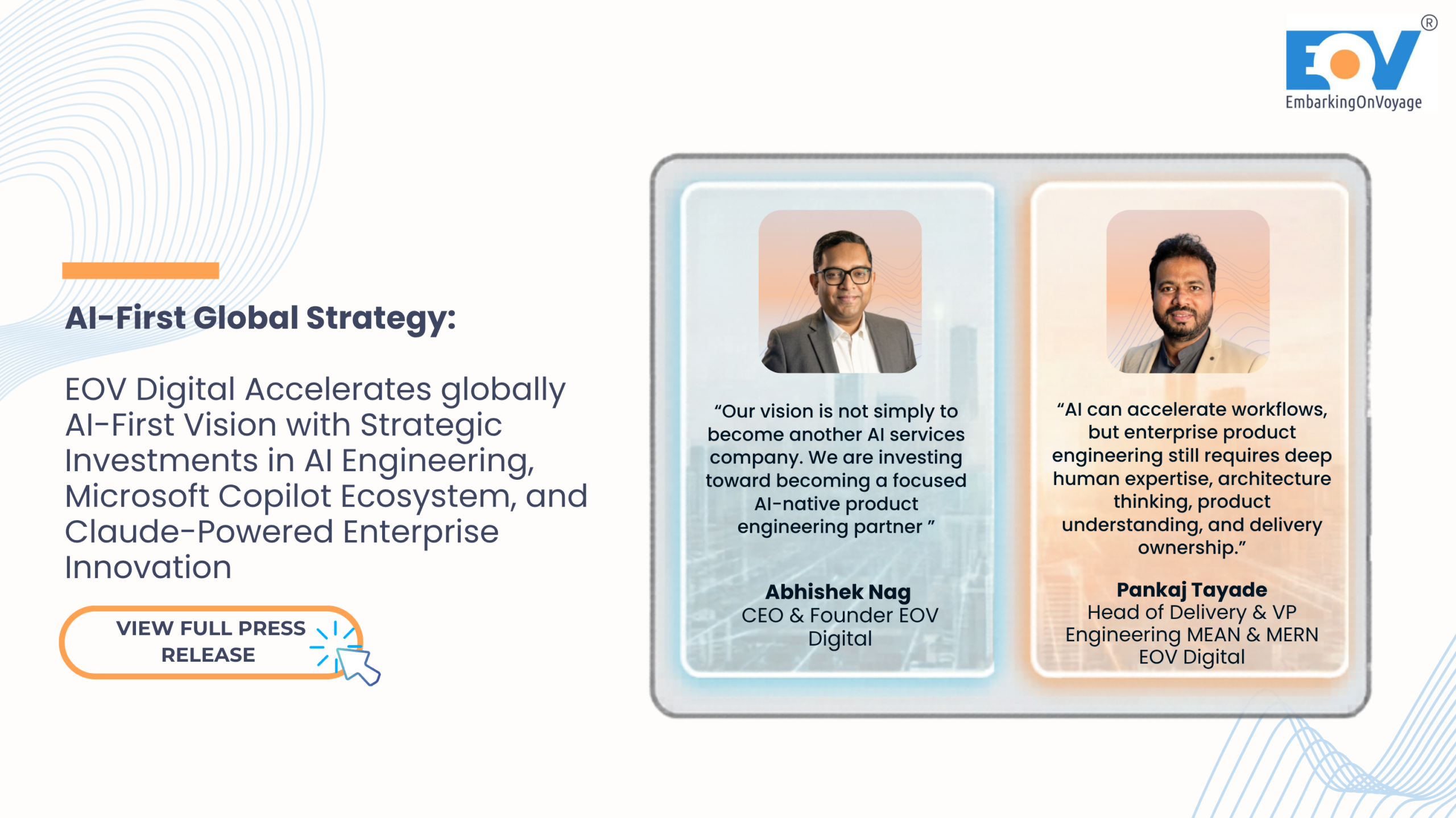
    “Our vision is not simply to become another AI services company,” said leadership at EOV Digital. “We are investing toward becoming a focused AI-native product engineering partner capable of helping enterprises build intelligent systems, scalable AI agents, autonomous workflows, and operationally mature AI-native digital platforms.” – Abhishek Nag, CEO & Founder EOV Digital

    The company’s AI-first strategy focuses heavily on combining:

    • human-in-the-loop engineering,
    • AI-assisted product development,
    • enterprise AI governance,
    • intelligent workflow orchestration,
    • and scalable cloud-native architectures.

    As part of this initiative, EOV Digital is actively strengthening its engineering ecosystem around modern AI-assisted development practices leveraging technologies and productivity ecosystems inspired by Microsoft Copilot capabilities and Claude-powered engineering acceleration frameworks.

    The company believes these modern AI engineering environments will significantly improve:

    • Product delivery velocity,
    • Engineering research capabilities,
    • Developer productivity,
    • Intelligent QA processes,
    • Enterprise workflow automation and operational scalability.

    However, EOV also emphasized that AI tools alone cannot replace engineering maturity or business understanding.

    “AI can accelerate development, research, testing, and operational workflows, but enterprise product engineering still requires deep human expertise, architecture thinking, product understanding, and delivery ownership,” the company stated. “We strongly believe the future belongs to organizations that successfully combine AI innovation with experienced engineering leadership.” – Pankaj Tayade, Head of Delivery & VP Engineering MEAN & MERN– EOV Digital

    EOV Digital’s long-term roadmap includes building specialized capabilities around:

    • Agentic AI engineering
    • AI-native SaaS modernization
    • Enterprise AI copilots
    • Intelligent workflow automation
    • AI-native UX engineering
    • AI-driven operational intelligence and scalable enterprise orchestration platforms.

    The company is particularly focused on industries undergoing rapid operational transformation through AI, including:

    • Fintech
    • Healthcare
    • Retail
    • Travel technology
    • Hospitality and enterprise SaaS platforms.

    According to EOV Digital, many enterprises today are still approaching AI through isolated pilots and experimentation. The company believes the next phase of enterprise transformation will involve building AI directly into the operational foundation of enterprise software products rather than treating AI as an external layer.

    This shift is driving increased demand for:

    • AI-native product development companies
    • Enterprise AI engineering partners
    • Intelligent automation specialists and scalable AI-first software engineering teams

    EOV Digital aims to differentiate itself by operating as a long-term co-development partner rather than a traditional outsourced delivery vendor.

    The company combines expertise across:

    • .NET,
    • Azure AI
    • Full stack product engineering
    • Cloud-native modernization
    • React
    • Angular
    • Node.js
    • Enterprise workflow orchestration and modern AI-native software architectures

    The company also plans to expand its R&D initiatives around:

    • LLM benchmarking
    • Enterprise AI validation
    • Human-centered AI experiences
    • AI governance frameworks and operational trust engineering

    Industry observers believe India’s software product ecosystem is entering a significant transition period as AI-native engineering models become increasingly mainstream across enterprise technology initiatives globally.

    Pune, already known for its strong enterprise engineering talent pool, is emerging as a growing center for AI-native product engineering innovation. EOV Digital believes this creates a strong opportunity for focused and specialized AI-first engineering companies to build globally competitive product engineering capabilities from India.

    “Our goal is to help enterprises move from legacy operational systems toward intelligent, autonomous, and AI-native digital ecosystems,” EOV Digital added. “The future of enterprise software will not just be cloud-native. It will be AI-native and the journey has already begun” – Priya Nag, CPO & Founder EOV Digital

    Through its continued investments in AI-first engineering practices, intelligent automation frameworks, and enterprise AI product development capabilities, EOV Digital aims to establish itself as a trusted AI-native product engineering partner for businesses looking to modernize, innovate, and scale in the evolving AI-driven global economy.

    About EOV Digital

    EmbarkingOnVoyage Digital Solutions (EOV Digital) is a Pune-based AI-native product engineering and co-development company helping ISVs, digital agencies, startups, and enterprises build intelligent enterprise platforms, scalable digital products, and autonomous AI-native systems.

    The company specializes in:

    • AI-native product development
    • Agentic AI engineering
    • Full stack product engineering
    • Enterprise modernization
    • Intelligent workflow orchestration
    • AI-native UX engineering and scalable cloud-native digital platforms

    EOV Digital works with organizations across Europe, the UK, North America, Australia, APAC, and India to accelerate digital transformation through AI-first engineering and human-centric innovation.

    Press Contact: 

    EOV Digital Solutions

    marketing@embarkingonvoyage.com 

    Maruti Millennium Tower, Office # 712 & 713, Level 7, Mumbai Pune Expressway, Baner, Pune 

    Phone: +91 – 20 – 6723 5802 

    Latest Press Release Highlights: https://embarkingonvoyage.com/press-release/eov-digital-solutions-joins-pune-devcon-2025-as-a-bronze-sponsor/

  • EOV Digital Solutions Joins Pune DevCon 2025 as a Bronze Sponsor

    EOV Digital Solutions Joins Pune DevCon 2025 as a Bronze Sponsor

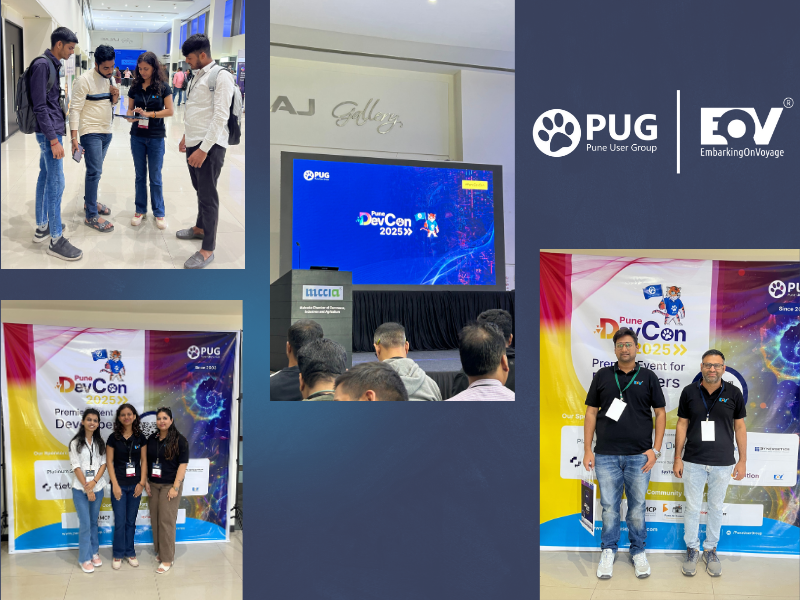
    Pune, India | [20.12.2025] – EOV Digital Solutions Joins Pune DevCon 2025 as a Bronze Sponsor, a flagship technology conference organized by the Pune User Group (PUG) at the prestigious MCCIA Tower, Pune. The event brought together developers, architects, technology leaders, and Microsoft ecosystem enthusiasts under one roof to exchange knowledge, explore innovation, and discuss the future of modern software development. 

    As a Bronze Sponsor, EOV Digital Solutions was honored to be part of a platform that fosters learning, collaboration, and community-driven growth within the technology ecosystem. Pune DevCon 2025 stood out as a vibrant forum showcasing advancements in cloud computing, AI, modern application development, and Microsoft technologies. 

    Gratitude to Pune User Group (PUG) 

    EOV extends its special thanks and heartfelt appreciation to the Pune User Group (PUG) for organizing such a well-curated and impactful event. The passion, dedication, and professionalism demonstrated by the PUG team played a key role in making Pune DevCon 2025 a resounding success. Their continued efforts to strengthen the developer community and promote technical excellence are truly commendable. 

    EOV Digital Solutions Commitment to the Microsoft Ecosystem 

    EOV Digital Solutions has long been committed to building scalable, secure, and future-ready digital solutions within the Microsoft ecosystem. From .NET, Azure Cloud, Blazor, and enterprise-grade architectures to cutting-edge innovations, EOV continues to invest deeply in Microsoft technologies to deliver real business value to its clients. 

    Speaking on EOV’s vision, Shwetamber Chourey, Vice President – Engineering (Microsoft Practices), emphasized the company’s growing focus on Artificial Intelligence and Microsoft Copilot  
     
    “At EOV, we strongly believe that the future of digital transformation lies in intelligent, AI-driven solutions. Our commitment to the Microsoft ecosystem especially in AI and Copilot technologies is about empowering businesses to work smarter, automate faster, and make data-driven decisions with confidence”. 

    EOV is actively leveraging Microsoft AI, Azure OpenAI, and Copilot integrations to help organizations enhance productivity, streamline workflows, and unlock new growth opportunities. 

    Leadership Perspective 

    Sharing corporate feedback on EOV’s participation, Abhishek Nag, CEO & Founder, EOV Digital Solutions, stated: 

    “Pune DevCon 2025 perfectly aligns with EOV’s vision of innovation through collaboration. Being part of this event allowed us to engage with the developer community, exchange ideas, and reaffirm our commitment to building meaningful solutions on the Microsoft platform. We are proud to support initiatives like Pune DevCon that strengthen the technology ecosystem and inspire future innovation.”   

    Looking Ahead 

    EOV Digital Solutions looks forward to continuing its journey with the Microsoft community, contributing to knowledge-sharing platforms, and partnering with organizations to co-create impactful digital products. Participation in events like Pune DevCon 2025 reinforces EOV’s belief in community-driven growth, innovation, and continuous learning. 

    About EOV Digital Solutions

    EOV Digital Solutions is a technology-driven organization focused on co-creating scalable digital products using modern architectures and Microsoft technologies. With a strong emphasis on cloud, AI, and enterprise solutions, EOV partners with businesses to transform ideas into high-performing digital experiences. 

    Press Contact: 

    EOV Digital Solutions

    marketing@embarkingonvoyage.com 

    Maruti Millennium Tower, Office # 712 & 713, Level 7, Mumbai Pune Expressway, Baner, Pune 

    Phone: +91 – 20 – 6723 5802 

    Latest Press Release Highlights: https://embarkingonvoyage.com/press-release/wtm-london-2025/

  • EOV Showcases Innovation at WTM London 2025

    EOV Showcases Innovation at WTM London 2025

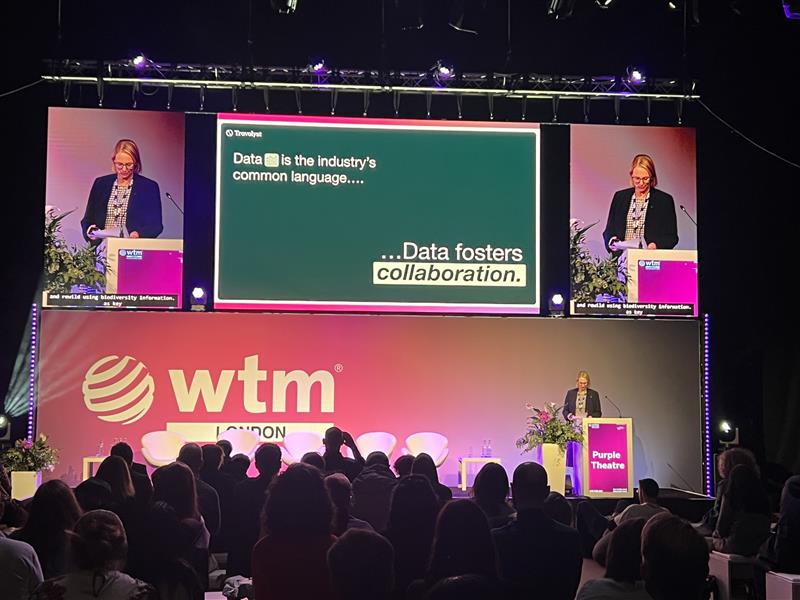
    Pune, India | [06.11.2025] — EOV (EmbarkingOnVoyage), a global product engineering and digital transformation company, participated in World Travel Market (WTM) London 2025, one of the world’s largest and most influential travel and technology events.

    The event served as a dynamic platform for EOV to engage with global travel, tourism, and technology leaders, exchange insights on digital innovation, and explore new partnership opportunities across the travel tech ecosystem.

    Driving Innovation in Travel Technology

    EOV’s participation at WTM London reinforces its commitment to advancing digital solutions for the global travel and hospitality industry. The company showcased its expertise in data-driven platforms, AI-powered personalization, intelligent automation, and modern product engineering—designed to help travel enterprises reimagine customer experience and operational efficiency.

    Speaking on the occasion, Abhishek Nag, CEO of EOV, said:
    “WTM London is not just an event—it’s a hub of global innovation. Being here allows us to understand evolving traveler expectations and collaborate with visionary companies shaping the future of travel technology. Our goal is to engineer solutions that make global travel smarter, seamless, and more sustainable.”

    Strengthening Global Presence

    With a growing client base across the US, Europe, and APAC, EOV continues to expand its footprint in the travel technology domain. The WTM participation reflects EOV’s strategy to align with global partners, co-create solutions, and drive digital transformation across the travel industry value chain.

    This milestone adds another chapter to EOV’s journey of empowering enterprises across diverse sectors—including TravelTech, FinTech, HealthTech, and Cybersecurity—with its strong product mindset and engineering excellence.


    About EOV (EmbarkingOnVoyage)

    EOV is a modern product engineering company helping startups, scale-ups, and enterprises accelerate innovation through deep technology expertise, agile execution, and a strong Microsoft ecosystem focus. Trusted globally, EOV partners with leading organizations to build digital products that create impact, efficiency, and growth.

    Press Contact: 

    EOV Digital 

    marketing@embarkingonvoyage.com 

    Maruti Millennium Tower, Office # 712 & 713, Level 7, Mumbai Pune Expressway, Baner, Pune 

    Phone: +91 – 20 – 6723 5802 

  • Regulatory & Compliance Challenges of Big Data in Healthcare

    As healthcare systems increasingly leverage big data—EHRs, clinical records, genomics, sensor streams—the regulatory stakes rise. Complying with privacy, security, data governance, AI oversight, and interoperability rules is complex. If you get it wrong, the consequences are steep: fines, legal liability, patient harm, reputational damage. Let’s explore the major challenges and how to overcome them.

    1. Why Big Data in Healthcare Is Highly Regulated

    Before diving into challenges, it helps to see why big data in healthcare attracts so much regulatory attention:

    • The data processed in healthcare is inherently sensitive (medical history, diagnoses, biometric data, genetic data).
    • Decisions based on data can impact patient care, rights, outcomes—errors or bias can cause real harm.
    • Healthcare systems often cross institutional, regional, and national boundaries, making regulatory complexity high.
    • There’s increasing scrutiny of AI systems, especially in clinical or regulatory decision-making.
    • Data sharing, interoperability, and secondary use (research, public health) create tension with privacy rights.

    Because of that, regulations impose strict obligations on how data is collected, stored, shared, processed, audited, and disposed.

    2. Major Regulatory & Compliance Challenges

    Here are the key regulatory & compliance challenges when applying big data in healthcare:

    2.1 Privacy & Data Protection Laws (HIPAA, GDPR, etc.)

    • In the U.S., HIPAA (Health Insurance Portability and Accountability Act) governs Protected Health Information (PHI)—how it must be protected, when it can be used, patient rights, breach notification.
    • Under GDPR (EU), health data is a “special category” requiring additional safeguards and stricter consent, purpose limitation, data minimization.
    • Differences in national or state privacy laws.
    • Ensuring anonymization / de-identification meets legal thresholds (and resisting re-identification risk).
    • Legal definitions, enforcement, and penalties are evolving.

    A 2024 article notes that changes proposed to HIPAA will strengthen requirements on encryption, multifactor auth, incident response, and enforcement.
    Also, a study on data privacy in healthcare highlights inconsistent definitions, lack of standardized protocols, and semantic discrepancies as obstacles.

    2.2 Data Governance, Consent & Patient Rights

    • Obtaining informed consent for data collection, use, secondary reuse (e.g. research).
    • Managing consent revocation and data deletion requests.
    • Ensuring patients can access, correct, or delete their data.
    • Enforcing purpose limitation (data only used for specified purposes).
    • Ensuring data provenance and lineage (how data came to be, transformations).

    2.3 Interoperability, Standards & Data Sharing

    • Healthcare providers use diverse systems (EHR, lab systems, imaging), with heterogeneous formats and semantics.
    • Lack of universal adoption of standards (HL7, FHIR, LOINC, SNOMED) causes challenges in combining data meaningfully.
    • Regulatory regimes sometimes mandate interoperability or “open APIs,” creating tension with privacy or business logic.
    • Standardization can help ensure compliance and auditability.

    2.4 AI / Algorithmic Accountability & Explainability

    • When big data drives AI/ML models used for diagnosis, risk scoring, treatment suggestions, regulators demand explainability, fairness, avoidance of bias, accountability.
    • Models must often meet regulatory standards around safety, robustness, auditability.
    • Regulatory ambiguity remains about how “AI in healthcare” is regulated—oversight bodies are evolving.
    • Research surveys note that responsible, conform machine learning in medicine must align with privacy, transparency, safety, fairness, nondiscrimination.

    2.5 Cross-Border / Jurisdictional Compliance

    • Data flows across borders raise issues: a dataset stored or processed in another jurisdiction may be subject to its laws (e.g. GDPR).
    • Requirements for localization, data residency, cross-border transfer restrictions.
    • Reconciling multiple legal regimes in multinational analysis or research.

    2.6 Security, Breach Risk & Incident Reporting

    • Healthcare is a prime target for cyberattacks, ransomware.
    • Regulations mandate incident reporting, breach notification timelines, penalties.
    • Ensuring encryption in transit, at rest; strong access controls; regular security audits.
    • The article “Healthcare Risk and Compliance: 5 Key Challenges” highlights that regulatory complexity, third-party risk, and cyber threats are rising.

    2.7 Auditability, Provenance & Traceability

    • Regulators expect you to show an audit trail of data access, processing steps, transformations, model decisions.
    • Versioning, logging, immutable records are critical.
    • Tools must prove chain of custody of data and outputs.

    2.8 Vendor / Third-Party Risk & Compliance

    • Big data systems often rely on vendors (cloud, analytics, AI platforms).
    • Ensuring vendors comply with same regulations, have proper contracts, data access controls.
    • Liability, oversight, audits of third parties.

    3. Real Examples & Regulatory Pressure Trends

    • The Biden administration is proposing stricter cybersecurity rules for healthcare, including updates to HIPAA’s Security Rule with required encryption, multifactor authentication, and forced compliance checks.
    • Privacy law practitioners identify six emerging data privacy challenges in healthcare: rulings on patient data, AI use, global regulatory updates, litigation trends, use of tracking technologies, state-level privacy expansions.
    • In the academic sphere, surveys on Responsible and Regulatory Conform ML for Medicine illustrate the gap between AI innovation and regulatory alignment.
    • In articles analyzing big data in healthcare, data privacy & security are among the top cited barriers.

    These real pressures show that regulatory compliance is not hypothetical — it’s immediate and evolving.

    4. Mitigation Strategies & Best Practices

    How can healthcare organizations and tech teams build big data systems that comply and minimize risk?

    Best Practices

    1. Privacy-by-Design & Data Minimization
      Build systems that collect only necessary data, anonymize or aggregate where possible, default to privacy.
    2. Strong Consent Management
      Use dynamic, fine-grained consent frameworks. Track and enforce consent for secondary uses.
    3. Standard Data Models & Interoperability Frameworks
      Use FHIR, HL7, OMOP, CDISC where relevant to ensure data semantics and facilitate auditability. (E.g., CDISC is used in regulatory clinical research.)
    4. Access Controls & Role-Based Security
      Strict least-privilege, separation of duties, multi-factor authentication.
    5. Encryption & Secure Transmission
      Always encrypt data in transit and at rest; use secure key management, HSMs, etc.
    6. Auditing & Logging
      Maintain immutable logs of data access, processing steps, transformations, model decisions.
    7. Model Governance & Explainability
      For ML/AI systems, retain model interpretability, versioning, bias detection, impact assessment.
    8. Vendor and Third-Party Compliance
      Require contractual obligations, audits, compliance certifications, vendor assessments.
    9. Continuous Monitoring & Risk Assessment
      Run regular compliance audits, penetration testing, privacy impact assessments.
    10. Cross-Jurisdiction Compliance Strategy
      Map laws across countries, set data residency policies, design for lawful data flows (e.g. standard contractual clauses).
    11. Governance & Oversight Bodies
      Establish internal compliance committees, appoint Data Protection Officer (DPO), ethics boards.
    12. Transparency & Patient Rights
      Provide data subject access, corrections, deletion, clear privacy notices.

    By combining these practices, you significantly reduce regulatory risk.

    5. Regulatory Roadmap: What to Expect in Coming Years

    Here’s what big data / healthcare organizations should watch for:

    • Evolving HIPAA modernization proposals (as mentioned above) to mandate more stringent technical controls.
    • More AI regulation: requiring audits, explanation, safety, bias mitigation, alignment with ethics.
    • Stronger enforcement and penalties for data breaches in healthcare.
    • Global privacy regimes converging or conflicting (cross-border data rules).
    • Mandates for interoperability (patients’ right to data, API access).
    • Increased demand for auditability, provenance, data lineage in real-world evidence and regulatory submissions.
    • Use of emerging technologies for compliance: blockchain smart contracts to enforce data policy compliance. (For example, a paper proposes blockchain + smart contracts for enforcing EHR access policies.)
    • Growing requirements for “explainable AI” particularly in clinical decision systems.

    Being proactive helps you not be reactive.

    6. Conclusion & Key Takeaways

    The regulatory & compliance challenges of big data in healthcare are complex, multi-dimensional, and constantly evolving. But they’re not insurmountable — with thoughtful design, governance, and vigilance, you can responsibly harness big data without falling afoul of laws.

    💡 Summary of Key Points

    • Use big data compliance healthcare as your anchor keyword across content.
    • Major challenge areas: privacy law (HIPAA, GDPR), consent, interoperability, AI accountability, security, auditability, vendor risk.
    • Real-world regulatory trends are pushing stronger technical mandates now.
    • Best practices: privacy-by-design, consent management, standards adoption, encryption, logging, model governance, vendor compliance.
    • Expect stricter regulation going forward — plan ahead.

    Additional Resources: 

  • Top 10 Benefits of Building Cloud-Native Applications in 2025

    In today’s fast-changing tech landscape, cloud-native is more than a buzzword — it’s a foundational shift. Applications built cloud-native can scale, evolve, recover, and deliver features faster than ever. But what exactly do you gain from adopting this paradigm? Below are 10 compelling benefits (backed by examples and expert sources) that make cloud-native a must-consider path in 2025 and beyond.

    1. What Does “Cloud-Native” Mean?

    Before listing benefits, let’s set a baseline definition. Cloud-native applications are built to leverage cloud infrastructure fully, employing patterns like microservices, containers, orchestration (e.g. Kubernetes), immutable infrastructure, and declarative APIs.

    They are designed to be resilient, scalable, modular, and operate in dynamic, distributed cloud environments.

    With that in mind, here are the top benefits.

    2. Benefit #1: Scalability & Elasticity

    One of the strongest benefits is the ability to scale dynamically — up or down — according to demand.

    • Cloud-native apps can spin up additional instances or services automatically during traffic spikes, and scale down during idle times.
    • This elasticity prevents overprovisioning “just in case,” reducing waste and ensuring performance.
    • Recent research (e.g. Unlocking True Elasticity for the Cloud-Native Era with Dandelion) aims to push elasticity further, reducing cold-start overheads and resource waste.

    3. Benefit #2: Resilience & Fault Tolerance

    Cloud-native architectures are built with failure in mind:

    • Components are decoupled (microservices), so failure in one service doesn’t necessarily bring down the whole system.
    • Tools like Kubernetes enable health checks, self-healing (restarting failed pods), automatic failover.
    • Better fault isolation, graceful degradation, and circuit breaker patterns become easier to implement.

    This increases availability and trust in production systems.

    4. Benefit #3: Faster Time to Market / Velocity

    Cloud-native enables speed in ways legacy apps struggle with:

    • Services can be developed, tested, and deployed independently, enabling parallel work by teams.
    • Automation, CI/CD, containerization reduce manual overhead and release friction.
    • You can iterate faster and respond to market changes, feature demands, or bug fixes more nimbly than in monolithic systems.

    In short: speed + safety.

    5. Benefit #4: Cost Efficiency & Optimized Resource Use

    Cloud-native can reduce both capital and operational costs:

    • Pay-as-you-go model: you pay only for resources used.
    • Resource sharing and multi-tenancy mean infrastructure is more efficiently used.
    • Scaling down during off-peak hours saves cost.
    • Reduced operational overhead (less manual ops, fewer large monolithic upgrades).

    Thus, cloud-native often leads to better ROI.

    6. Benefit #5: Portability & Avoiding Vendor Lock-In

    One criticism of cloud direction is vendor lock-in — but cloud-native patterns help mitigate that:

    • When built using containers, microservices, and abstractions, the app becomes portable across cloud providers.
    • Decoupling service dependencies from specific cloud APIs enables migrating or multi-cloud strategies more easily.
    • This gives strategic flexibility and bargaining power.

    7. Benefit #6: Automation, DevOps & Continuous Delivery

    Cloud-native is tightly coupled with modern development practices:

    • Infrastructure as Code (IaC), automated provisioning, declarative configurations.
    • Continuous integration and delivery pipelines become smoother by virtue of container consistency.
    • Automated testing, deployment, rollback, release can be built into services.
    • The result: less toil, fewer manual errors, more predictable releases.

    This benefit accelerates the entire software lifecycle.

    8. Benefit #7: Better Observability & Monitoring

    Because services are modular, cloud-native makes it more feasible to instrument, monitor, trace, and observe:

    • You can track metrics per service (latency, error rates).
    • Distributed tracing across microservices helps root cause analysis.
    • Log aggregation, metrics, dashboards, alerts at fine granularity.
    • This visibility leads to better reliability and quicker fixes.

    9. Benefit #8: Enhanced Security & Compliance Enablement

    While cloud-native introduces some security complexity, it also aids security if done well:

    • Cloud platforms often provide built-in security controls, identity & access management, encryption, policy enforcement.
    • You can isolate services, reduce blast radius, sandbox components.
    • Patches, updates, and upgrades can be deployed rapidly and automatically.
    • Compliance is easier because infrastructure control is more standardized and auditable.

    10. Benefit #9: Innovation & Flexibility for Ecosystem Growth

    Cloud-native supports innovation and future growth:

    • You can experiment with new services (e.g. AI, serverless, event-driven), mix & match components.
    • The microservices architecture lets you replace or upgrade individual parts without affecting the whole.
    • Teams can adopt new stacks, languages, frameworks per service without large ripples.
    • The ecosystem of cloud services (databases, ML, streaming) can be integrated more easily.

    11. Benefit #10: Energy Efficiency & Sustainable Architecture

    This is a more cutting-edge but growing benefit:

    • Cloud-native systems can more finely optimize resource usage, turning off idle services, scaling precisely, and reducing wasted compute.
    • Recent research introduces frameworks for measuring energy consumption at all layers of cloud-native systems and making trade-offs between energy usage and performance.
    • The better your architecture, the lower the carbon footprint for equivalent work.

    So cloud-native isn’t just better from a technical perspective — it helps with sustainability too.

    12. Challenges & Trade-offs to Be Aware Of

    Be honest — cloud-native is powerful but not free of trade-offs:

    • Complexity: managing distributed systems, microservices, orchestration is more complex.
    • Operational overhead: more components to monitor, secure, maintain.
    • Learning curve & cultural shift: teams must adopt DevOps, reliability engineering, new practices.
    • Cold starts, startup latency (especially in serverless).
    • Inter-service communication overhead and latency.
    • Over-engineering smaller apps — for trivial use-cases, monoliths may still suffice.

    Knowing these helps you plan wisely.

    13. How to Get Started (Practical Steps)

    Here’s a simple path to adopt cloud-native:

    1. Start with a pilot service — pick a non-critical domain and build it as cloud-native.
    2. Containerize & orchestrate — use Docker + Kubernetes (or similar) for orchestration.
    3. Adopt DevOps practices — automate CI/CD, infrastructure provisioning.
    4. Set up observability — metrics, tracing, logging.
    5. Gradually refactor legacy components — incrementally migrate pieces.
    6. Monitor cost & performance — tune for resource usage and service behavior.
    7. Train your team & culture — invest in knowledge of distributed systems, failure patterns.
    8. Review, iterate & evolve — cloud-native is not “done once” but evolves.

    14. Conclusion & Key Takeaways

    Adopting cloud-native applications unlocks real, strategic advantages — scalability, resilience, speed, cost efficiency, portability, innovation, and even sustainability. But it does require investment, discipline, and careful architecture.

    Key Takeaways

    • Use benefits of cloud native applications as your focus keyword across headline, meta, content.
    • The top 10 benefits above provide the rationale for migrating or investing in cloud-native.
    • Be aware of the challenges and plan to mitigate them.
    • Start small, build incrementally, and evolve the rest of your system.

    Additional Resources: