
Author: Corporate

  • Top 5 Mistakes Developers Make with Microservices Architecture

    Microservices offer great promises — modularity, scalability, independent deployments. But many teams stumble into traps that turn their “microservices wins” into pain. Here are five common mistakes developers make — and how to steer clear.

    1. Mistake #1: Poor Service Boundaries & “Wrong Granularity”

    What Happens

    Developers sometimes carve microservices in ways that are too fine-grained or too coarse:

    • Services that do little more than CRUD for a single entity — so many that changes require touching multiple services.
    • Or services that are too “fat,” carrying too much responsibility and becoming monolithic again.
    • Dependencies become tangled, and coordination between services becomes heavy.

    This is a known anti-pattern: improper service boundaries.

    Why It’s a Problem

    • Increases coupling: changes ripple across services.
    • Reduces independent deployability & autonomy.
    • Makes debugging, versioning, and coordination harder.

    How to Avoid It

    • Use Domain-Driven Design (DDD) and bounded contexts to define service boundaries.
    • Use business capabilities rather than technical layers as the dividing line.
    • Start with coarser services, refactor gradually as need emerges.
    • Monitor coupling: if two services change together often, reconsider merging or redesigning.

    2. Mistake #2: Shared Database / Data Coupling

    What Happens

    Developers sometimes allow multiple services to read/write the same database tables or schema. Or service A queries tables owned by service B directly.

    This breaks the principle of service autonomy and leads to tight coupling.

    Why It’s a Problem

    • Violates encapsulation: services’ internal data leaks.
    • Changes in one service’s schema break others.
    • Makes migration, scaling, or independent upgrades nearly impossible.

    How to Avoid It

    • Each microservice should own its own data (database or schema) and expose APIs for access.
    • Use event-driven synchronization (publish/subscribe) or data replication patterns if other services need derived data.
    • Use caches or asynchronous data flows rather than direct coupling.

    3. Mistake #3: Creating a “Distributed Monolith”

    What Happens

    Under the guise of microservices, a system ends up being a tightly coupled network — services depend on each other too much, and deployments must be coordinated across many services.

    This is often called a distributed monolith.

    Why It’s a Problem

    • You lose many benefits of microservices: independent deployability, failure isolation, scaling.
    • A failure in one service cascades.
    • Release coordination becomes painful again.

    How to Avoid It

    • Ensure loose coupling between services (asynchronous communication, message queues, event-driven architecture).
    • Use circuit breakers, timeouts, fallback strategies to prevent cascading failures. (circuit breaker is a common pattern in distributed systems)
    • Design APIs / contracts intentionally rather than ad hoc coupling.

    4. Mistake #4: Neglecting Observability, Monitoring & Logging

    What Happens

    Teams build many small services without decent instrumentation — limited logging, tracing, metrics. They monitor only each service in isolation, but not how they work end-to-end.

    One of the “don’t omit observability” mistakes listed in Thoughtworks’ microservices lessons.

    Why It’s a Problem

    • When something fails, it’s hard to trace root causes across services.
    • Debugging distributed systems without trace visibility is extremely painful.
    • You lose visibility into performance, latency, error propagation, bottlenecks.

    How to Avoid It

    • Implement distributed tracing (e.g. OpenTelemetry, Jaeger), request IDs across API calls.
    • Collect metrics (latency, error rates, throughput) per service and aggregate.
    • Use structured logging, correlation IDs, context propagation.
    • Define SLAs / alerts for cross-service performance degradation, not just single-service metrics.

    Empirical studies show that complexity of microservices increases difficulty in monitoring, testing, and design.

    5. Mistake #5: Inadequate Testing, CI/CD & Contract Management

    What Happens

    Developers treat testing like monoliths — heavy end-to-end tests, few or no contract tests, no automation pipelines for each service.

    They also skip or weakly enforce API contract versioning between services.

    Why It’s a Problem

    • New releases break consumers downstream.
    • APIs can change incompatibly, causing runtime failures.
    • Deployments become risky and manual.

    How to Avoid It

    • Implement contract testing (consumer-driven contracts) so service consumers and providers agree on API behavior.
    • Automate CI/CD pipelines per microservice — build, test, deploy independently.
    • Use versioning and backward compatibility strategies for APIs.
    • Incorporate unit, integration, end-to-end tests, and end-to-end tests across service boundaries.
    • Use test data isolation and test doubles / stubs for dependent services.

    6. Bonus Mistakes & Overarching Themes

    Here are a few additional pitfalls worth watching:

    • Adopting microservices too early — organizations jump in before they are ready (automations, culture, team structure).
    • Inconsistent standards / tech fragmentation — too many frameworks, inconsistent API styles, lack of uniform governance.
    • Ignoring technical debt & postponed refactoring — microservices systems accumulate debt; lack of continuous cleanup hurts long term.
    • Overreliance on synchronous communication — synchronous calls across microservices introduce latency and coupling. Better to prefer asynchronous or event-driven designs.

    7. Bringing It All Together: Your Action Plan

    MistakeKey Mitigation / Best Practice
    Poor service boundariesUse DDD, start coarse, refactor, monitor coupling
    Shared databasesEach service owns its data, use eventing or APIs for cross-service data
    Distributed monolithLoose coupling, patterns like circuit breaker, fallback, asynchronous APIs
    Weak observabilityImplement traces, metrics, structured logging, cross-service dashboards
    Inadequate testing / contractsUse consumer-driven contract tests, CI/CD pipelines, versioning, automated tests

    Steps to adopt these in your next project:

    1. Begin with clear domain modeling and bounded contexts.
    2. Define API contracts before implementation.
    3. Set up automated pipelines and enforce contract tests early.
    4. Instrument services from day one (tracing, metrics, logging).
    5. Monitor coupling and service dependencies, refactor when needed.
    6. Use resilience patterns (timeouts, circuit breakers, retry, fallback).
    7. Review and evolve standards, governance, and practices continuously.

    Conclusion & Key Takeaways

    Building microservices is powerful — but only if executed with discipline. Many developers stumble into common traps: bad boundaries, data coupling, distributed monoliths, lack of observability, and weak testing/contracts.

    By recognizing these mistakes ahead of time, applying domain-driven design, enforcing contracts, instrumenting properly, and automating rigorously, you give your microservices architecture a greater chance to deliver its promise.

    Additional Resources: 
  • Sustainability, Ethics & Social Responsibility in Software Outsourcing: What Every Leader Must Know

    As outsourcing continues to scale globally, clients and vendors alike face not just technical and cost challenges—but ethical, environmental, and social responsibilities. Ignoring these can mean reputational risk, regulatory backlash, and loss of stakeholder trust. In this blog, we’ll dig into sustainability, ethics & social responsibility in the context of software outsourcing, showing what you must consider and how to operationalize it.

    1. Why Sustainability & Ethics Matter in Outsourcing

    Here are the core reasons this is no longer optional:

    • Stakeholder expectations: Clients, regulators, investors, employees demand sustainable, ethical operations.
    • Reputation & brand risk: Outsourcing partners associated with labor violations, environmental damage, or data misuse can tarnish your brand.
    • Regulatory pressure: Data privacy laws, ESG reporting, supply-chain regulations force greater oversight.
    • Long-term viability: Sustainable practices reduce waste, inefficiency, resource overuse, and improve resilience.
    • Differentiation: Outsourcing firms that embed ethics & sustainability can command premium positioning.
    • Moral imperative: Beyond business, companies have a responsibility to treat people, communities, and ecosystems justly.

    Sustainability and ethics in software are growing research areas: e.g., sustainable software engineering tools/techniques are being critically reviewed.
    Also, broader ESG & tech trends emphasize fairness, transparency, and accountability in technology deployment.

    So, embedding these values into outsourcing is increasingly strategic, not optional.

    2. Key Dimensions: What Does It Mean in Practice?

    Sustainability, ethics, and social responsibility cover multiple dimensions. Here’s how they play out in software outsourcing:

    2.1 Environmental / Green Software

    • Energy consumption & efficiency
      Outsourced development and operations consume compute, data center power, cooling. Encouraging energy-efficient coding, low-power architecture, optimized resource consumption helps reduce carbon footprint.
      Tools, techniques, and trends in sustainable software engineering explore energy-aware design, efficient frameworks, green architectures, etc.
    • Efficient infrastructure use
      Use of serverless, autoscaling, workload consolidation, off-peak scheduling, and green hosting.
    • Lifecycle & hardware waste
      Consider the environmental impact of devices used, hardware disposal, e-waste, and supply chain sourcing.
    • Carbon reporting / offsets
      Track emissions tied to outsourced operations, and offset or mitigate them.

    2.2 Labor Rights & Fair Work Practices

    • Fair wages & compensation
      Ensuring outsourced teams are paid fairly, given reasonable hours, overtime, and benefits.
    • Safe working conditions
      Ensuring remote or on-site teams have safe, healthy work environments.
    • Diversity, inclusion & non-discrimination
      Promoting equity, inclusion across gender, ethnicity, disability.
    • Freedom of association / collective voice
      Respecting rights of workers to organize, voice concerns, raise grievance.
    • Avoiding exploitative labor / forced conditions
      No forced “crunch culture,” undue pressure, or unethical demands.

    2.3 Data Ethics, Privacy & Intellectual Property

    • Privacy & consent
      Ensuring that client and user data handled by vendor adheres to privacy laws (GDPR, HIPAA etc.).
    • Data security & protection
      Encryption, access control, audit logging, secure handling of secrets.
    • Intellectual property (IP) handling
      Clear contracts on ownership, licensing, rights, reuse, derivative works.
    • Bias, fairness & algorithmic ethics
      If vendor builds AI/ML, ensure they guard against bias, fairness, misuse. The trade-offs of AI systems include environmental, social, and ethical costs that must be transparent and accounted for. arXiv

    2.4 Governance, Transparency & Accountability

    • Transparency in operations
      Visibility into vendor decisions, processes, data flows, subcontractors, supply chains.
    • Accountability frameworks
      Who is responsible for failures, breaches, ethical lapses.
    • Audits, third-party verification & certification
      e.g. ISO sustainability, audits, ESG reporting, transparency standards.
    • Reporting & stakeholder metrics
      Publishing sustainability KPIs, ethical indicators, impact reports to partners or public.

    2.5 Community & Social Impact

    • Local community engagement
      Outsourced operations often are located in communities — how is vendor contributing locally (skills, jobs, infrastructure)?
    • Training, skills transfer & local capacity building
      Ensuring your outsourcing contributes to local development, not just extraction.
    • Avoiding negative externalities
      Insuring vendor operations don’t worsen inequality, environmental damage, or social harm.

    3. Risks, Trade-offs & Tensions

    Embedding sustainability and ethics in outsourcing isn’t frictionless. Some of the tensions include:

    • Cost vs impact trade-off
      Green practices, fair wages, audits, certifications cost more. You must balance cost and ethical impact.
    • Complex supply chains & subcontracting
      Vendors often use subcontractors or multiple tiers — controlling ethics across them is hard.
    • Greenwashing / superficial commitments
      Claims of “sustainability” may be superficial unless backed by measurable practices.
    • Metric gaming / misreporting
      Without strong oversight, sustainability metrics can be manipulated.
    • Conflicting goals
      Speed, cost, quality vs sustainability — trade-offs must be managed.
    • Data/AI ethical risk
      AI solutions from vendors may embed biases or cause social harm unless audited thoroughly.
    • Regulatory mismatch across geographies
      Vendor location may have different norms, laws, or enforcement.
    • Measurement challenges
      Quantifying environmental/social impact can be nontrivial, especially for software footprint.

    The academic literature on integrating sustainability in AI warns that while AI brings benefits, it also introduces environmental and social trade-offs that need holistic evaluation.

    4. Frameworks, Standards & Benchmarking

    To embed ethics and sustainability reliably, aligning with standards and frameworks helps:

    • Sustainable Software Engineering (SSE) / Green Software Principles
      Incorporating energy awareness, efficiency, eco-design across software life cycle.
    • ESG & CSR frameworks
      Environmental, Social & Governance reporting standards; sustainability indices; CSR reporting.
    • Certifications & audits
      ISO 14001 (environment), ISO 26000 (social responsibility), SA8000, B Corp, etc.
    • Vendor sustainability scorecards
      Internal criteria you define (e.g. carbon usage, labor practices, audits) and score prospective vendors.
    • Third-party verification / ethical audits
      Independent audits to validate vendor claims.
    • Transparent supply-chain disclosures
      Demand vendor mapping of subcontractors and impact metrics.
    • Lifecycle assessments (LCA)
      For software + hardware, assessing carbon, resource use per module, as part of architecture decisions.

    Using frameworks helps move from promises to measurable, trusted action.

    5. Best Practices & Actionable Steps

    Here’s a roadmap of concrete actions you (as a client or outsourcing lead) can take:

    1. Define your sustainability & ethical goals up front
      What matters most—carbon, labor, social equity, data ethics? Make them explicit in your RFP or contract.
    2. Embed ethical & sustainability clauses in contracts
      Include minimum standards, audits, rights to inspections, penalties for violations.
    3. Vet vendors on ethics / sustainability maturity
      Ask for policies, audits, track record, metrics. Prefer vendors that already have commitments.
    4. Require vendor transparency and reporting
      Monthly or quarterly reports on energy usage, carbon, labor metrics, social impact.
    5. Request sustainability / ethics audits & certifications
      Independent audits, third-party validation, certifications where possible.
    6. Build sustainability checkpoints in delivery
      At milestones, check architecture for energy efficiency, algorithm fairness, use efficient code.
    7. Encourage shared capacity building
      Vendor training, joint ethical review committees, local skills building.
    8. Use measurement & KPIs
      Track metrics like vendor carbon intensity per module, number of audit findings, diversity & labor statistics.
    9. Be willing to pay more for ethical premium
      Recognize that truly sustainable/ethical vendors may cost more — budget accordingly.
    10. Plan for evolution & continuous improvement
      Sustainability is a journey. Reassess, iterate, improve the standards year over year.

    These steps let you embed responsibility into outsourcing, not treat it as an afterthought.

    6. Case Examples & Emerging Trends

    Here are examples or trends indicating momentum:

    • Research in Tools, techniques, and trends in sustainable software engineering discusses how software industry is increasingly factoring energy, resource use, and sustainable design into practice.
    • The theory of software sustainability is evolving: sustainable software engineering is “stratified” and multisystemic — meaning that sustainability must address multiple layers (technical, organizational, environmental).
    • In the financial services domain, a recent case study shows differences in perceptions between management (focusing on technical / economic sustainability) vs developers (valuing human and workload sustainability) — indicating ethical & social dimensions are as important as environmental ones.
    • On the ESG / tech frontier, there’s increasing pressure for transparency and fairness in technology. McKinsey’s 2025 trends highlight that responsible innovation and accountability will be key differentiators.

    Though specific public “outsourcing sustainability” case studies are rarer, these trends underscore that sustainability in software is becoming mainstream — outsourcing must not lag behind.

    7. The Road Ahead: What to Watch Out For

    • Standardization & regulation: ESG and sustainability laws will increasingly cover tech and supply chains.
    • Demand from clients / RFPs: More clients will demand ethical & sustainability credentials from vendors.
    • AI & sustainability trade-off scrutiny: Because AI-driven software has substantial energy usage, tests of balance between capability and environmental cost will intensify.
    • Supply-chain accountability: Vendors will be held accountable for their subcontractors’ ethics, environmental impact, labor practices.
    • Better measurement & tooling: Tools to measure software energy usage, footprint, fairness — more maturity will come.
    • Public reporting & transparency: Vendors will increasingly publish sustainability metrics, third-party audits, ethical impact reports.
    • Consumer & employee pressure: Talent and users may favor companies that outsource ethically and sustainably.

    Staying ahead of these helps ensure your outsourcing strategy is future-proof.

    8. Conclusion & Strategic Checklists

    Embedding sustainability, ethics & social responsibility in software outsourcing is no longer optional — it’s a strategic imperative. Doing it well builds trust, resilience, and competitive advantage.

    Key Takeaways:

    • Use sustainability in software outsourcing as your guiding keyword across titles, content, links.
    • Consider environmental, social, and ethical dimensions, not just technical or cost.
    • Use contracts, audits, transparency, and measurement to enforce accountability.
    • Prefer vendors with proven maturity, policies, and willingness to be evaluated.
    • View sustainability as a continuous journey, not a checkbox.

    Additional Resources: 

  • EOVx Recognized in Sakal Newspaper for Guiding Students and Professionals Through Industry-Focused Programs

    EOVx Recognized in Sakal Newspaper for Guiding Students and Professionals Through Industry-Focused Programs

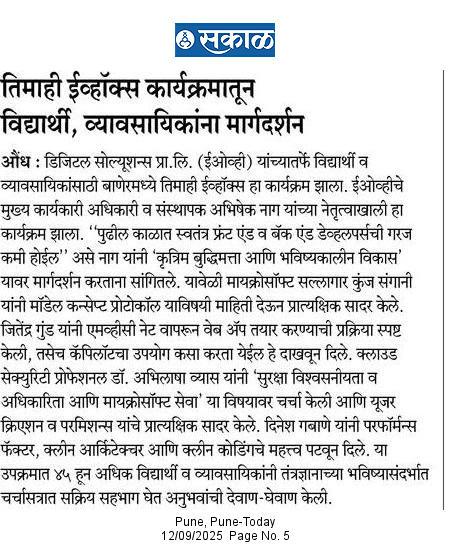
    Pune, India | 12th September 2025 — EOV (EmbarkingOnVoyage) Digital Solutions has been featured in Sakal, one of Maharashtra’s leading newspapers, for its pioneering efforts in mentoring students and professionals through the flagship EOVx program.

    EOVx, a quarterly initiative by EOV, is designed to bridge the gap between academic learning and industry requirements. By creating a platform where technology leaders, industry experts, and young professionals come together, EOVx provides actionable guidance on career development, entrepreneurship, and emerging technologies.

    The recognition in Sakal highlights EOV’s commitment to building an innovation-driven, mentorship-led ecosystem where the next generation of leaders can thrive.

    Abhishek Nag, CEO of EOV, said:
    “EOVx was envisioned to inspire and guide students, startups, and professionals to embrace innovation fearlessly. This recognition from Sakal further motivates us to expand the program and continue empowering talent with real-world knowledge and leadership mentorship.”

    Through EOVx, participants not only gain exposure to global trends in product engineering, design thinking, and digital transformation, but also get an opportunity to learn directly from industry veterans. The initiative has already become a launchpad for young innovators who aspire to create meaningful impact.

    This milestone adds to EOV’s growing presence as a trusted partner for product companies across the US, Europe, and APAC in industries like fintech, health-tech, travel, and cybersecurity.

    About EOV (EmbarkingOnVoyage Digital Solutions)

    EOV is a modern product engineering company helping startups, scale-ups, and enterprises accelerate product success. With expertise in Microsoft technologies, deep product culture, and a global delivery model, EOV empowers clients to innovate faster and build transformative digital solutions.

    Press Contact: 

    EmbarkingOnVoyage Digital Solutions Pvt Ltd.

    marketing@embarkingonvoyage.com

    Level 7, Maruti Chowk, Maruti Millennium Tower Office # 712 & 713, S No. 36/2, Mumbai Pune Expressway, above Yamaha Motors, Baner, Pune, Maharashtra 411045

    Phone: +91 20 45056207

  • EOV Wins Bronze Stevie Award for Most Innovative Company of the Year – Up to 100 Employees

    EOV Wins Bronze Stevie Award for Most Innovative Company of the Year – Up to 100 Employees

    Pune, Maharashtra – August 08, 2025

    EmbarkingOnVoyage (EOV) is thrilled to announce its recent win of a prestigious Bronze Stevie® Award in the International Business Awards®! Recognized as the Most Innovative Company of the Year – Up to 100 Employees, this award celebrates EOV’s remarkable trajectory and dedication to excellence. 

    “We are incredibly proud to receive this recognition from the Stevie Awards,” said Abhishek Nag, CEO of EOV Digital Solutions.

    “This award is a testament to the tireless efforts of our dedicated team, whose commitment to growth and innovation has propelled EOV to new heights. It validates our customer-centric approach and outcome-driven strategies that consistently deliver exceptional results for our partners.” 

    The Stevie Awards, widely recognized as one of the world’s premier business awards programs, honor and generate public recognition for the achievements and positive contributions of businesses and working professionals worldwide.

    EOV’s Bronze Stevie win in Most Innovative Company of the Year – Up to 100 Employees, category signifies its exceptional growth trajectory up to 100 Employees.

    About EmbarkingOnVoyage Digital Solutions Pvt Ltd. 

    EmbarkingOnVoyage Digital Solutions: Your leading data and product engineering partner. We empower Technology companies/ISVs, large enterprises, and SMBs to revolutionize technology through innovative solutions in travel, healthcare, banking, finance, and beyond. 

    We’ve helped countless partners optimize processes, maximize profitability, and achieve their goals. Our dedicated team, driven by ultimate customer satisfaction, delivers expertise in competitive product development, app modernization, UI/UX, data analytics, and more.  

    Led by industry leaders, we seamlessly bridge the gap between services and products, leveraging modern technology to optimize results.  

    Our close-knit team thrives on collaboration, creativity, and mutual motivation, propelling each other to excel and delivering exceptional results reflected in every project.  

    Fuelled by passion for technology and a deep understanding of modern challenges, we bring out the best solutions for our partners. 

    We’re more than just a service provider; we’re your reliable partner in navigating the ever-evolving digital landscape. 

    About the Stevie Awards 

    Stevie Awards are conferred in nine programs: the Asia-Pacific Stevie Awards, the German Stevie Awards, the Middle East & North Africa Stevie Awards, The American Business Awards®, The International Business Awards®, the Stevie Awards for Women in Business, the Stevie Awards for Great Employers, the Stevie Awards for Sales & Customer Service, and the Stevie Awards for Technology Excellence.  

    Stevie Awards competitions receive over 12,000 nominations each year from organizations in over 70 nations.  

    “The 2025 International Business Awards have set a new benchmark for excellence,” said Stevie Awards President Maggie Miller. “Our winners have demonstrated remarkable ambition and achievement in reaching their goals.

    We congratulate them on their well-earned recognition and look forward to honoring them on stage in Lisbon on 10 October.”

    Learn more about the Stevie Awards at www.StevieAwards.com

    Press Contact: 

    EmbarkingOnVoyage Digital Solutions Pvt Ltd.

    marketing@embarkingonvoyage.com

    Level 7, Maruti Chowk, Maruti Millennium Tower Office # 712 & 713, S No. 36/2, Mumbai Pune Expressway, above Yamaha Motors, Baner, Pune, Maharashtra 411045

    Phone: +91 20 45056207

  • ITB India International Conference Travel Mart 2 – 4 September 2025

    [et_pb_section fb_built="1" _builder_version="4.27.4" _module_preset="default" background_enable_color="off" background_image="https://embarkingonvoyage.com/wp-content/uploads/2025/08/Add-a-heading-10.webp" custom_margin="0px||||false|false" custom_padding="||64px|||" hover_enabled="0" da_disable_devices="off|off|off" global_colors_info="{}" width__hover_enabled="on|desktop" alt="ITB India International Conference Travel Mart 2 – 4 September 2025" title_text="ITB India International Conference Travel Mart 2 – 4 September 2025" sticky_enabled="0" da_is_popup="off" da_exit_intent="off" da_has_close="on" da_alt_close="off" da_dark_close="off" da_not_modal="on" da_is_singular="off" da_with_loader="off" da_has_shadow="on"][et_pb_row column_structure="3_5,2_5" _builder_version="4.24.1" _module_preset="default" global_colors_info="{}"][et_pb_column type="3_5" _builder_version="4.24.1" _module_preset="default" global_colors_info="{}"][et_pb_heading title="Meet us at ITB India 2025" _builder_version="4.27.4" _module_preset="default" title_font="metorpliseRegular1|600|||||||" title_text_align="left" title_text_color="#FFFFFF" title_font_size="58px" title_line_height="1.1em" custom_margin="||0px|||" custom_padding="33px||0px||false|false" hover_enabled="0" global_colors_info="{}" sticky_enabled="0"][/et_pb_heading][et_pb_text _builder_version="4.27.4" _module_preset="default" hover_enabled="0" global_colors_info="{}" sticky_enabled="0"]

    International Conference Travel Mart

    [/et_pb_text][et_pb_button button_url="/itb-berlilne/" button_text="2-4 September 2025" _builder_version="4.27.4" _module_preset="default" custom_button="on" button_text_size="20px" button_text_color="#FFFFFF" button_border_width="2px" button_border_radius="57px" button_icon="||divi||400" button_icon_placement="left" animation_style="fade" hover_enabled="0" global_colors_info="{}" sticky_enabled="0"][/et_pb_button][et_pb_button button_url="/itb-berlilne/" button_text="India" _builder_version="4.27.4" _module_preset="default" custom_button="on" button_text_size="20px" button_text_color="#FFFFFF" button_border_width="2px" button_border_radius="57px" button_icon="||divi||400" button_icon_placement="left" animation_style="fade" hover_enabled="0" global_colors_info="{}" sticky_enabled="0"][/et_pb_button][et_pb_image src="https://embarkingonvoyage.com/wp-content/uploads/2025/08/EOV-l-ITB.png" title_text="EOV at ITB India" _builder_version="4.27.4" _module_preset="default" hover_enabled="0" global_colors_info="{}" alt="EOV at ITB India" sticky_enabled="0"][/et_pb_image][/et_pb_column][et_pb_column type="2_5" _builder_version="4.24.1" _module_preset="default" global_colors_info="{}"][et_pb_contact_form email="info@embarkingonvoyage.com,abishek1075@gmail.com,rohan.omer@embarkingonvoyage.com" custom_message="Sender Name is %%senderName%% ||et_pb_line_break_holder||Sender Email is %%senderEmail%% ||et_pb_line_break_holder||Sender contact no :- %%contactNo%% ||et_pb_line_break_holder||Sender meeting date:- %%meetingDate%% ||et_pb_line_break_holder||Sender message %%senderMessage%% ||et_pb_line_break_holder||||et_pb_line_break_holder||" use_redirect="on" redirect_url="https://www.itb.com/en/besuchen/tickets/" success_message="Thanks for Contacting us, see you at ITB Berlin!" _builder_version="4.27.0" _module_preset="default" _unique_id="672b8c52-36c0-4af5-b07e-bb2d6c90b006" background_color="#FFFFFF" background_enable_image="off" custom_button="on" button_text_color="#FFFFFF" button_bg_color="#ff7d1f" button_border_color="#ff7d1f" custom_padding="10px|10px|10px|10px|true|true" border_width_all="2px" border_color_all="#FFFFFF" global_colors_info="{}"][et_pb_contact_field field_id="senderName" field_title="Name " fullwidth_field="on" _builder_version="4.24.1" global_colors_info="{}" button_text_size__hover_enabled="off" button_one_text_size__hover_enabled="off" button_two_text_size__hover_enabled="off" button_text_color__hover_enabled="off" button_one_text_color__hover_enabled="off" button_two_text_color__hover_enabled="off" button_border_width__hover_enabled="off" button_one_border_width__hover_enabled="off" button_two_border_width__hover_enabled="off" button_border_color__hover_enabled="off" button_one_border_color__hover_enabled="off" button_two_border_color__hover_enabled="off" button_border_radius__hover_enabled="off" button_one_border_radius__hover_enabled="off" button_two_border_radius__hover_enabled="off" button_letter_spacing__hover_enabled="off" button_one_letter_spacing__hover_enabled="off" button_two_letter_spacing__hover_enabled="off" button_bg_color__hover_enabled="off" button_one_bg_color__hover_enabled="off" button_two_bg_color__hover_enabled="off"][/et_pb_contact_field][et_pb_contact_field field_id="senderEmail" field_title="Email Address" field_type="email" fullwidth_field="on" _builder_version="4.24.1" global_colors_info="{}" button_text_size__hover_enabled="off" button_one_text_size__hover_enabled="off" button_two_text_size__hover_enabled="off" button_text_color__hover_enabled="off" button_one_text_color__hover_enabled="off" button_two_text_color__hover_enabled="off" button_border_width__hover_enabled="off" button_one_border_width__hover_enabled="off" button_two_border_width__hover_enabled="off" button_border_color__hover_enabled="off" button_one_border_color__hover_enabled="off" button_two_border_color__hover_enabled="off" button_border_radius__hover_enabled="off" button_one_border_radius__hover_enabled="off" button_two_border_radius__hover_enabled="off" button_letter_spacing__hover_enabled="off" button_one_letter_spacing__hover_enabled="off" button_two_letter_spacing__hover_enabled="off" button_bg_color__hover_enabled="off" button_one_bg_color__hover_enabled="off" button_two_bg_color__hover_enabled="off"][/et_pb_contact_field][et_pb_contact_field field_id="meetingDate" field_title="Enter Meeting Date e.g %225 March 2024 %22 " fullwidth_field="on" _builder_version="4.24.1" global_colors_info="{}" button_text_size__hover_enabled="off" button_one_text_size__hover_enabled="off" button_two_text_size__hover_enabled="off" button_text_color__hover_enabled="off" button_one_text_color__hover_enabled="off" button_two_text_color__hover_enabled="off" button_border_width__hover_enabled="off" button_one_border_width__hover_enabled="off" button_two_border_width__hover_enabled="off" button_border_color__hover_enabled="off" button_one_border_color__hover_enabled="off" button_two_border_color__hover_enabled="off" button_border_radius__hover_enabled="off" button_one_border_radius__hover_enabled="off" button_two_border_radius__hover_enabled="off" button_letter_spacing__hover_enabled="off" button_one_letter_spacing__hover_enabled="off" button_two_letter_spacing__hover_enabled="off" button_bg_color__hover_enabled="off" button_one_bg_color__hover_enabled="off" button_two_bg_color__hover_enabled="off"][/et_pb_contact_field][et_pb_contact_field field_id="contactNo" field_title="Enter Contact No. %22+49 69 1234 5678%22" fullwidth_field="on" _builder_version="4.24.1" global_colors_info="{}" button_text_size__hover_enabled="off" button_one_text_size__hover_enabled="off" button_two_text_size__hover_enabled="off" button_text_color__hover_enabled="off" button_one_text_color__hover_enabled="off" button_two_text_color__hover_enabled="off" button_border_width__hover_enabled="off" button_one_border_width__hover_enabled="off" button_two_border_width__hover_enabled="off" button_border_color__hover_enabled="off" button_one_border_color__hover_enabled="off" button_two_border_color__hover_enabled="off" button_border_radius__hover_enabled="off" button_one_border_radius__hover_enabled="off" button_two_border_radius__hover_enabled="off" button_letter_spacing__hover_enabled="off" button_one_letter_spacing__hover_enabled="off" button_two_letter_spacing__hover_enabled="off" button_bg_color__hover_enabled="off" button_one_bg_color__hover_enabled="off" button_two_bg_color__hover_enabled="off"][/et_pb_contact_field][et_pb_contact_field field_id="senderMessage" field_title="Message" field_type="text" fullwidth_field="on" _builder_version="4.24.1" global_colors_info="{}" button_text_size__hover_enabled="off" button_one_text_size__hover_enabled="off" button_two_text_size__hover_enabled="off" button_text_color__hover_enabled="off" button_one_text_color__hover_enabled="off" button_two_text_color__hover_enabled="off" button_border_width__hover_enabled="off" button_one_border_width__hover_enabled="off" button_two_border_width__hover_enabled="off" button_border_color__hover_enabled="off" button_one_border_color__hover_enabled="off" button_two_border_color__hover_enabled="off" button_border_radius__hover_enabled="off" button_one_border_radius__hover_enabled="off" button_two_border_radius__hover_enabled="off" button_letter_spacing__hover_enabled="off" button_one_letter_spacing__hover_enabled="off" button_two_letter_spacing__hover_enabled="off" button_bg_color__hover_enabled="off" button_one_bg_color__hover_enabled="off" button_two_bg_color__hover_enabled="off"][/et_pb_contact_field][/et_pb_contact_form][/et_pb_column][/et_pb_row][/et_pb_section]
  • Australia’s Leading Supply Chain Tech Company Selects EOV as Strategic Development Partner 

    Australia’s Leading Supply Chain Tech Company Selects EOV as Strategic Development Partner 

    Pune, India | [31.07.2025] — In a significant global win for Indian product engineering, EOV (EmbarkingOnVoyage) has been selected by Australia’s leading and VC-funded Supply Chain Tech company as their strategic partner for next-generation product development and innovation initiatives. 

    This decision comes after a rigorous evaluation process involving several global technology providers.

    The selection of EOV has been both systemic and strategic, aligning with the client’s long-term vision of accelerating cybersecurity innovation with engineering partners who bring deep technical expertise, transparency, and a modern product culture. 

    What Set EOV Apart? 

    “We spoke with references from Germany and the UK — every conversation highlighted EOV’s integrity, agility, and quality of work.

    What really impressed us was how accessible senior leadership was — there was no hierarchical red tape, just open, honest conversations,” said Senior Advisory at the Australian firm. 

    The Australian client emphasized three key factors in choosing EOV: 

    • Strong Microsoft Technology Focus: EOV’s deep commitment to Microsoft technologies — including .NET Core, Azure, Blazor, and Copilot integration — stood out as a key differentiator. 
    • Community-Driven Engineering Culture: With Microsoft MVPs actively mentoring internal teams and contributing to the wider tech ecosystem, EOV has built a culture that blends innovation with real-world impact. 
    • Transparency During Evaluation: EOV’s leadership, including CEO Abhishek Nag, demonstrated remarkable transparency, even when discussing competitor strengths. The team’s warm, hospitable approach, combined with honest feedback, helped the client make a confident, informed decision. 

    “Abhishek and his team didn’t try to oversell. They helped us evaluate all our options — including their competitors — and that level of integrity is rare. It gave us the confidence that we’re investing in a partner, not just a vendor,” Martin R., Product Head, Brisbane. 

    This partnership marks a significant milestone in EOV’s global journey, as it continues to serve as a trusted engineering partner for hi-tech, cybersecurity, fintech, travel, and health-tech innovators across the US, Europe, and APAC. 

    About EOV 

    EOV (EmbarkingOnVoyage) is a modern product engineering company focused on empowering global product companies with deep tech talent, agile delivery, and an unwavering focus on product success.

    With a strong presence in Microsoft ecosystems and a culture rooted in mentorship and openness, EOV is trusted by startups, scale-ups, and software companies worldwide. 

    Press Contact: 

    EOV Digital 

    marketing@embarkingonvoyage.com 

    Maruti Millennium Tower, Office # 712 & 713, Level 7, Mumbai Pune Expressway, Baner, Pune 

    Phone: +91 95525 71099