



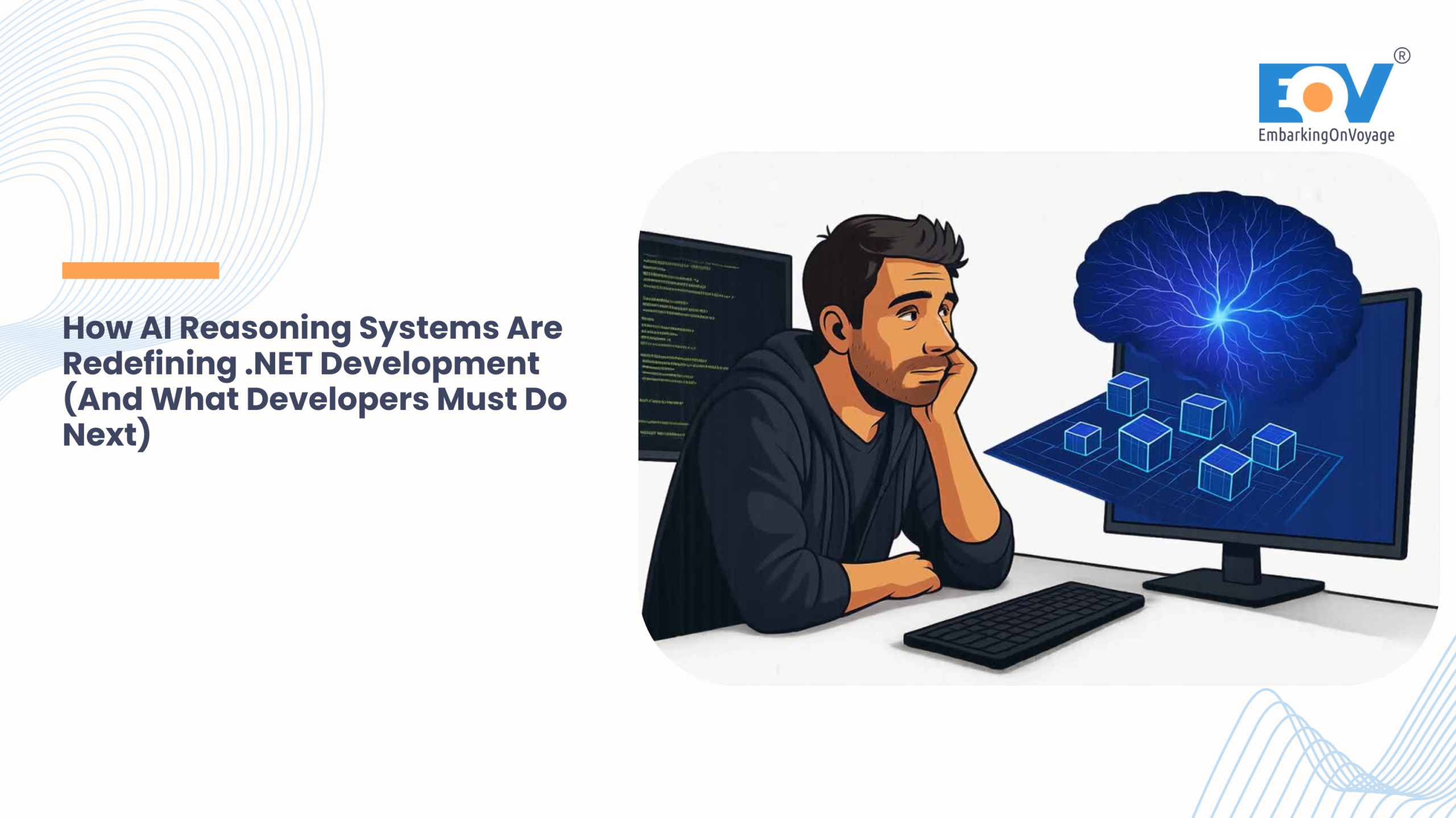
AI reasoning systems are redefining .NET development. The .NET ecosystem has never stood still, and from the early days of the monolithic .NET Framework to modern, cross-platform development with ASP.NET Core, it has continuously evolved to meet the needs of scalable, enterprise-grade software.
But what we’re witnessing right now is not just another phase of evolution. It’s a fundamental shift in how software is conceptualized, designed, and delivered.
The emergence of advanced AI reasoning systems is radically reshaping the software development lifecycle. These systems go far beyond simple autocomplete, Copilot suggestions, and boilerplate generation. Today’s AI models can interpret business intent, reason through complex architectural trade-offs, and assist in structuring entire distributed systems.
The Bottom Line: This is not about writing code faster. It’s about building software differently.
The Evolution: From Code Craftsmanship to Architectural Orchestration
Traditionally, .NET development has been treated as a hands-on craft. The balance of a developer’s day was heavily skewed toward syntax and execution.
That balance is now changing. With AI-assisted tools integrating directly into IDEs like Visual Studio and Rider, a significant portion of the execution layer is being automated. The real disruption, however, isn’t happening at the coding level—it’s happening at the reasoning level.
| Traditional .NET Craftsmanship | AI-Augmented Orchestration |
| Read and interpret manual requirements. | Input structured intent and business rules. |
| Design architecture from scratch. | Evaluate AI-suggested architectural patterns. |
| Manually write thousands of lines of C#. | Guide AI to generate, refactor, and optimize code. |
| Write unit and integration tests post-development. | Auto-generate comprehensive test suites instantly. |
| Manually configure CI/CD and deployment scripts. | Validate AI-generated infrastructure-as-code (IaC). |
A Real-World Scenario: Modernizing a Legacy .NET Application
Imagine an enterprise running a legacy monolithic .NET Framework application. The system works, but it struggles with modern scalability demands, performance bottlenecks, and technical debt.
Here is how the modernization process shifts when AI reasoning systems are introduced:
The Traditional Approach
- Weeks of Discovery: Manually tracing dependencies and documenting legacy spaghetti code.
- Architecture Workshops: Lengthy meetings to decide between microservices, serverless, or a modular monolith.
- Multiple Dev Cycles: Months spent carefully rewriting business logic in modern C#.
The AI-Augmented Approach
- Structured Intent Input: Feeding the legacy codebase into an AI system alongside modern scaling requirements.
- Architecture Suggestions: AI instantly maps dependencies and suggests optimal modernization paths (e.g., extracting specific modules to Azure Functions).
- Risk Identification: Proactive highlighting of breaking changes, security flaws, or performance regressions.
- Test Generation: Automatic creation of baseline tests to ensure parity between the legacy and modernized systems.
The Result: Faster clarity, significantly reduced rework, and a safer migration path.
How This Changes the .NET Development Methodology
As AI reasoning takes on the heavy lifting of code generation, the day-to-day methodology of a .NET developer shifts dramatically:
- Requirements Become Structured: Vague user stories are replaced by structured prompts and clear constraints that an AI can interpret.
- Architecture Becomes Evaluation-Driven: Instead of designing the one “perfect” architecture, developers will evaluate multiple AI-generated architectures and choose the best fit based on trade-offs.
- Coding Becomes Less Central: Writing C# syntax becomes secondary to reviewing, guiding, and orchestrating code blocks.
- Testing Becomes Integrated (and Immediate): Test-Driven Development (TDD) evolves as AI instantly generates tests alongside the functional code.
- Cloud-Native Thinking Becomes Mandatory: With AI seamlessly writing boilerplate for cloud deployment, developers must instinctively understand distributed cloud environments.
The 5 Essential Skills .NET Developers Must Build Next
To thrive in an AI-augmented ecosystem, .NET developers must pivot their skill sets from syntax memorization to higher-order problem-solving.
- System Design Thinking: Understanding how disparate services, databases, and APIs communicate at scale.
- Deep Cloud (Azure) Understanding: Moving beyond basic hosting to mastering cloud-native architectures, containerization (Docker/Kubernetes), and serverless environments.
- Performance Engineering: Knowing how to profile, benchmark, and optimize code that an AI generated to ensure it meets enterprise standards.
- AI Collaboration Skills: Mastering the art of “prompt engineering” for code—learning how to effectively communicate intent, constraints, and context to AI models.
- Domain Expertise: Understanding the specific business logic of your industry (finance, healthcare, retail) better than any generalized AI model ever could.
Final Thoughts
This shift toward AI reasoning systems is not about replacing developers. It’s about elevating them.
By removing the friction of boilerplate and syntax, AI allows developers to focus on what actually matters: solving complex business problems, ensuring security, and designing resilient systems.
The most valuable .NET developers of the future will not be those who write the most code—but those who make the best decisions.
Latest Blog : https://embarkingonvoyage.com/blog/dedicated-development-teams/
External Read : https://dev.to/victormai/rethinking-developer-responsibility-in-ai-assisted-net-applications-4pdj
Leave a Reply