


Artificial Intelligence is no longer a speculative innovation line item reserved for Big Tech experimental labs. Across major global business corridors spanning the United States, the United Kingdom, Germany, the Netherlands, Belgium, Luxembourg, Denmark, Norway, Singapore, and India enterprises are actively pivoting toward AI-Native product engineering. The objective is clear: modernize digital platforms, automate fragmented operational workflows, unlock hidden data intelligence, and accelerate executive decision cycles.
For CEOs, CTOs, VPs of Engineering, and Digital Innovation leaders, the strategic conversation has fundamentally shifted. The critical question is no longer, “Should we adopt AI?”
The real question is: “When do we transition to an AI-Native product engineering paradigm, and how do we execute it responsibly at an enterprise scale?”
To achieve this transition without discarding decades of core infrastructure investment, Microsoft’s enterprise grade technology ecosystem specifically Azure AI, .NET, and advanced AI orchestration frameworks has emerged as the premier strategic foundation. Organizations that move early to build AI-Native systems with robust governance, sound architecture, and tight business alignment will capture asymmetric competitive advantages in digital scalability and market agility.
What Is AI-Native Product Engineering?
Traditional software architectures are fundamentally rule-based systems. They rely on rigid, predefined relational workflows, hard-coded conditional logic, and static data processing paradigms. If an edge case falls outside the hard-coded parameters, the system breaks, requiring manual human intervention or expensive code refactoring.
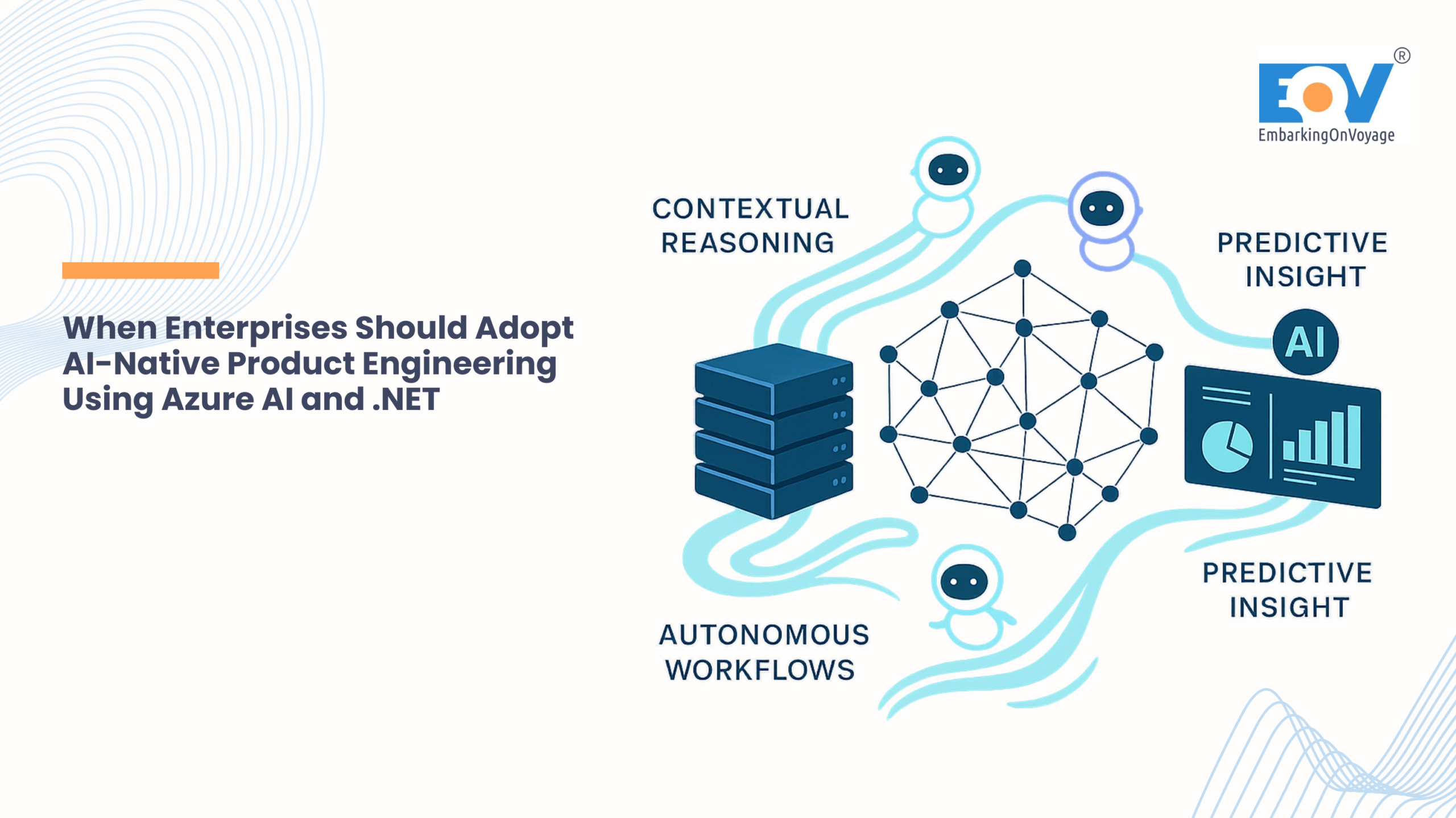
AI-native product engineering completely flips this script. An AI-Native application is conceived, architected, and deployed from the ground up to inherently leverage:
- Contextual Reasoning: The ability to understand nuance, human intent, and unstructured operational inputs.
- Autonomous Workflows: Self-orchestrating software sequences that dynamically adapt to real-time changes without human micro-management.
- Predictive Insight & Decision Intelligence: Moving from descriptive dashboards (what happened) to prescriptive execution (what to do next).
Instead of tacking a basic generative AI wrapper or chat widget onto a legacy system, AI-native engineering embeds deep cognitive intelligence directly into core workflows, microservices, databases, and customer-facing experiences. These systems do not remain static; they continuously evolve by learning from ongoing data interactions, system logs, and changing operational patterns.
Why Azure AI and .NET Are Emerging as Enterprise Standards
A massive roadblock to digital transformation is the sheer risk and cost of a “rip-and-replace” approach. A significant portion of the world’s enterprise infrastructure runs on deep Microsoft ecosystems built around .NET, Microsoft Azure, SQL Server, Dynamics 365, and enterprise APIs.
Adopting AI-native engineering through Azure AI and .NET allows global organizations to inject advanced cognitive intelligence into their software assets without rebuilding their underlying technological foundations from scratch.
The Microsoft AI stack provides a highly resilient environment for enterprise applications due to several key factors:
1. Enterprise-Grade Security & Compliance
Azure AI inherits the comprehensive security compliance of the Azure cloud ecosystem. This includes strict data privacy controls ensuring your proprietary enterprise data is never used to train public foundational models, satisfying stringent GDPR, HIPAA, and local data sovereignty laws across Europe and APAC.
2. Semantic Kernel and Advanced Orchestration
Semantic Kernel is a powerful lightweight SDK that allows developers to easily mix conventional programming languages like C# with the latest AI Large Language Models (LLMs). It acts as the orchestration engine, enabling developers to build sophisticated AI plugins, manage native memory, and seamlessly trigger autonomous workflows.
3. Cloud-Native Infrastructure & Reliability
By combining .NET performance with Azure Kubernetes Service (AKS), Azure OpenAI service, and Azure AI Search, enterprises can construct high-throughput, low-latency AI platforms that automatically scale based on global operational demand.
For corporate leadership, this ecosystem provides a predictable, secure, and lower-risk pathway toward complete AI transformation.
5 Critical Indicators: When to Transition to AI-Native Engineering
AI-native transformation should never be pursued merely to chase technological trends; it must be driven by operational necessity. The most successful implementations occur when traditional software systems hit a wall regarding complexity and scale.
If your enterprise is experiencing any of the following five indicators, it is time to transition to an AI-native engineering model:
1. When Existing Workflows Hit an “Operational Complexity” Wall
As an enterprise scales globally, its internal processes fragment across dozens of siloed legacy applications, regional vendor databases, and inconsistent customer communication channels. Traditional rule-based software buckles under the weight of this variance, requiring teams to build endless integration patches.
- The AI-Native Solution: You should transition when your business demands intelligent workflow orchestration that can autonomously analyze multi-layered data inputs, make real-time decisions, and handle complex edge cases.
- Enterprise Examples: Automated multi-currency financial risk analysis, intelligent end-to-end customer onboarding, real-time supply chain inventory re-routing, and predictive dynamic pricing engines.
2. When Your Enterprise Has Mass Data But Lacks Actionable Intelligence
Most mid-market and enterprise companies sit on absolute goldmines of structured and unstructured operational data (emails, PDFs, logs, call recordings, database records). However, they face an immense gap between data availability and real-time decision-making velocity. Traditional business intelligence tools can only tell you what went wrong last quarter.
- The AI-Native Solution: When your leadership teams realize that standard static dashboards are stalling corporate agility, an AI-native system powered by Azure AI Search and .NET can step in. It ingests enterprise-wide data streams to surface real-time predictive insights and automated recommendations directly to your operational staff.
3. When Customer Experience Becomes a Critical Churn Risk
Modern digital consumers and B2B clients demand hyper-personalized, ultra-responsive interactions. Static forms, rigid menus, and basic keyword-based customer service chatbots no longer suffice. If your client experiences feel transactional and slow, your market share is vulnerable.
- The AI-Native Solution: Especially critical within high-stakes verticals like Fintech, Healthcare, Retail, and B2B SaaS, AI-native product engineering enables deep contextual personalization, intelligent autonomous support desks, and predictive engagement loops that learn what your customer needs before they explicitly ask.
4. When Core Software Innovation Cycles Stagnate
If your engineering talent spends 70% of their weekly cycles managing boilerplate code maintenance, tracking down legacy integration bugs, or performing routine regression testing, your business agility is dying.
- The AI-Native Solution: Transitioning to an AI-native engineering framework utilizing tools like GitHub Copilot and customized Azure AI pipelines completely changes developer velocity. It offloads low-level code acceleration and routine prototyping to AI agents, freeing your senior architects to focus heavily on core business logic, strict security architecture, and high-impact product innovation.
5. When Modernizing Legacy Systems via “Rip-and-Replace” Is Too Risky
Many established enterprises across Europe and North America possess sprawling legacy .NET framework systems that manage mission-critical business logic. Scrapping these platforms entirely is an operational nightmare it is cost-prohibitive, incredibly risky, and causes severe business disruption.
- The AI-Native Solution: Azure AI and modern .NET (.NET 8/9+) offer an ideal modernization runway. Engineering teams can incrementally wrap legacy services in intelligent APIs, gradually introducing autonomous orchestration layers and AI-driven data insights without disturbing the core operational engine.
The Core Philosophy: Human-in-the-Loop Engineering
A dangerous misconception in the current market is that enterprise AI adoption means replacing human oversight with completely unchecked autonomous algorithms. In high-compliance, enterprise-grade ecosystems, this approach leads to catastrophic failures, hallucinations, and severe legal liability.
True AI-native engineering champions a Human-in-the-Loop (HITL) architecture:
| What the Azure AI / .NET Stack Accelerates | Where Humans Retain Absolute Control |
| High-velocity data processing and structural analysis | Comprehensive algorithmic governance and policy |
| Real-time predictive recommendations | Complex enterprise architecture design |
| Autonomous cross-platform workflow orchestration | Deployment validation and edge-case auditing |
| Automated low-level code generation | Strategic business alignment & ethical decisioning |
The future of sustainable enterprise software is not fully autonomous, isolated machine logic. It is AI-augmented enterprise intelligence completely guided by seasoned human expertise. This framework is non-negotiable for sectors like Fintech, Insurance, and Healthcare, where auditing and data provenance are strictly mandated.
Deployed Reality: The Ascent of Agentic AI
The absolute cutting edge of AI-native product engineering is the shift toward Agentic AI. Unlike standard conversational chatbots that simply respond to text prompts, Agentic AI systems are comprised of goal-oriented, autonomous software agents capable of independent reasoning, maintaining contextual memory across long operational cycles, and executing multi-step cross-application tasks.
Using Semantic Kernel and .NET, developers can construct multi-agent networks where individual AI agents are assigned specialized operational roles:
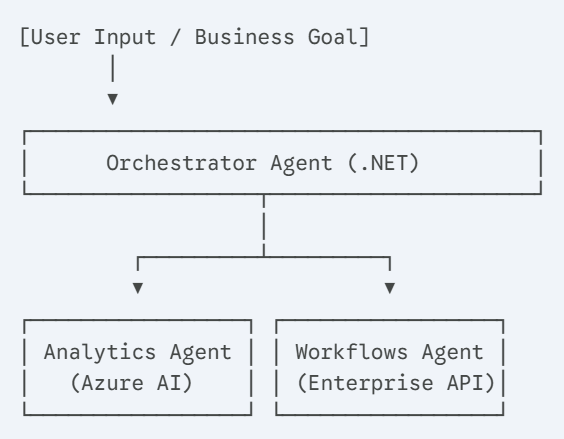
or instance, one agent can continuously monitor global logistics data via Azure AI, another can analyze financial impacts, and a third can automatically execute supply chain adjustments via enterprise APIs—all working collaboratively under human-defined parameters.
Actionable Best Practices for Enterprise AI Transformation
For leadership teams mapping out their AI-native product roadmaps over the next 12 to 24 months, prioritize these foundational principles:
- Anchor Strategy to Real Business Friction: Never build an AI platform simply for the sake of saying you use AI. Start directly with an operational pain point—whether it’s an inefficient customer onboarding workflow, a bloated supply chain node, or stagnating developer output. Technology must serve the business outcome.
- Establish Algorithmic Governance Day One: AI safety, auditability, explainability, and bias mitigation must be baked directly into your product architecture, not added as a post-deployment checklist. Utilize Azure AI Content Safety and strict enterprise telemetry logs to ensure absolute transparency.
- Commit to Up-skilling Your Technical Teams: Moving to an AI-native development paradigm means your engineers must transition from traditional coders into orchestrators of AI systems. Invest heavily in training your team on Semantic Kernel, vector databases, and prompt architecture.
The enterprises that successfully balance advanced AI acceleration, rigorous human oversight, and modern product engineering will define the next generation of global digital business.
Ready to Future-Proof Your Enterprise Application Stack? At EmbarkingOnVoyage (EOV), we specialize in helping global enterprises architect, deploy, and scale robust AI-native products using the power of Azure AI and modern .NET ecosystems. Let’s turn your operational complexity into a distinct market advantage.
Connect with our Product Engineering Experts at EOV Today.
Latest Blog – https://embarkingonvoyage.com/hr/cultivating-global-innovators-how-eov-is-building-the-future-of-ai-native-tech-in-pune/
Leave a Reply