


If you walk onto any engineering floor today, you will see developers using AI. They are tabbing through Copilot suggestions, asking conversational agents to debug cryptic errors, and generating boilerplate code.
But there is a massive gap between “our engineers use AI tools” and “our engineering organization is AI-native.”
Many companies shopping for a technology partner end up buying traditional staff augmentation with a chatbot license attached. Choosing an AI-Native Outcome Engineering Partner represents a fundamental architectural shift in how software is built. It focuses on rewiring your organization to achieve specific business results, rather than simply delivering code.
Here is what it means to make the shift, and why it is the defining engineering model for 2026.
AI-Assisted vs. AI-Native: The Crucial Distinction
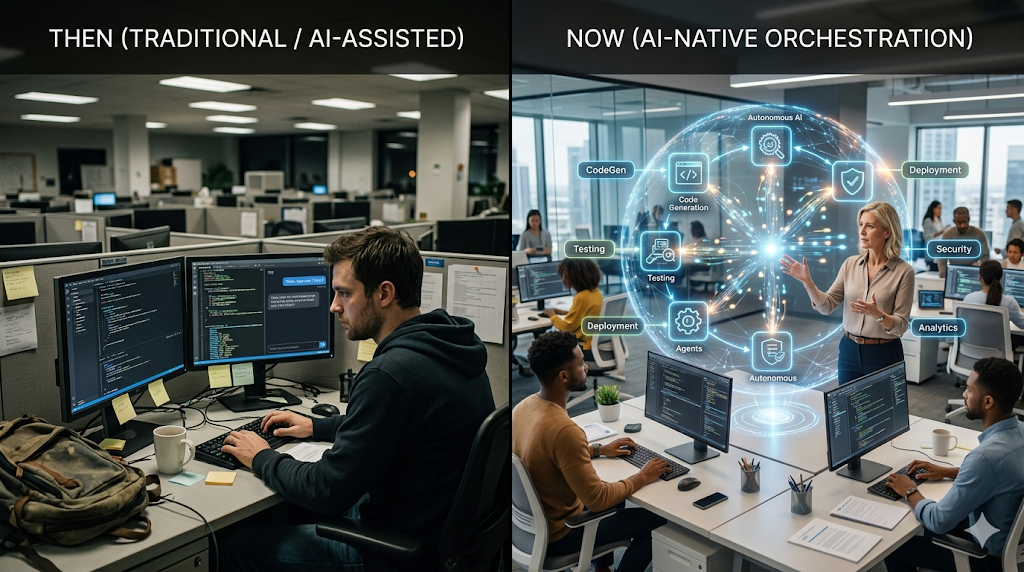
To understand the value of an outcome engineering partner, we first need to distinguish between adding AI to your workflow and building your workflow around AI.
- AI-Assisted Engineering: A traditional team workflow where individual developers use AI to code faster. The software development lifecycle (SDLC) remains the same. Sprint planning, code reviews, and deployments are unchanged. The productivity gains accrue to the individual and often dissipate at the team bottlenecks.
- AI-Native Engineering: The entire SDLC is designed from the ground up around large language models (LLMs) and agentic workflows. AI agents act as primary collaborators handling first-pass work across planning, test scaffolding, and code generation. The human role shifts from writing raw code to orchestrating, reviewing, and defining architectural intent.
An AI-assisted vendor gives you faster typists. An AI-Native Outcome Engineering Partner fundamentally changes your delivery economics.
What Does an Outcome Engineering Partner Actually Do?
An outcome-focused partner does not just ship a product for you and disappear. They are a transformation vehicle. Their engagement is at the organizational level: they staff, train, and manage an engineering team that permanently changes how your business builds software.
Here is what sets this approach apart from traditional delivery teams:
1. The Centaur Model of Execution

The partner operates on the “Centaur Model,” where work is explicitly divided between Agentic AI and human engineers.
- AI leads the first pass: Autonomous agents draft user stories from meeting transcripts, generate test scaffolding, and propose refactoring.
- Humans lead the judgment: Senior engineers interrogate the AI’s assumptions, handle complex edge cases, and make high-stakes architectural decisions.
2. Structured, Day-One AI Governance
In an AI-native setup, the volume of code generated is staggering often 3x to 5x higher than traditional methods. A true partner establishes rigorous, automated governance. All AI-generated code must pass continuous security gates, OWASP security standards, and automated testing before a human ever reviews it.
3. Accountability for Business Outcomes
Traditional IT outsourcing bills for hours worked or heads in seats. An outcome engineering partner ties their success to measurable delivery metrics:
- Cycle time: How fast does an idea reach production?
- Throughput: What is the feature output per engineer?
- Defect escape rate: Are bugs being caught by AI reviewers before integration?
Is This the Right Model for Your Enterprise?
Not every project requires a transformation partner. If you have a short-term, fixed-scope project, a dedicated delivery team is fine. If you just need a specialized developer for three months, traditional staff augmentation works.
However, you need an AI-Native Outcome Engineering Partner if:
- You have net-new digital products to build with intense time-to-market pressure.
- You want to compress new product development cycles by 30-50% while relying on secure data pipelines.
- You want to transition your senior engineers into “mini-CEOs” of their product domains, rather than manual coders.
The Bottom Line
Buying an AI tool is easy. Restructuring an engineering organization to safely, securely, and rapidly capitalize on that tool is incredibly hard. At Embarking on Voyage (EOV), our AI-native digital product engineering bridges that gap. We ensure that your investment in Agentic AI translates into tangible business outcomes, unparalleled speed, and a permanently upgraded engineering culture.
Leave a Reply