



For the past few years, digital transformation has been heavily focused on cloud migrations and bolting on generative AI chat interfaces. While helpful, these solutions often act as static assistants rather than active problem solvers.
The next frontier of digital product engineering isn’t just about software that answers questions; it’s about systems that take action. If your organization is looking to reduce technical debt, optimize workflows, and drive strict operational transparency, leveraging agentic ai for enterprise modernization is no longer optional – it is a competitive necessity.
The industry is scaling rapidly toward this paradigm. By 2028, 33% of enterprise software applications will include agentic AI. Furthermore, 80% of automation leaders are expected to accelerate AI agent investments over 2025.
Why Choose Agentic AI for Enterprise Modernization?
Unlike standard Large Language Models (LLMs) that rely entirely on human prompts to generate text or code, Agentic AI systems possess autonomous reasoning capabilities.
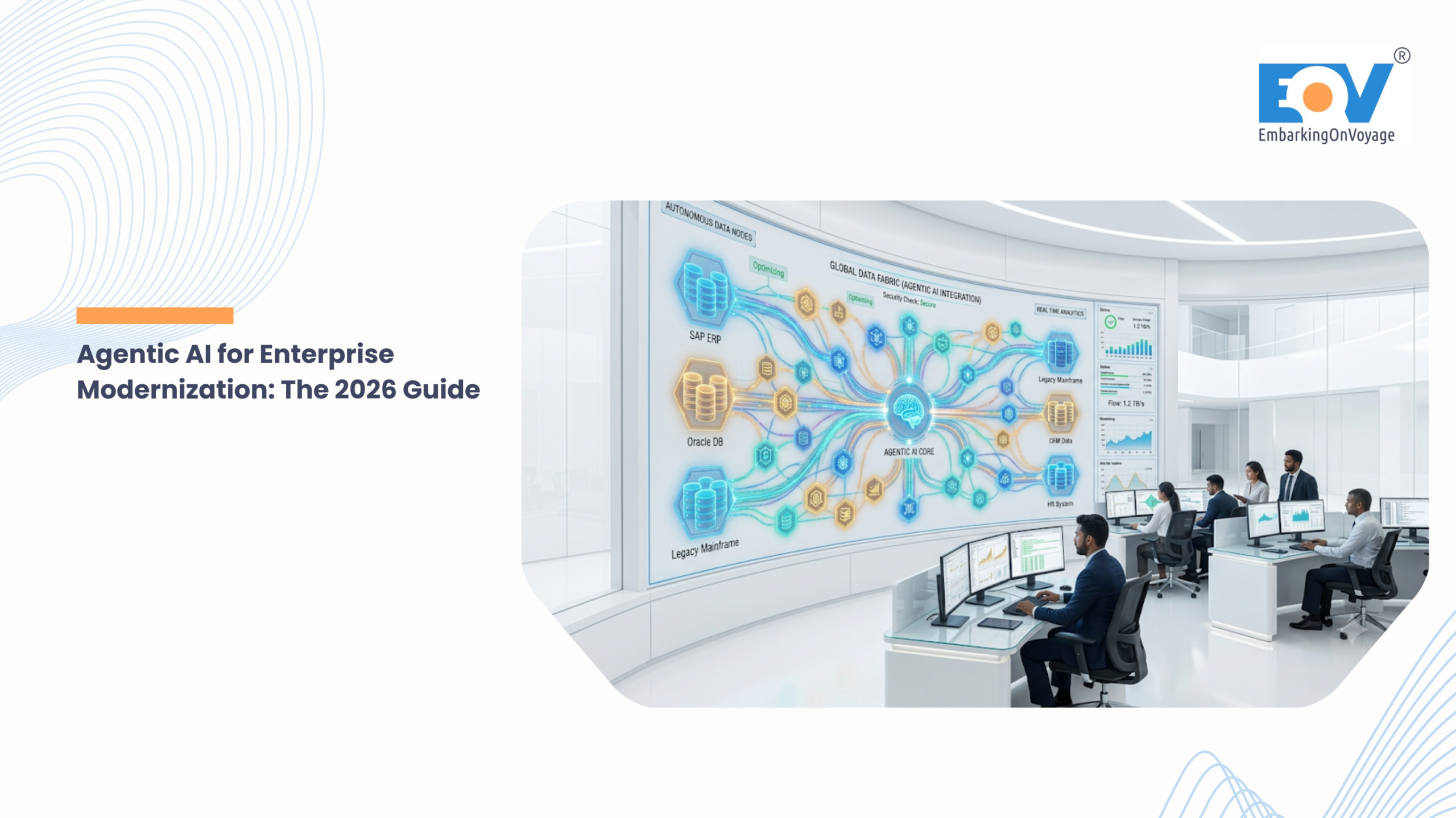
An AI “agent” can understand a complex goal, break it down into sequential tasks, interact with multiple enterprise databases (ERPs, CRMs, legacy mainframes), execute the necessary steps, and evaluate the outcome all with minimal human intervention. Agentic AI gives AI new levels of agency, allowing it to select what actions to take for achieving particular outcomes.
When you deploy agentic ai for enterprise modernization, you shift your entire technical landscape from passive automation to active, intelligent orchestration.
3 Ways Agentic AI Accelerates Enterprise Modernization
Enterprise AI spending is facing increased financial scrutiny in 2026, with CFOs across industries imposing budget controls and demanding measurable returns from AI projects. Modernizing legacy architecture is traditionally fraught with high costs and operational downtime. Agentic AI mitigates these risks by injecting intelligence into the very fabric of your engineering lifecycle, ensuring a clear ROI.
1. Autonomous Legacy Code Refactoring & De-Risking

One of the largest bottlenecks in enterprise modernization is untangling decades-old, spaghettified monolithic code (such as COBOL, outdated Java, or legacy .NET). Traditionally, this requires massive teams of developers to manually map dependencies, read undocumented logic, and rewrite code—a process notorious for scope creep and the risk of breaking core business operations.
Agentic AI completely shifts this paradigm by deploying specialized, autonomous agents to handle the heavy lifting:
- Discovery and Mapping Agents: Instead of relying on outdated documentation, AI agents autonomously crawl the legacy codebase to map data flows, identify deprecated libraries, and flag security vulnerabilities.
- Translation and Refactoring Agents: Once the logic is mapped, Agentic workflows can autonomously translate monolithic scripts into clean, modern, microservices-based architectures (e.g., Python, Node.js, or Go).
- Autonomous Quality Assurance (QA): Perhaps the most critical step, testing agents autonomously generate thousands of unit and regression tests to ensure the newly refactored code maintains absolute business logic parity with the old system.
By automating these highly manual tasks, enterprises can reduce developer hours by magnitudes and accelerate their time-to-market.
More importantly, this autonomous refactoring transforms a rigid, isolated system into a flexible, AI-ready ecosystem. For instance, once a healthcare or enterprise backend is modernized through these workflows, it becomes infinitely easier to plug in advanced, specialized AI products like EOV Navigator for clinical guideline assistance or EOV Pulse seamlessly integrating cutting-edge intelligence into what was once a legacy bottleneck.
2. Self-Healing Systems and Operational Transparency
Enterprise leaders require data-driven insights to measure the success of a digital transformation. Agentic AI doesn’t just run processes; it monitors them. By establishing continuous feedback loops, these agents can detect anomalies in system performance, autonomously trigger remediation protocols (self-healing), and generate real-time KPI dashboards for leadership, ensuring absolute operational transparency.
3. Intelligent Workflow Orchestration
Modernization isn’t just about code; it’s about business processes. Agentic AI can bridge the gap between siloed legacy systems and modern SaaS platforms. For example, an agent can autonomously reconcile financial data between an outdated on-premise ledger and a modern cloud-based analytics tool, handling edge cases and errors dynamically without requiring a human to write rigid API middleware.
The AI-First Engineering Paradigm
Adopting Agentic AI requires a fundamental shift in how digital products are built. It requires an AI-First Engineering mindset.
This means architecting your data infrastructure, APIs, and security protocols specifically to support autonomous agents. It involves creating robust orchestration layers where multiple specialized AI agents (e.g., a data retrieval agent, a logical reasoning agent, and an execution agent) can collaborate seamlessly.
How EOV Can Future-Proof Your Enterprise
At EOV, we don’t just build software; we engineer intelligent systems designed for commercial impact. Our approach to Agentic AI Enterprise Development and Modernization is built on a foundation of agility, data-centricity, and measurable ROI.
Whether you are looking to untangle legacy monolithic architecture or implement autonomous workflows that drive down operational costs, our specialized engineering pods are equipped to guide your transition into the AI-first era.
Ready to move beyond the AI hype and start building autonomous enterprise systems? Contact EOV today to discuss how our modernization frameworks can accelerate your technical roadmap.
Leave a Reply