




AI product engineering in India is fundamentally changing how European enterprises build modern software. For over two decades, tech leaders treated offshore software development like an assembly line writing a spec sheet, shipping it across time zones, and waiting for code to return. But in an enterprise landscape driven by rapid technological shifts, that legacy model is dead. Traditional vendor “body shopping” simply cannot keep pace with the demands of modern digital transformation. Today, progressive CTOs across Germany, Benelux, and the UK are pivoting to co-creation models to build resilient, AI-native platforms.
Today, progressive CTOs and product leaders across Germany, Benelux, and the UK are pivoting to AI product engineering in India to build resilient, AI-native platforms.
By shifting from reactive vendor models to collaborative co-creation partners, European businesses are cutting time to market while embedding intelligence directly into their core applications.
Why European Tech Leaders Are Pivoting to AI-Native Engineering
The global market for digital products has fundamentally changed. According to research from Gartner, global IT spending continues to prioritize software modernization, with an aggressive shift toward intelligent, autonomous platforms.
European tech leaders face a double-edged sword: a severe local engineering talent shortage and an urgent commercial need to integrate generative and agentic workflows before competitors do.
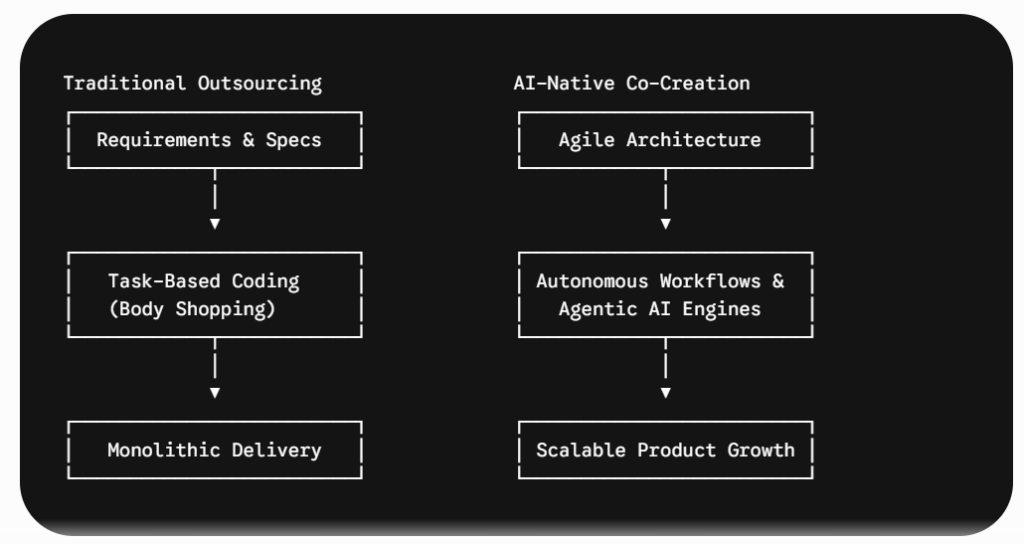
When evaluating offshore product development options, leading companies are moving beyond sheer headcount. They want agile squads capable of driving architectural decisions, optimizing microservices, and deploying production-ready AI models.
Key Pillars of Modern AI Product Engineering in India
Building an intelligent software product requires more than wrapping an API around a large language model. True AI product engineering in India focuses on three fundamental engineering principles:
1. Autonomous Agentic Workflows
Traditional software responds to direct human input. Modern enterprise platforms leverage Agentic AI to execute multi-step reasoning, evaluate data context, and automate complex tasks without constant manual oversight.
Key Advantage: By embedding agentic workflows into business logic, platforms reduce operational bottlenecks while maintaining strict governance and compliance standards.
2. High-Performance Architecture (.NET 9 & Microservices)
AI systems require robust, low-latency backends. Modern engineering teams combine advanced frameworks like .NET 9 with microservices architectures to process high-throughput data streams smoothly.
3. Co-Creation Over Ticket-Taking
Rather than functioning as passive ticket-takers, dedicated co-creation teams collaborate directly with internal European engineering heads. This alignment ensures strict GDPR compliance, clean code standards, and seamless CI/CD delivery pipelines.
Comparing Engineering Models for Enterprise Growth
Choosing the right engineering strategy dictates your long-term scaling velocity. Here is how modern AI product co-creation compares to legacy models:
| Strategic Indicator | Legacy Vendor Outsourcing | In-House European Team | AI-Native Co-Creation (India) |
| Primary Focus | Task execution & hourly billing | Core strategy & local oversight | Product outcomes & innovation |
| AI Capability | Surface-level integrations | Constrained by local hiring pools | End-to-end Agentic AI architecture |
| Scaling Velocity | Slow administrative onboarding | High overhead & long search cycles | On-demand scaling with agile squads |
| Time-to-Market | Predictable but rigid | Dependent on hiring capacity | Accelerated continuous deployment |
How to Choose the Right Offshore Engineering Partner
Navigating the technology landscape requires identifying a partner that aligns with your technical debt profile and long-term vision.
1.Assess AI Readiness & Technical Depth:Phase 1.
Review the partner’s past projects involving autonomous agents, LLM orchestration, and modern cloud architecture. Avoid providers that only offer legacy maintenance without dedicated AI expertise. Explore our breakdown of the top 5 best offshore product development companies in India to benchmark capabilities.
2.Evaluate Cultural & Operational Alignment:Phase 2.
Ensure the team operates with overlapping time zones, transparent sprint demos, and direct Slack/Teams integration. Consult our guide on co-partnering for product development to establish shared accountability frameworks.
3.Verify Security & Regulatory Compliance:Phase 3.
Confirm full adherence to global privacy frameworks, including GDPR and ISO standards, ensuring data safety across cross-border environments.
4.Execute a Prototype / Proof-of-Concept:Phase 4.
Initiate a focused 4-to-6-week sprint to build a functional prototype, testing performance, communication velocity, and architectural cleanliness before full-scale deployment.
Looking Ahead: Building Sustainable AI Advantage
As enterprise software transitions from static dashboards to dynamic, autonomous systems, standing still is equivalent to falling behind. Leveraging AI product engineering in India empowers forward-thinking companies to innovate faster, optimize engineering spend, and deliver incredible user experiences.
Ready to elevate your engineering pipeline? Discover how Embarking On Voyage helps global leaders engineer scalable, AI-first platforms.
Leave a Reply