



AI-readiness is not achieved by simply adding a large language model API to an existing SaaS platform.
For CTOs and engineering leaders, the real challenge is architectural: how do you evolve a stable, revenue-generating SaaS platform into an environment where AI can safely understand context, make recommendations, orchestrate workflows, and eventually execute autonomous actions?
The answer is not a complete rewrite. As we advocate at [Internal Link: EmbarkingOnVoyage’s Digital Product Engineering], it requires a controlled, incremental architectural evolution.
9 Steps to Build an AI-Ready SaaS Architecture
1. Start With the Business Workflow, Not the Model
The most common mistake engineering teams make is asking, “Where can we add GenAI?”
Instead, the starting point must be: “Which business workflow should become significantly better with AI?”
Identify two or three high-value workflows and map them end-to-end: Input → Data → Decision → Workflow → Action → Outcome
Measure today’s baseline, including processing time, human intervention limits, error rates, costs, and business value. This baseline becomes essential when proving AI ROI to stakeholders later in the lifecycle.
2. Modernize the Data Layer First
An AI-ready architecture strictly demands AI-ready data. Traditional SaaS often distributes data across relational databases, document stores, APIs, event streams, logs, and third-party systems.
Before introducing [Internal Link: Agentic AI capabilities], establish:
- Clear data ownership and governance policies.
- Data quality rules and strict metadata lineage.
- Structured and unstructured data access protocols.
- Event-driven data flows where real-time context is needed.
- Appropriate vector and semantic search capabilities.
- Role-based access control (RBAC) applied directly to data retrieval.
Do not assume that simply bolting on a vector database makes an application AI-ready. Context quality matters exponentially more than vector volume. Scaling AI from pilots into production depends on unified, trusted, and operationally accessible data, not just better foundational models.
3. Separate the AI Layer From the Core Business Logic
Avoid the anti-pattern of embedding model API calls directly into hundreds of existing business services. Instead, introduce a dedicated AI Abstraction Layer.
Conceptual Separation:
- SaaS Application / User Interface
- AI / Intelligence Layer (Model gateway, Prompt management, RAG, Context management, Agent orchestration, Tool registry, Evaluation, Guardrails)
- Enterprise Data + Core Business Services
This separation gives your engineering teams the agility to swap models, change providers, and update AI strategies without redesigning the entire product. It also centralizes security, cost management, and observability.
4. Make Your Existing APIs Agent-Ready
This is one of the most critical architectural pivots. Your existing APIs were likely designed for human-driven frontend interfaces. AI agents, however, require machine-consumable capabilities with strict boundaries.
For every core business capability (e.g., get_customer(), modify_booking(), issue_refund()), ask: Can an authorized AI agent safely invoke this function?
Exposing the API is not enough. Each tool exposed to an agent requires: Identity + Permissions + Input Validation + Policy + Audit Trail + Error Handling + Idempotency
An AI agent should never receive unrestricted or administrative access to your application.
5. Introduce Controlled Agent Orchestration
Resist the urge to jump straight into a multi-agent architecture just because it sounds sophisticated.
Start small and evolve where justified:
- Phase 1: One use case → One agent → Limited tools → Clearly defined boundaries.
- Phase 2: Single Agent → Expanded Tools → Specialist Agents → Orchestrator.
The architecture should allow deterministic software to remain deterministic. Use AI where reasoning, synthesis, or interpretation creates value. Rely on traditional code where business rules are static and predictable. This hybrid approach is inherently more reliable than attempting full autonomy on day one.
6. Build Evaluation Before Scaling
Traditional software is tested through deterministic assertions (unit and integration tests). AI introduces probabilistic behavior, meaning your CI/CD pipeline requires a new testing paradigm: Code Testing + AI Evaluation.
Evaluate the model outputs against:
- Accuracy and Groundedness
- Relevance and Contextual fit
- Tool selection logic
- Policy compliance
- Hallucination rates
- Latency and Token Cost
- Failure recovery mechanisms
Create representative evaluation datasets before allowing any AI feature to scale. Do not scale an AI feature you cannot reliably measure. The [External Link: NIST AI Risk Management Framework] explicitly treats continuous testing, verification, and validation as mandatory for trustworthy AI lifecycle management.
7. Build Guardrails, Identity, and Human-in-the-Loop
The exact moment an AI system is permitted to take action, your security architecture fundamentally changes. An agent answering documentation questions is low-risk; an agent modifying customer data or executing transactions requires rigorous oversight.
Implement a strict authorization chain: Identity → Policy → Permissions → Guardrails → Human Approval → Audit
For high-impact actions, establish explicit human-in-the-loop (HITL) checkpoints. The [External Link: OWASP guidelines for Agentic Applications] heavily emphasizes the risks associated with excessive agency. The objective for enterprise SaaS is not maximum autonomy—it is bounded autonomy.
8. Make Observability a First-Class Capability
Traditional application monitoring (CPU, memory, server latency, error rates) is insufficient for generative AI.
You need specialized AI telemetry mapping the entire execution chain: Prompt → Context → Model → Tool → Decision → Action → Outcome
Your telemetry dashboard must be able to instantly answer:
- Which model produced this specific result?
- What exact context was supplied in the prompt?
- Which internal tools or APIs were called?
- What permissions were leveraged?
- Where did the reasoning fail?
- What was the token cost for this transaction?
This level of tracing is non-negotiable for debugging, regulatory compliance, cost optimization, and retaining customer trust.
9. Modernize Incrementally—Don’t Rewrite the SaaS
The safest, most commercially viable strategy is leveraging the [External Link: Strangler Fig Architecture pattern], not a big-bang rewrite.
Keep your existing SaaS core intact while introducing an AI capability layer around carefully selected workflows.
- Phase 1: AI-assisted search and internal knowledge retrieval.
- Phase 2: Retrieval-Augmented Generation (RAG) and contextual recommendations.
- Phase 3: AI-assisted workflow automation (Copilot mode).
- Phase 4: Task-specific bounded agents.
- Phase 5: Controlled multi-agent orchestration.
Each phase must demonstrate measurable business value before engineering moves to the next level of autonomy.
The Target Architecture for AI-Native SaaS
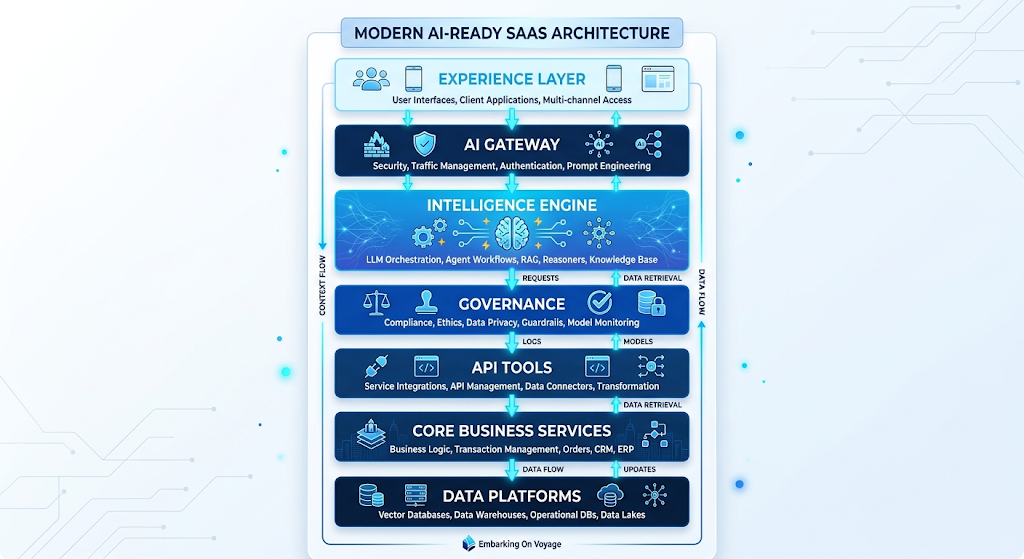
A practical, highly scalable AI-ready SaaS architecture ultimately looks like this:
| Layer | Primary Components & Functions |
|---|---|
| Experience Layer | User Interface, API Consumers, AI Agent interfaces |
| AI Gateway | Rate limiting, Model routing, Load balancing, Provider abstraction |
| Intelligence Engine | RAG, Context Assembly, Memory management, Agent Orchestrator |
| Governance & Security | Guardrails, Identity & RBAC, Policy enforcement, Evaluation |
| Tool Layer | Agent-ready internal APIs, Webhooks, Third-party integrations |
| Core Business Services | Traditional SaaS microservices and deterministic business logic |
| Data Platform | Operational DBs, Vector Stores, Event Streams, Data Warehouses |
| Observability | AI Telemetry, Cost tracking, Audit logs, Performance monitoring |
This tiered architecture allows your SaaS platform to evolve aggressively without discarding the legacy systems that currently generate revenue.
The CTO’s Real Question: Delivering Business Value
AI modernization should never be measured by the raw number of models deployed or LLM features released. The true metrics of success are: Revenue Created, Costs Reduced, Productivity Gained, Customer Experience Improved, and Risk Controlled.
The objective is not: “Make our SaaS platform use AI.” It is: “Make our SaaS architecture capable of safely turning AI intelligence into business execution.”
Achieving this requires a precise combination of modern software architecture, high-quality data governance, API-first design, robust AI engineering, and stringent security.
Organizations that begin this controlled transformation early will secure a massive competitive advantage: they won’t need to frantically rebuild their platforms when agentic AI becomes the enterprise standard. They will already have the architectural foundation to scale it.
Ready to evolve your platform? Speak with the engineering experts at to architect your AI-ready future.
Leave a Reply