



Artificial Intelligence is no longer simply another feature being added to software products. It is forcing companies to rethink product architecture, user experience, pricing, data strategy, and the economics of software itself. For companies looking to survive, the AI-Native SaaS Transition is no longer optional—it is mandatory.
The question for SaaS leaders is no longer, “Should we adopt AI?” It is: “How do we redesign our platform so AI becomes part of the operating architecture rather than another feature?”
The answer is emerging through a combination of AI augmentation, agentic workflows, stronger data foundations, and new commercial models.
1. From AI Features to AI-Native Architecture
The first wave of SaaS adoption was relatively simple: add copilots, summarization, search, or content generation to existing products. That approach is rapidly evolving.
Leading platforms are increasingly embedding AI deeper into the product architecture: Data → Context → Models → Agents → Tools → Workflow → Execution
The AI layer needs access to enterprise data, business rules, APIs, identity, permissions, and workflows. This makes AI adoption as much an architecture transformation as a model-selection exercise.
The important distinction in the AI-Native SaaS Transition is understanding the difference between AI-enabled and AI-native platforms:
- AI-enabled SaaS: Adds intelligence to an existing workflow.
- AI-native SaaS: Redesigns the workflow entirely around intelligence.
2. Agents Are Becoming Part of the Product
The next step is moving from passive copilots to autonomous agents. A copilot assists a user, but an agent can potentially execute a defined workflow.
For example, instead of a CRM merely suggesting that a customer needs attention, an agent could analyze the account, retrieve relevant information, prepare the communication, update the CRM, and escalate the decision when human approval is required.
This changes SaaS from a System of Record towards a System of Record + System of Intelligence + System of Action.
Gartner estimates that up to $234 billion of enterprise application software spending could be exposed to agentic AI by 2030, representing roughly 20% of enterprise SaaS spending. The important point is not that SaaS disappears, but that agents can increasingly perform work across applications, drastically reducing dependence on traditional user interfaces.
3. Data Is Becoming More Important Than the Model
Many SaaS companies initially approached AI through the question: “Which model should we use?” That is increasingly the wrong starting point.
The more critical questions for your AI-Native SaaS Transition are:
- Is our data clean and accessible?
- Is it properly structured to establish context?
- Can we control what an agent can access?
- Can we trace how an answer or action was produced?
A powerful model operating on poor enterprise data will still produce poor outcomes. For SaaS companies, proprietary data and domain context will become a stronger competitive moat than the underlying AI model itself.
4. The SaaS Interface Is Changing
Traditional SaaS was designed around humans navigating screens. AI introduces an entirely new interaction model: Human intent → Agent → APIs → SaaS applications → Action
This does not mean the user interface disappears. Instead, the interface increasingly becomes a control and supervision layer. Users may simply ask the system what they want to achieve, while the agent determines which tools and workflows need to be executed.
This creates a new technical requirement: SaaS platforms need to become agent-ready through robust APIs, structured data, tool definitions, permissions, and reliable execution mechanisms.
5. Pricing Is Beginning to Follow Value
The traditional SaaS model is largely based on: Users × Subscription.
AI challenges this because one agent can potentially perform work previously requiring multiple human users. As a result, SaaS companies are experimenting with consumption and outcome-oriented models. Salesforce, for example, now offers Agentforce through consumption-based pricing based on actions or conversations, alongside traditional licensing models.
The future may increasingly move from: Per User → Per Usage → Per Action → Per Outcome
The challenge for SaaS companies will be capturing the economic value created by AI without making pricing unpredictable for their customers.
6. Governance Is Becoming Part of Product Architecture
Giving an AI agent access to enterprise systems is fundamentally different from adding a chatbot. Agents may access customer information, modify records, initiate transactions, or trigger workflows.
Therefore, an AI-native product requires strict governance embedded directly into the architecture: Identity → Permissions → Guardrails → Evaluation → Observability → Auditability → Human-in-the-loop
The objective should not be unlimited autonomy. It should be controlled autonomy. The agent must act within clearly defined boundaries, while sensitive, high-impact decisions remain subject to human accountability.
7. SaaS Companies Are Becoming More Outcome-Oriented
The strongest AI strategy isn’t necessarily held by the company with the most AI features. It belongs to the company that can demonstrate: AI → Productivity → Business Outcome
SaaS leaders need to measure more than just model accuracy. They must measure:
- Time saved and human intervention required
- Revenue generated and costs reduced
- Conversion improved and errors prevented
- Customer satisfaction and workflow completion
This is where AI transitions from an experimental feature to concrete enterprise value.
8. The Winning Architecture Will Be Hybrid
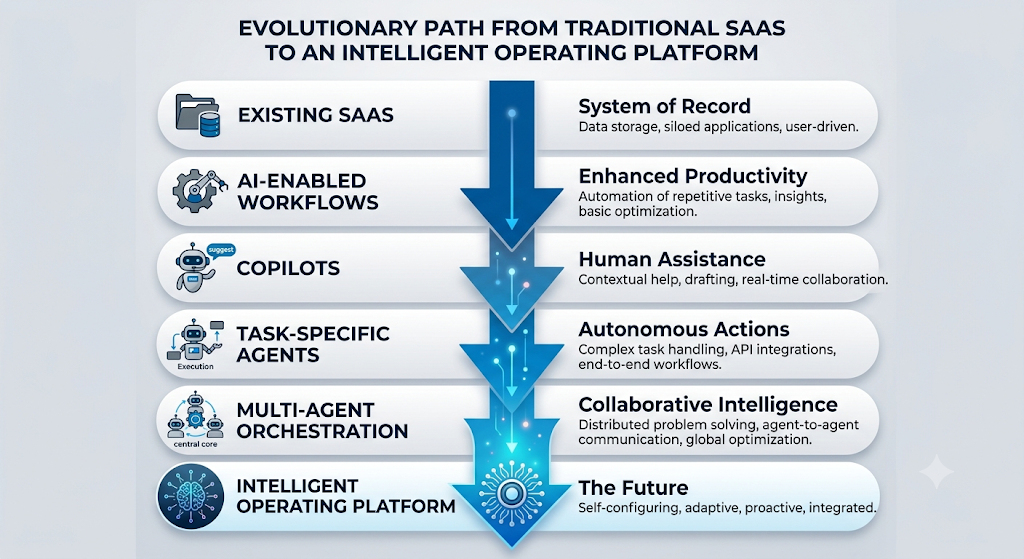
SaaS companies will not suddenly replace their entire technology stack with AI agents overnight. Research suggests that large-scale replacement of incumbent enterprise applications by agents is unlikely in the near term.
Instead, the more realistic path is evolutionary: Existing SaaS ↓ AI-enabled workflows ↓ Copilots ↓ Task-specific agents ↓ Multi-agent orchestration ↓ Intelligent operating platform
The underlying systems of record remain important, while AI becomes the intelligence and orchestration layer operating above them.
The Strategic Question for SaaS Leaders
The AI-Native SaaS Transition is not simply about embedding an LLM into a product. It is about rethinking the entire software operating model. SaaS companies need to ask:
- What should the human do?
- What should AI do?
- What should remain deterministic software?
- Where must a human remain accountable?
The SaaS companies that navigate this transition successfully won’t necessarily be those that automate everything. They will be the ones that combine AI intelligence with reliable software engineering, proprietary data, domain expertise, governance, and measurable business outcomes.
The future of SaaS is not AI replacing software. It is software becoming intelligent enough to understand intent, orchestrate systems, and execute work—while remaining secure, observable, and accountable.
DM us or comment below. Tell us how you are handling it below.
Leave a Reply