



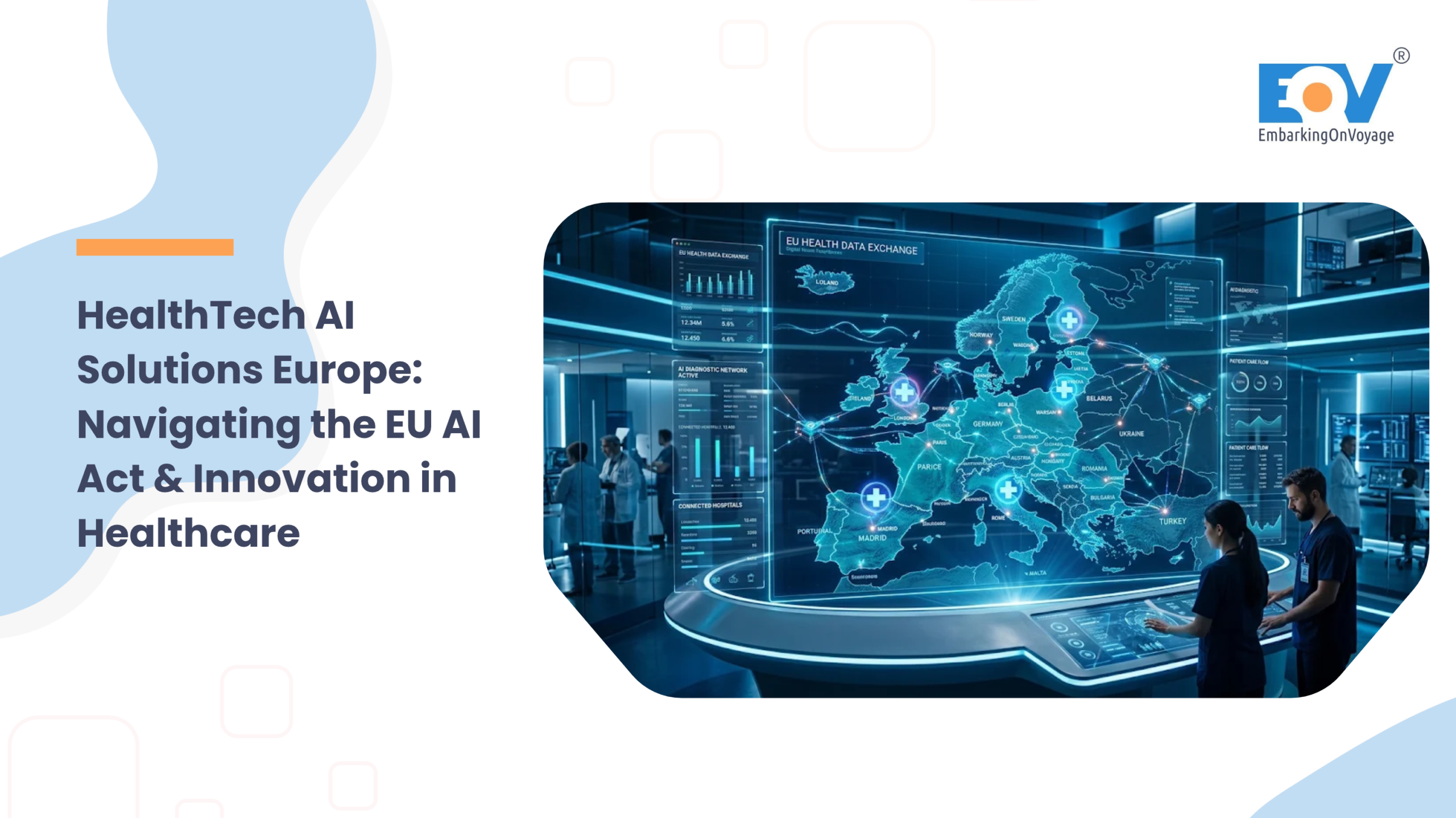
The demand for HealthTech AI solutions Europe has never been higher. From predictive diagnostics to Agentic AI streamlining hospital workflows, artificial intelligence is reshaping the foundation of European healthcare. However, building and scaling these digital products on the continent requires more than just innovative engineering; it requires a deep understanding of a rapidly evolving regulatory landscape.
For decision-makers, CTOs, and founders, the challenge is clear: how do you build cutting-edge, AI-native healthcare applications while remaining compliant with stringent new data and safety laws?
In this comprehensive guide, we will explore the current state of HealthTech AI solutions Europe, decode the impact of the EU AI Act and the European Health Data Space (EHDS), and outline how the right engineering partner can help you build compliant, scalable digital products.
The Regulatory Dual-Engine: EU AI Act and the EHDS
To succeed in the European healthcare market, technology leaders must navigate a dual regulatory framework designed to democratize data while enforcing strict safety protocols.
1. The EU AI Act: Balancing Innovation and Control
Adopted in 2024, the European Union’s Artificial Intelligence Act (EU AI Act) is the world’s first comprehensive legal framework for AI. For healthcare providers and software vendors, the implications are massive.
Under the Act, medical AI systems such as software intended for diagnostics, patient triage, or predictive care are classified as “high-risk.“ This classification imposes stringent requirements, including:
- Transparency & Human Oversight: Systems must be designed so that medical professionals can interpret the system’s results correctly and intervene or shut down the system if necessary.
- Strict Data Governance: Datasets used to train AI models must be relevant, representative, and error-free to prevent algorithmic bias.
While these measures safeguard patient safety, they also introduce significant compliance costs. Research indicates that certification burdens for high-risk medical AI can range from €16,800 to €23,000 per unit. To offset these costs and avoid costly engineering rework, healthcare innovators must adopt AI-native architectures that bake compliance in from day one.
2. The European Health Data Space (EHDS)
While the AI Act focuses on risk and safety, the European Health Data Space (EHDS) aims to unlock the power of medical data. The EHDS creates a unified data-sharing framework across EU member states, allowing healthcare providers and researchers to access electronic health data securely.
For developers of HealthTech AI solutions Europe, the EHDS is a game-changer. It provides a standardized data quality label that helps AI providers fulfill their data obligations under the AI Act, effectively democratizing access to high-quality datasets for R&D.
Doctor interacting with AI data interfaces. Source: IT United
Core Use Cases for HealthTech AI Solutions Europe
With regulatory clarity taking shape, organizations are rapidly moving from theoretical AI models to enterprise-ready solutions.
Agentic AI and Autonomous Workflows
Legacy workflows in European hospitals are heavily burdened by administrative tasks. Agentic AI – autonomous agents that can think, adapt, and execute is transforming this space. Instead of simply predicting outcomes, Agentic AI can independently schedule patient follow-ups, optimize bed management, and process insurance claims while keeping a “human-in-the-loop” to satisfy AI Act regulations.
Advanced Medical Diagnostics
Computer vision and machine learning models are being deployed to detect anomalies in radiology and pathology at unprecedented speeds. By leveraging intelligent pipelines and Enterprise Data Engineering, hospitals are creating modern ELT/ETL architectures that feed raw, unstructured medical images directly into secure, predictive AI models.
Predictive Patient Care
By utilizing the data interoperability championed by the EHDS, predictive models can analyze cross-border patient histories to forecast chronic disease risks. This proactive approach shifts European healthcare from reactive treatments to preventative care.
Overcoming AI Adoption Challenges in European Healthcare
Despite the vast potential, scaling healthcare AI in Europe comes with hurdles. Fragmented legacy systems, data silos, and the fear of regulatory penalties often paralyze deployment. Here is how leading innovators are mitigating these risks:
- Regulatory Sandboxes: Forward-thinking organizations are utilizing innovation hubs and AI-Native Engineering Labs to test AI technologies under controlled environments before a full-scale launch. This allows developers to test mandatory human oversight and bias audits in real-time.
- Zero-Trust Architecture: Protecting patient data requires robust access controls and data masking. Security must be built into the CI/CD pipeline, not treated as an afterthought.
- Engaging AI-Native Partners: Building high-risk AI systems in-house can drain capital and delay time-to-market. Partnering with specialized engineering teams ensures your architecture meets both clinical needs and legal standards.
Complex AI healthcare data pipeline dashboard. Source: RDP Technologies
Why Partner with EmbarkingOnVoyage?
Transitioning from a legacy healthcare workflow to an intelligent, AI-driven ecosystem requires a specialized approach. At EmbarkingOnVoyage (EOV), we bridge the gap between traditional digital product engineering and next-generation Agentic AI.
As a niche AI-first engineering partner, we help ISVs, Tech Companies, and Healthcare enterprises build risk-mitigated technical roadmaps. Here is how we support the growth of HealthTech AI solutions Europe:
- AI Native Digital Product Consulting: Stop guessing and start building. We deliver the precise blueprints from Business Requirement Documents (BRDs) to interactive prototypes that healthcare founders and CTOs need to secure funding and validate compliance upfront.
- AI-Native Digital Product Engineering: We deliver high-performance, enterprise-scalable software. Our agile delivery sprints ensure your product reaches the market faster, with security (GDPR, HIPAA, SOC 2) built into every line of code.
- Data-to-Intelligence Pipelines: We engineer secure cloud data warehouses and lakehouses, transforming fragmented legacy data silos into intelligent pipelines that power predictive healthcare analytics.
Conclusion
The intersection of the EU AI Act, the EHDS, and rapid advancements in machine learning has created a unique, high-stakes environment. Developing successful HealthTech AI solutions Europe requires more than just writing code; it demands an architected approach to data governance, patient safety, and scalable cloud infrastructure.
By embracing transparent, AI-native engineering practices, European healthcare providers and tech disruptors can navigate regulatory complexities and deliver life-saving innovations to the market faster.
Are you ready to turn your healthcare vision into a scalable, compliant digital product? Contact the experts at EmbarkingOnVoyage today to book your strategic product consultation.
Leave a Reply