



Building an effective artificial intelligence system requires far more than just a powerful machine learning model or a simple prompt interface. While the algorithmic side of artificial intelligence gets the vast majority of the public attention, the true bottleneck for modern enterprises lies entirely in the underlying data infrastructure feeding those models. This precise challenge is exactly why custom data pipeline development for AI has become the absolute critical foundation for businesses looking to move beyond simple data analytics and successfully deploy production-grade, agentic AI infrastructure solutions.
When organizations attempt to scale their artificial intelligence initiatives, they often realize that their existing data architecture is fundamentally misaligned with the needs of modern machine learning. Standard data workflows are typically built to generate static reports for human reading. In contrast, AI data pipelines are engineered strictly for machine consumption. They require continuous feedback loops, the ability to handle massive volumes of unstructured multimodal data such as video files, text documents, system logs, and IoT sensors, and they demand ultra-low latency that legacy systems simply cannot provide.
In this comprehensive and detailed guide, we will break down the underlying architecture, the essential core stages, and the proven industry best practices for engineering high-performance, scalable AI data pipelines that can future-proof your enterprise infrastructure.
Why Standard ETL Fails for Modern AI Initiatives
Traditional Extract, Transform, Load (ETL) processes were brilliantly designed for the era of business intelligence and historical analytics. They operate predominantly in batches, carefully moving structured data from point A to point B, usually into relational data warehouses at scheduled intervals, such as every midnight. This was perfectly adequate when the end goal was a weekly sales dashboard.
However, when applied to the dynamic needs of artificial intelligence, standard batch-oriented ETL completely falls short. AI workloads operate in a different paradigm altogether. First, they require continuous feedback loops. Machine learning models naturally degrade over time in a process known as model drift. To maintain accuracy, they need a constant stream of real-time AI data ingestion to retrain and adapt to new patterns dynamically.
Furthermore, modern generative AI and deep learning heavily rely on unstructured multimodal data. A standard ETL pipeline expects neat rows and columns of SQL data, but an AI pipeline must be capable of processing raw text for natural language processing, vector embeddings for similarity searches, and pixel data for computer vision.
Finally, the most glaring limitation of traditional ETL is latency. AI inference, such as instantly approving a financial transaction based on fraud detection or generating a real-time product recommendation on an e-commerce site, requires instantaneous data retrieval measured in milliseconds. Batch processing fundamentally cannot support the microsecond latency required by an advanced agentic AI infrastructure.
Therefore, investing in custom data pipeline development for AI is no longer optional. It ensures your infrastructure is highly resilient, infinitely scalable, and optimized specifically for both predictive and generative workloads.
Core Architecture Stages of an AI Data Pipeline
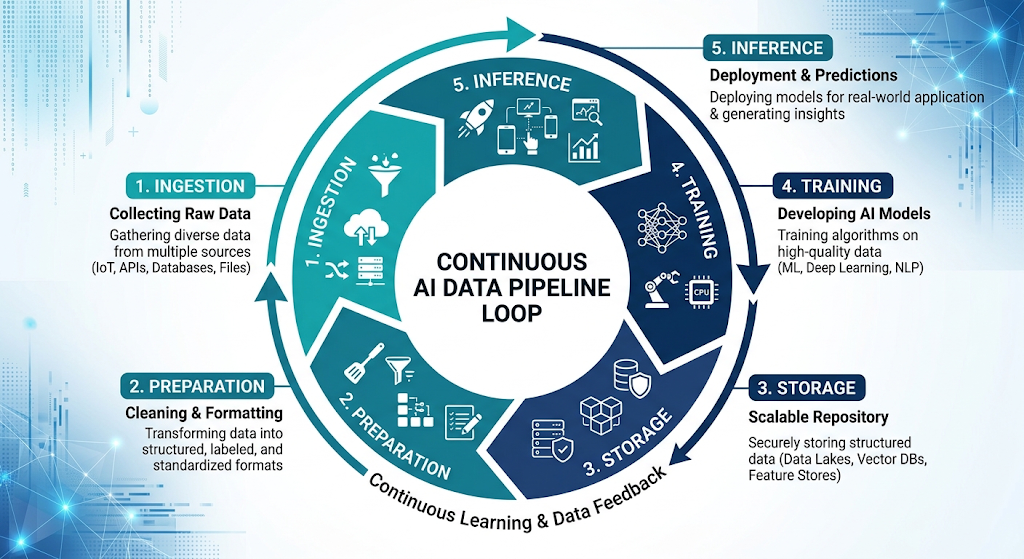
Modern scalable AI architecture is best understood as a continuous, self-optimizing loop rather than a linear, one-way street. A robust custom data pipeline development for AI project generally follows five distinct and highly specialized stages.
| Pipeline Stage | Primary Function | Specific AI Requirement |
| 1. Data Ingestion | Pulling raw data from operational databases, IoT sensors, file repositories, and external APIs. | Must support streaming architectures (like Kappa or Lambda) rather than relying solely on batch processing to capture real-time metadata. |
| 2. Preparation and Enrichment | Cleaning, formatting, filtering, and transforming raw inputs into usable formats. | Requires automated bias checking, anomaly detection, and complex vectorization processes specifically designed for Large Language Models. |
| 3. Dataset Storage | Housing massive volumes of data for immediate model consumption and historical archiving. | Requires incredibly high throughput to feed training GPU clusters efficiently, alongside versioning capabilities to reproduce exact dataset states. |
| 4. Model Training | Iterative computational workflows feeding processed data directly into the machine learning model. | Pipeline must support continuous, automated retraining triggers as new data streams arrive, rather than treating training as a one-time static event. |
| 5. Inference and Feedback | Deploying the trained model into a production environment to make live decisions and predictions. | Must close the loop entirely by capturing end-user interactions and edge-case failures to feed back into the ingestion stage for continuous learning. |
Let us look deeper into these stages. During data ingestion, the focus is on volume and velocity. Engineers must build connectors that can handle APIs, webhooks, and raw database logs simultaneously.
In the preparation and enrichment phase, the data is transformed. For AI, this often means converting text documents into mathematical vectors so that a machine can understand the semantic meaning behind the words. This step is highly compute-intensive and requires specialized orchestration tools.
Dataset storage for AI has also evolved. Rather than just using standard data lakes, custom data pipeline development for AI often incorporates vector databases. These specialized databases are designed to store and query high-dimensional vectors, which is the exact format required by modern generative AI models.
The model training stage relies heavily on the pipeline’s ability to deliver massive amounts of data to the compute layer without bottlenecking the expensive GPU resources. Finally, inference and feedback represents the ongoing operational lifecycle of the AI. Every time a user interacts with the AI, that interaction is logged, securely processed, and routed back to the beginning of the pipeline to make the model slightly smarter for the next user.
5 Best Practices for Custom Data Pipeline Development for AI
To ensure your enterprise data infrastructure is robust, secure, and genuinely future-proof, data engineering teams must adopt highly scalable architectural patterns. Here are the top five best practices recommended by industry leaders to optimize your custom data pipeline development for AI.
1. Automate Data Quality Assurance at the Source
Bias and quality issues introduced during the initial data ingestion phase will not just persist; they will compound exponentially during the model training phase. In the world of AI, garbage in truly means garbage out, but at scale. To prevent this, data engineering teams must treat data validation as strict code. You must implement automated data profiling tools to actively catch missing values, unexpected schema changes, and statistical anomalies long before they have a chance to corrupt your downstream AI datasets. Automated checks against data type consistency, acceptable value ranges, and unexpected null distributions ensure that only mathematically sound inputs move forward into the machine learning models.
2. Leverage Streaming Over Batching Wherever Possible
For advanced use cases like Retrieval-Augmented Generation (RAG), autonomous robotics, or real-time cybersecurity anomaly detection, your artificial intelligence requires absolute real-time context. Relying on data that is even a few hours old can render the AI’s output entirely useless. Utilizing event-based messaging platforms like Apache Kafka or implementing streaming data pipeline architectures effectively minimizes data lag from hours down to mere seconds. Streaming pipelines process individual events continuously exactly as they are generated by the source systems, delivering the real-time data flow that is absolutely essential for operational AI analytics and fast inference.
3. Implement Strict Metadata Governance and Lineage Tracking
In the field of artificial intelligence, transparency is everything. If you cannot explain exactly how a model reached a specific decision, you cannot trust it, and in highly regulated industries, you cannot legally deploy it. Effective metadata management meticulously tracks the provenance and history of your data. You must always know precisely where a piece of data originated, exactly how it was transformed along the way, and which specific version of a dataset was utilized to train a particular iteration of your model. By maintaining a centralized metadata repository, you ensure that data lineage tracking is treated as a fundamental piece of operational infrastructure rather than just an afterthought for legal compliance.
4. Build Highly Modular and Reusable Components
As your AI initiatives grow, your data pipelines will inevitably become more complex. You must actively avoid monolithic pipeline designs where everything is tightly coupled together. Breaking down your custom data pipeline development for AI into modular, loosely coupled microservices allows your engineering team to scale distinct components independently based on demand. For example, if your ingestion volume spikes during a marketing campaign, you should be able to scale the ingestion service without paying to scale the storage or training services. Utilizing containerization technologies via Docker and orchestration via Kubernetes keeps your entire data architecture portable, resilient, and highly adaptable to unpredictable workload spikes. Promoting strict code reusability through shared libraries also significantly enhances long-term maintainability.
5. Design for the Continuous Feedback Loop on Day One
A machine learning data pipeline is never a set it and forget it system. The moment a model is deployed into production, it begins interacting with a changing world, and its accuracy will begin to drift. Feedback from the production environment, such as explicit model errors, user corrections, or statistical shifts in data drift, must feed directly and automatically back into the ingestion stage to trigger automated model retraining. You must build these monitoring alerts and retraining loops into the very initial architectural design. Treating the feedback loop as a day one requirement ensures your agentic AI infrastructure actually grows more intelligent over time instead of slowly degrading into obsolescence.
Partnering for AI-Native Engineering Success
Building an enterprise-scale, production-ready data infrastructure requires highly specialized engineering expertise. The landscape of tools, frameworks, and architectural patterns is shifting incredibly fast, and building this entirely in-house can lead to expensive trial and error. This is exactly where partnering with an experienced AI-first digital product engineering firm becomes an invaluable strategic advantage.
At EmbarkingOnVoyage (EOV), we boast over a decade of hands-on experience bridging the complex gap between legacy enterprise systems and autonomous, cutting-edge innovation. We do not just act as an outsourced vendor; we work collaboratively alongside your internal team to engineer truly AI-native digital products from the ground up.
From architecting high-throughput, real-time data ingestion streams to orchestrating complex Large Language Model integrations and scalable agentic workflows, our seasoned experts ensure your data pipeline is deeply resilient, infinitely scalable, and inherently intelligent.
Are you ready to transform your dormant raw data into a highly strategic AI asset? Book a Product Strategy Call with our technical engineering experts today, and let us collaboratively architect a custom data pipeline that multiplies your team’s operational impact and accelerates your AI journey.
Leave a Reply