



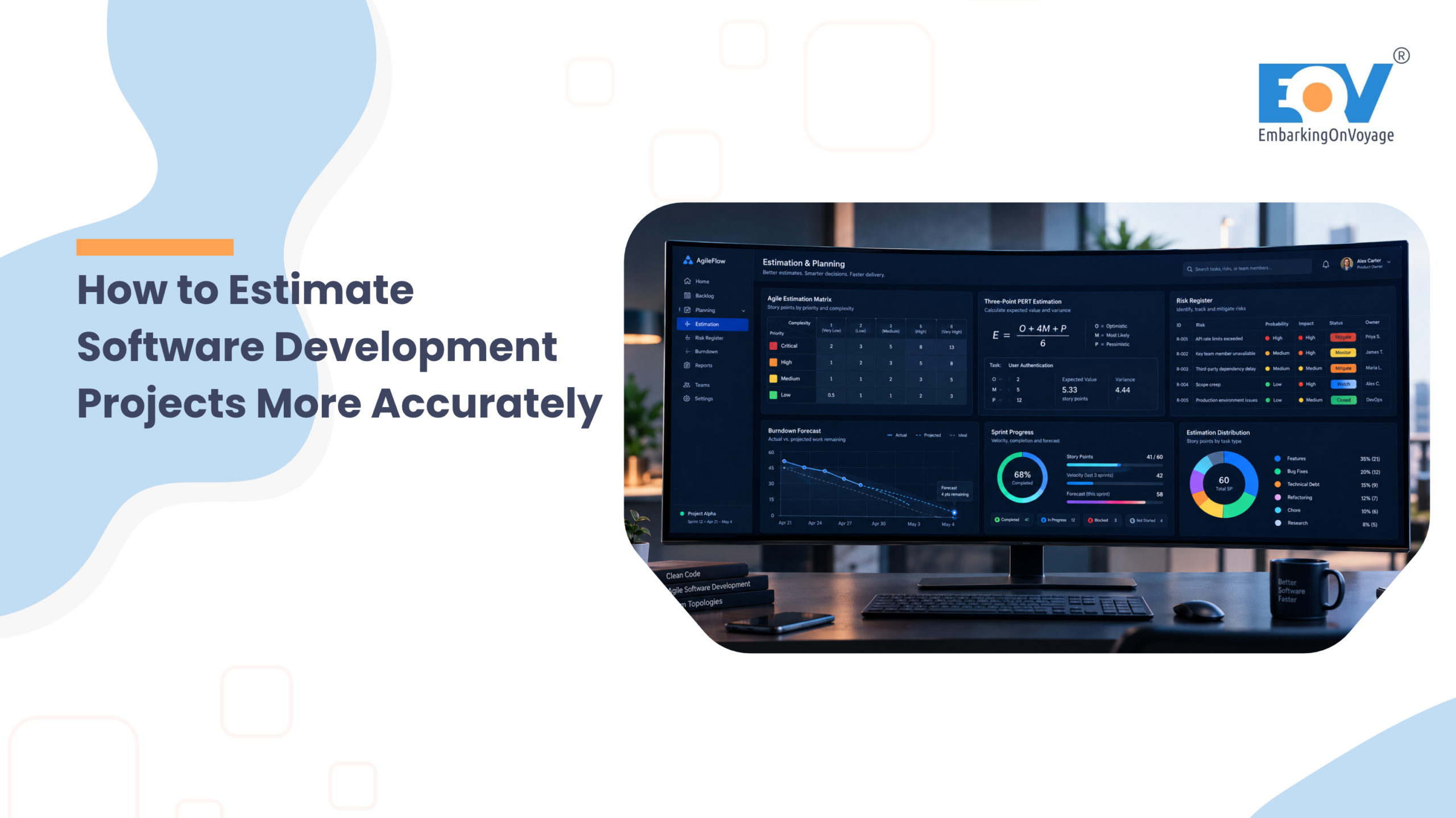
A software development estimate frequently determines whether a digital agency wins a contract, how profitably the work is priced, and whether client trust survives delivery. Yet, teams often produce estimates when requirements are half-formed, third-party APIs are untested, and technical debt remains buried.
The outcome is painfully familiar: delivery timelines slide, scopes balloon, profit margins erode, and client relationships fray under pressure.
Accurate software development project estimation does not mean predicting every ticket with pinpoint precision. Software engineering contains inherent variance. The real goal is establishing an evidence-based, transparent framework that factors in technical uncertainty and protects both your agency’s bottom line and the client’s commercial investment.
Here are 10 foundational rules to modernize your software development project estimation workflow.
1. Clarify the Business Problem Before Sizing Features
A frequent breakdown in estimation is jumping straight into technical user stories before interrogating the broader business objective.
A client request as seemingly straightforward as a “customer portal” routinely conceals multi-tenant authentication, granular role-based access control (RBAC), legacy enterprise resource planning (ERP) syncs, and PCI-DSS compliant payment gateways. What sounds like a two-week sprint can quickly expand into three months of architectural groundwork.
Before assigning developer hours, document the baseline criteria:
- Target Commercial Outcome: What specific metric or workflow does this deliverable move?
- Core User Personas & Workflows: Who interacts with the system, and through what entry points?
- MVP Boundary: What must be in Release 1.0 versus subsequent quarterly releases?
- Integration Topology: Which internal databases, microservices, and external APIs are mandatory?
- Non-Functional Requirements (NFRs): Latency ceilings, uptime Service Level Agreements (SLAs), and compliance mandates (e.g., SOC 2, GDPR).
- Explicit Exclusions: What will the team intentionally not build during this phase?
A well-architected scope does not require anticipating every feature iteration; it requires defining the project perimeter with sufficient clarity to commit commercial resources responsibly.
2. Decouple Discovery from Delivery Estimation
Committing to a fixed-price delivery figure while critical technical variables remain unknown creates unhedged commercial risk.
If an engagement requires integrating with an undocumented legacy mainframe or an erratic third-party platform, the engineering team cannot know whether integration requires a single webhook or a complex intermediary middleware layer.
Instituting a paid technical discovery engagement mitigates this exposure before delivery begins.
High-Impact Discovery Deliverables
- Stakeholder architectural workshops and system boundary mapping
- Legacy codebase audits and dependency vulnerability scans
- Proof-of-concept (POC) prototypes validating high-risk API behaviors
- Database schema mapping and historical data migration audits
- Target cloud infrastructure blueprints and continuous integration/continuous deployment (CI/CD) design
Discovery is not unbillable overhead. It is the information-gathering phase required to make a sound commercial bid. If your internal team lacks bandwidth to scope complex cloud or AI workloads, leveraging dedicated engineering pods from Embarking On Voyage provides seasoned architects to audit risk profiles during discovery.

3. Deconstruct the Project into Estimable Work Packages
Estimating an enterprise application as a monolithic figure obscures delivery risk and prevents granular variance analysis. Instead, decompose the system into distinct architectural tiers:
| Work Package Tier | Core Delivery Activities | Primary Risk Factor |
| Foundation & Architecture | Scaffolding, cloud infrastructure (IaC), CI/CD pipelines, containerization | Cloud permission latency, environment mismatches |
| Security & Identity | OAuth2/SAML implementation, session management, RBAC matrices | Identity provider quirks, compliance audits |
| Business Logic & APIs | Core microservices, transaction handlers, database schemas | Unclear domain logic, edge-case mutations |
| Front-End Interfaces | Responsive design systems, state management, client-side validation | Browser variance, fluid stakeholder UI revisions |
| Integrations & Data | Third-party webhooks, ETL pipelines, legacy database sanitization | Inconsistent payload schemas, API rate limits |
| Quality Engineering | Automated integration tests, end-to-end (E2E) suites, load testing | Flaky test environments, missing test data |
Decompose work until no individual task package carries uninspected technical uncertainty. Large, ambiguous features should be flagged for rapid technical spikes rather than buried inside an arbitrary buffer.
4. Combine Complementary Software Estimation Techniques
Relying on a single sizing model introduces cognitive bias. Triangulate your projections using established industry models:
Analogous Estimation
Compare the target platform with completed projects featuring similar architectural scope. This top-down method offers a rapid reality check during initial sales discussions, provided the historical baseline is truly comparable.
Bottom-Up Estimation
Deconstruct work breakdown structures (WBS) into granular tasks estimated by the engineers who will build them. This works well once wireframes and API endpoints are finalized.
Three-Point PERT Estimation
Factor in project variance by assigning three specific values to each deliverable: Optimistic ($O$), Most Likely ($M$), and Pessimistic ($P$). Calculate the expected effort ($E$) using the classic beta distribution formula:
$$E = \frac{O + 4M + P}{6}$$
This weighted average forces the project team to quantify worst-case scenarios, preventing overly optimistic assumptions from skewing the commercial baseline. For complex deliveries, running Monte Carlo simulations across these ranges provides a probabilistic confidence interval (e.g., “85% probability of delivery within 14 to 17 sprints”).
5. Account for Ancillary Delivery Overhead
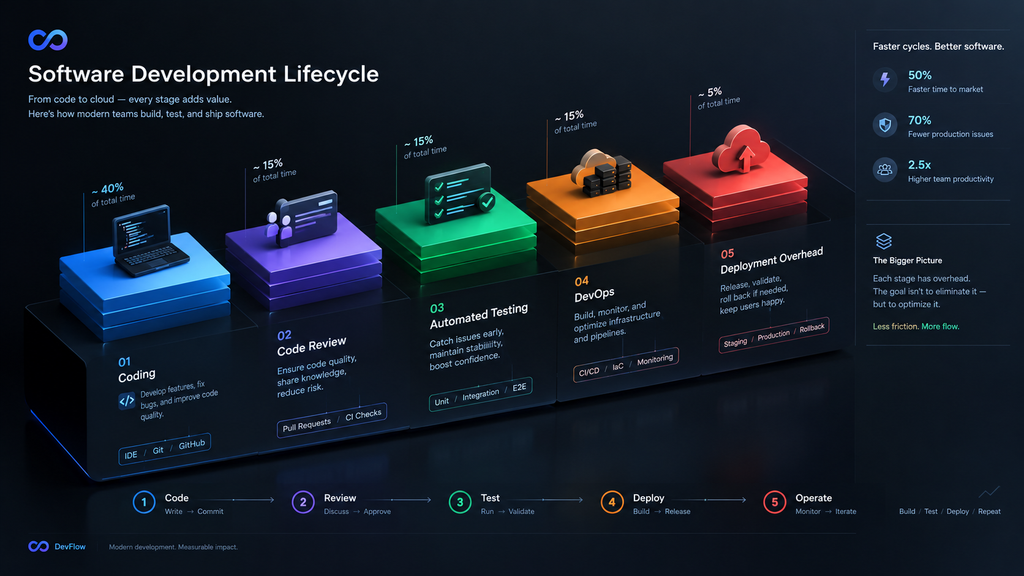
Software development project estimation frequently falls short by sizing code generation while overlooking release engineering. Writing production code accounts for roughly 40% to 50% of the total engineering effort.
The remaining balance comprises crucial deployment activities:
- Architectural Review & Refactoring: Ongoing pull request reviews, linting governance, and dependency updates.
- Environment Configuration: Terraform configurations, staging environment drift remediation, and database seeding.
- Security & Observability: Open-source vulnerability scanning, log aggregation pipelines (e.g., Datadog, Grafana), and tracing.
- Regression Stabilization: Hardening sprints, manual exploratory edge-case runs, and bug remediation triage.
- Operational Handover: System documentation, administrator guides, and stakeholder acceptance testing (UAT) cycles.
Estimating AI-Native Applications
When building systems leveraging Large Language Models (LLMs) or autonomous agents, budget for specialized workflows:
- Evaluation harness configuration and validation runs
- Retrieval-Augmented Generation (RAG) vector index optimization and chunk tuning
- Prompt latency testing, edge-case guardrails, and deterministic fallback logic
- Token consumption modeling, caching layers, and production inference unit economics
For organizations evaluating AI readiness, reviewing enterprise architectures via our Embarking On Voyage AI & Innovation Studio helps model runtime costs and evaluation timelines early.
6. Isolate Dependencies and External Integration Risks
Two identical web portals can have wildly different implementation timelines depending on what sits behind the API interface. A greenfield application built on modern infrastructure carries low integration variance. The same portal connected to a legacy SAP instance with sparse documentation carries substantial delivery risk.
When documenting third-party systems, cross-reference your integration assumptions with technical standards such as OWASP’s Secure Product Development Guidance to capture non-negotiable security requirements early.
Isolate dependencies into an explicit Risk and Assumptions Log:
- Third-Party API Limits: Rate limits, lack of sandbox testing environments, and unannounced payload deprecations.
- Client Approvals: Dependencies on client teams for domain verification, Apple Developer account approvals, or SAML SSO metadata.
- Legacy Data Integrity: Corrupted, duplicate, or unindexed historical datasets requiring extensive ETL cleanup before migration.
Where an external risk could derail the schedule, address it through contractual milestone gates or a time-and-materials spike rather than absorbing it into a fixed delivery fee.
7. Decouple Effort, Calendar Time, and Financial Cost
Engineering teams often treat effort, schedule, and cost as interchangeable variables. They are distinct metrics governed by different constraints:
- Effort (Person-Hours): The raw technical labor required to execute the tasks.
- Calendar Time (Elapsed Duration): The working days required from project kickoff to final sign-off.
- Cost (Commercial Burn): The blended cost of development, management, third-party tooling, cloud compute, and licensing.
Attempting to compress calendar time by adding developers triggers the classic dynamic outlined in Frederick Brooks’ landmark book The Mythical Man-Month: adding personnel to a late software project often makes it later.
Onboarding overhead, communication channels, and sequential architecture requirements mean that four developers rarely complete a four-month project in one month. Accurate estimates reflect communication friction, QA feedback loops, and stakeholder review pauses.
8. Benchmark Estimates Against Historical Delivery Data
The most reliable asset for future estimation is historical delivery telemetry. Instead of using arbitrary contingency percentages (e.g., adding a flat 20% cushion), benchmark your proposals against past velocity:
- Identify task categories that routinely exceed their estimates (e.g., third-party auth, custom payment workflows).
- Measure the true ratio of QA cycles and bug triage to active feature development.
- Quantify how often scope creep was introduced during sprint reviews.
- Track the variance between initial developer sizing and final logged sprint hours.
Capture this telemetry within your project management platforms (Jira, Linear, ClickUp) to refine bottom-up estimation templates over time.
9. Formulate Clear Commercial Assumptions and Guardrails
An estimate is an expression of cost under a specific set of operational conditions. When those conditions change, the estimate must adapt.
Define the operational parameters underpinning the estimate in your statement of work:
- For Fixed-Fee Deliverables: Include explicit wireframes, user stories, defined acceptance criteria, a strict limit on revision rounds, and a clear Change Request (CR) framework.
- For Time & Materials (T&M): Establish bi-weekly burn-rate reports, sprint threshold alerts, and shared backlog prioritization meetings.
- For Milestone-Driven Co-Development: Clearly specify technical prerequisites, environment handoffs, and client review turnaround windows (e.g., sign-off within 5 business days).
Transparent assumptions protect your working capital while setting clear expectations with the client.
10. Re-Estimate Continuously as New Variables Emerge
Treating an initial estimate as an immutable guarantee throughout a multi-month development cycle undermines delivery quality. As sprints progress, edge cases surface, client strategies pivot, and APIs reveal undocumented limitations.
Agile estimation requires continuous reassessment. When a sprint reveals material technical hurdles:
- Quantify the Delta: Calculate the exact impact on the critical path and remaining sprint capacity.
- Surface Trade-Offs Immediately: Present clear commercial paths rather than absorbing the deficit in silence.
- Execute Scope Adjustments: Work with stakeholders to prune non-critical backlog items, adjust delivery milestones, or allocate additional budget.
Early, evidence-based conversations keep client partnerships productive and project margins intact.
How AI Coding Assistants Impact Software Estimation
The rise of generative AI tools (such as GitHub Copilot, Cursor, and automated test generators) has led some to assume overall software delivery time can be cut in half. The reality is more nuanced.
While generative AI accelerates boilerplate syntax generation, unit test scaffolding, and initial documentation drafts, it does not bypass the most time-consuming phases of engineering:
- Translating ambiguous business goals into resilient architecture
- Validating complex cross-system data synchronization
- Security auditing, pen-testing, and compliance governance
- Debugging hallucinations, subtle edge-case race conditions, and integration faults
Agencies should baseline their estimates on observed internal metrics rather than theoretical AI speedups. Modernize your toolchains, measure your team’s actual velocity improvements, and adjust your capacity planning based on verifiable delivery data.
Improving Your Agency’s Delivery Predictability
Reliable software development project estimation is not about finding an equation that magically eliminates technical ambiguity. It is about systematically surfacing unknowns, grounding assumptions in engineering reality, and maintaining transparency throughout the delivery lifecycle.
If your agency or enterprise is scoping complex digital products, legacy integrations, or AI-native architectures, you don’t have to carry the scoping burden alone. Partnering with Embarking On Voyage connects your team with dedicated, product-minded engineering pods that integrate directly into your discovery, technical architecture, and production delivery.
To improve your estimation accuracy today, audit your last three delivered projects. Isolate where your projections diverged from reality, and incorporate those insights into your next discovery process.
Leave a Reply