


If you want to scale a digital agency without carrying more risk than you can afford, you are probably in a familiar spot. The pipeline looks healthy, existing clients are asking for more, and new opportunities need skills your team doesn’t have yet.
Hiring a permanent team for every project you hope to win feels risky. Hiring too slowly means missed deadlines and a tired team. Hiring too fast means payroll starts squeezing your margins before the revenue has even arrived.
The good news is you don’t have to choose between the two. You can build a delivery model that separates what you must own from the capacity you can access when demand calls for it. This guide walks you through how, step by step.
Why Headcount Alone Is a Poor Measure of Scalability
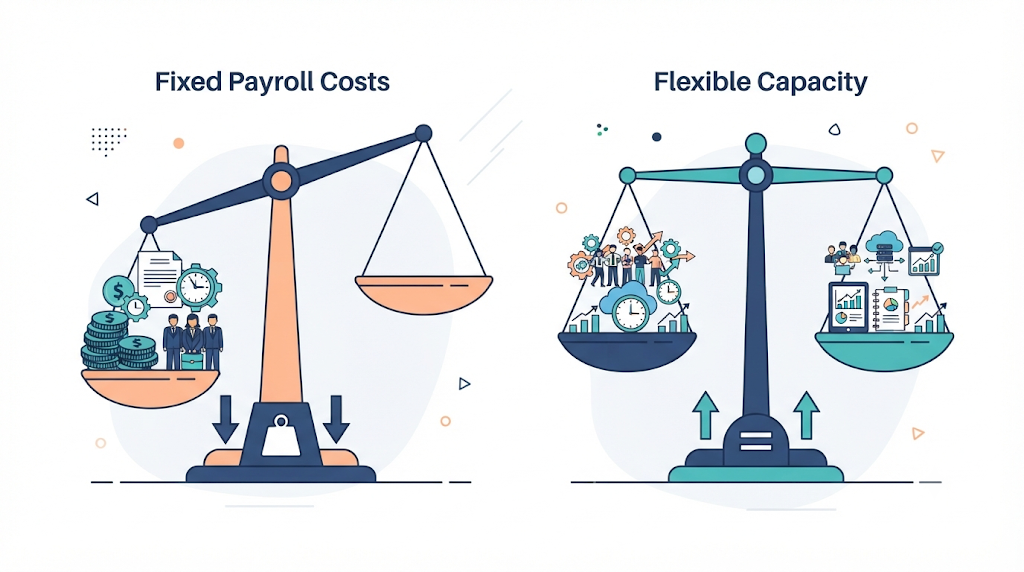
An agency can double its team and still earn less. Every permanent hire brings costs beyond salary: recruitment, onboarding, management time, equipment and training. When demand is strong, that investment pays off. When a client pauses a programme, those same costs become heavy.
The opposite extreme hurts too. A team that is permanently too small leads to burnout, slipping deadlines and too much dependence on a few people.
So the real goal when you scale a digital agency is to match delivery capacity to demand while protecting the capabilities that make you different. That takes deliberate capacity planning, which the steps below cover.
Step 1: Decide Which Capabilities Must Stay In-House
Start by separating strategic ownership from execution capacity. Client relationships, commercial strategy, service design, product direction and deep account knowledge usually need to stay close to you.
Some delivery skills may also be central to your competitive edge and worth a permanent investment. Others are only needed for certain projects or seasons.
Say your agency is expanding into software development. You might keep product strategy, client-facing technical leadership and solution oversight in-house, while extending implementation capacity through a specialist partner. There’s no universal split. Let your service portfolio, client expectations and long-term strategy guide you.
If you’re still shaping your offering, our guide to building a profitable digital agency service model can help you decide where your real strengths lie.
Step 2: Forecast Demand Before You Commit to Permanent Hires
A big pipeline is not the same as real demand. Before you hire, split your work into three groups:
- Committed demand: contracted work with agreed timelines.
- Probable demand: opportunities with a credible chance of closing.
- Speculative demand: early-stage leads without enough commercial certainty.
Then map the skills and hours each group needs. You’ll quickly see which roles need permanent cover and which skills can be sourced flexibly. You’ll also spot where you’re planning your team around deals that may never close.
Review this forecast regularly. A hiring decision that made sense last quarter can look very different after a client delays a programme or a large deal slips. The Project Management Institute offers useful resources on resource planning if you want a more formal framework.
Step 3: Improve Utilisation Before Adding People
Sometimes the problem isn’t a lack of people. It’s how their time is being used. Look at how much capacity you lose to:
- Unclear requirements and late decisions
- Unplanned work and constant scope changes
- Repeated manual testing or release processes
- Poorly managed dependencies
- Fragmented project ownership
- Senior people doing work that doesn’t need their level of expertise
Fixing these can free up real capacity without a single new hire. One caution, though: don’t turn utilisation into a goal of keeping everyone busy all day. Your team needs some breathing room for learning, quality, internal improvements and surprise client requests. A team running at 100% has no space to do its best work.

Step 4: Use Flexible Engineering Capacity for Variable Demand
When demand outgrows your internal team, a delivery partner lets you respond without committing to permanent headcount straight away. This is especially useful for specialist skills, short-term implementation support or a delivery peak.
There are a few common ways to do it:
- Specialist support: bring in expertise for one technical challenge or integration.
- Staff augmentation: add individual developers to your own team, under your technical leadership.
- Dedicated engineering pods: engage a team for a defined stream of work, with agreed responsibilities and delivery processes.
- Outcome-oriented co-development: work with a partner that helps plan and takes responsibility for agreed deliverables or milestones.
Each model changes how much control you keep, how continuous the work is, how pricing works and how much management time it takes. Choose based on the work in front of you, not on whichever model is trending. You can explore how this works in practice on our engineering pods and co-development services page.
Step 5: Compare the Real Economics, Not Just Salary or Day Rates
Flexible capacity isn’t automatically cheaper, and permanent hiring isn’t automatically more expensive. Compare the total cost of each option, including management time, onboarding, utilisation, recruitment, rework, continuity and the cost of delays.
A permanent hire often wins when demand is steady and the skill is needed all the time. A partner often wins when workload is uncertain or the expertise is only needed now and then.
Here is a simple starting point:
| Business condition | Model worth evaluating |
|---|---|
| Stable, recurring demand | Permanent in-house team |
| Temporary capacity shortage | Flexible engineering capacity |
| Need for specialist expertise | Specialist partner |
| Ongoing product roadmap | Dedicated engineering pod |
| Clearly defined, bounded scope | Project or milestone-based delivery |
| Uncertain requirements | Collaborative discovery, then the right delivery model |
Treat these as starting points rather than fixed rules. Your contract terms and the maturity of your internal team will shape the right choice.
Step 6: Protect Quality as Your Delivery Capacity Grows
When work is spread across several teams, quality can drift if everyone follows different habits. Set shared standards for requirements, code reviews, testing, security, documentation and releases. Give every project a clear technical owner, and keep dependencies between teams visible.
For security, a shared baseline such as the OWASP Top 10 is a practical place to start. To measure delivery health, the DORA research programme offers well-regarded metrics on deployment frequency and stability.
If an external partner is involved, agree on access permissions, IP ownership, coding standards, reporting and acceptance criteria from day one. A flexible workforce should never mean flexible quality standards.
Step 7: Turn Capacity Into a Repeatable Operating Model
Bringing in a different partner for every urgent project means repeating onboarding and getting uneven results. If external engineering is a regular part of how you work, build a small circle of trusted partners.
Define which technologies and project types each partner supports, how you request capacity, and how you judge performance. Then track what matters:
- Delivery predictability
- Defect rates and rework
- Client satisfaction
- Project contribution margin
Don’t judge a partnership only by how many developers it supplies. Over time, this approach makes planning calmer and more predictable, and you stop reinventing your delivery model for every new project. Our post on choosing the right engineering partner covers what to look for.
Where AI-Native Engineering Fits
AI-assisted engineering can help with code generation, test creation, documentation and developer workflows. But it doesn’t remove the need for architecture, review, security, integration and production validation.
If you’re considering AI-enabled delivery, first check whether your teams can use these tools responsibly and verify what they produce. Judge the benefit by measurable delivery improvements, not by the assumption that AI makes every project faster or cheaper. Capable engineers, sensible AI tooling and disciplined delivery practices together can lift throughput while keeping quality intact.

Scale Capacity Without Losing Control
A growing agency doesn’t need to do every task with permanent employees. It needs a clear view of which capabilities are strategic, which workloads are predictable and where flexible capacity makes commercial sense.
EOV Digital works as a product co-development partner, helping businesses extend engineering capacity through AI-native engineering pods. Depending on the engagement, that can cover roadmap planning, implementation and production delivery, with commercials tied to agreed deliverables where suitable.
Ready to plan your next stage of growth? Review your committed pipeline, find your delivery bottlenecks and decide what you should own. Then talk to our team about where a dependable engineering partner could help you scale.
Frequently Asked Questions
How can I scale a digital agency without hiring more full-time staff?
Forecast demand, improve utilisation, and use flexible capacity such as specialist support, staff augmentation or dedicated engineering pods for variable workloads. Keep strategy and client relationships in-house.
Is outsourcing cheaper than hiring permanent employees?
Not automatically. Permanent hires are often more economical for steady, continuous work. Partners tend to make more sense for uncertain or specialist workloads. Compare total cost, including management time, onboarding and rework.
What is a dedicated engineering pod?
It is a team engaged to support a defined stream of development work, with agreed responsibilities and delivery processes. It works well for ongoing product roadmaps.
How do I keep quality high when using external developers?
Agree on coding standards, access permissions, IP ownership, reporting and acceptance criteria up front, and assign a clear technical owner to every project.
Does AI make agency delivery cheaper?
It can improve some tasks, but you should measure the benefit through delivery results rather than assume it. Architecture, security and production validation still need skilled people.
Leave a Reply