



Technology companies don’t invest in engineering just to keep developers busy. They invest because products need to evolve, customer problems need solving, and business priorities need to reach production.
Yet most engagements are still built around capacity: how many people, how many hours, how many months. Outcome-based software development asks a different question. It asks what the engagement is meant to deliver, and who is accountable for getting it there.
In this guide, we’ll look at where the capacity model falls short, how AI is changing the equation, and the four elements that make an outcome-oriented engineering partnership work.
Table of Contents
The Limitation of Buying Engineering Hours
A capacity-based model has its place. It works well when requirements shift often, when the work is exploratory, or when you want direct control over day-to-day priorities.
The trouble is the gap it can create between activity and results. A team can be fully booked while a critical release slips because of unresolved dependencies, unclear requirements, or repeated rework. Everyone is busy, and the product still isn’t shipping.
That doesn’t make capacity-based engagements ineffective. It means hours alone give an incomplete picture of performance. Leaders should also ask:
- What is this engagement expected to deliver?
- Who owns the execution?
- How will we measure progress?
If your team is exploring how to structure a product engineering engagement, these three questions are the best place to start.
How AI Changes the Engineering Equation
AI tools now support code generation, testing, documentation, codebase analysis, and debugging. The impact is real but uneven. GitHub’s research on Copilot found measurable speed gains on specific tasks in a controlled experiment. McKinsey’s study on generative AI and developer productivity adds an important caveat: the gains shrink for more complex tasks.
As some tasks get faster, counting hours says even less about value. The real measure is the quality and usefulness of the software that ships.
The opportunity is to pair AI-enabled execution with clear delivery goals, strong ownership, and meaningful performance measures. This is where outcome-based software development fits naturally.
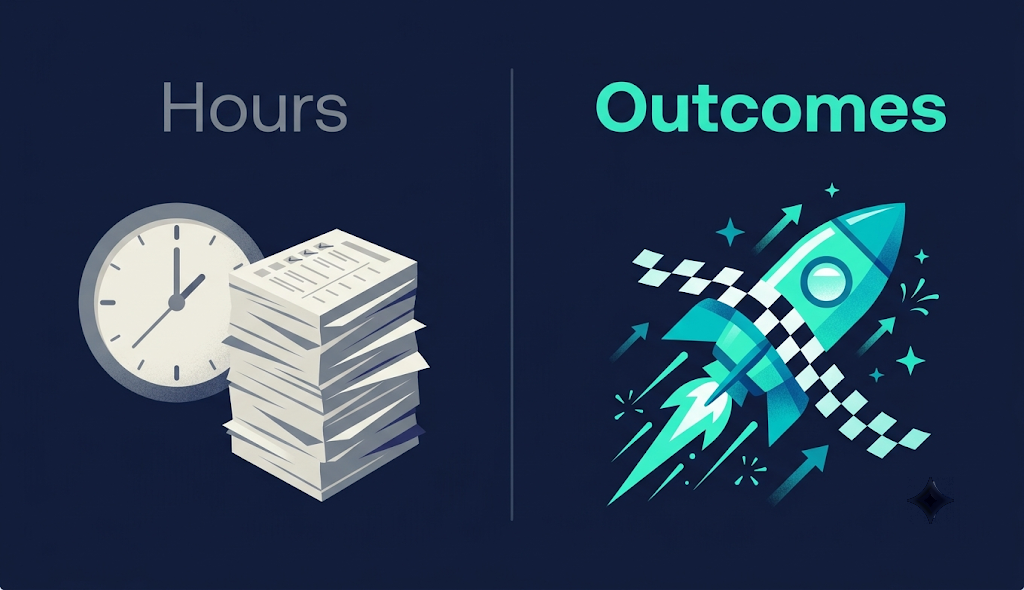
From Resource Allocation to Product Delivery
A product development partnership can be built around an agreed scope, defined deliverables, milestones, and quality expectations. Instead of focusing only on who is assigned, both sides agree on what must be achieved and what “done” looks like.
This doesn’t remove uncertainty. Software involves technical discovery, shifting requirements, and dependencies outside the engineering team’s control. But it gives you a much clearer foundation for accountability, and that makes for healthier working relationships on both sides.
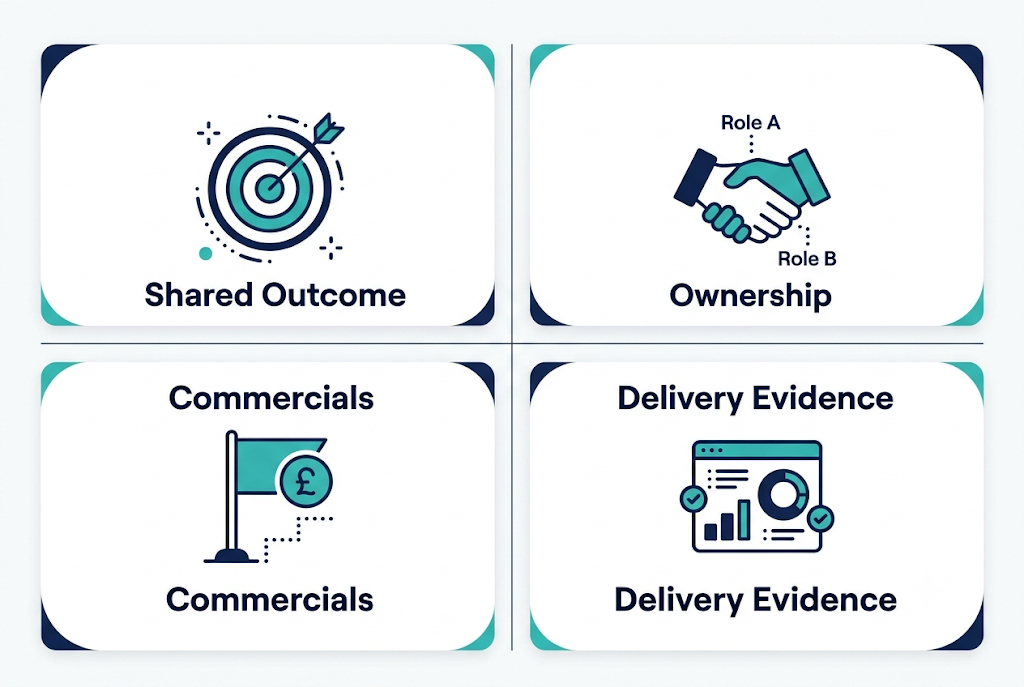
Four Elements of Outcome-Based Software Development
1. A Shared Understanding of the Outcome
Client and partner should agree on the problem being solved, the intended deliverable, the acceptance criteria, and the constraints.
“Add a new integration” is not a delivery definition. A complete scope specifies supported workflows, error handling, security requirements, test expectations, and documentation. Clarity up front prevents avoidable disagreement later.
2. Explicit Ownership of Execution
Decide who is responsible for product decisions, architecture, implementation, testing, approvals, and deployment.
The engineering partner owns the work it has committed to and raises risks early. The client keeps the decisions that belong to its product, business, or operations teams. Shared accountability only works when individual responsibilities are clear.
3. Commercials Aligned with Agreed Commitments
Outcome-based pricing can tie payments to milestones, accepted deliverables, or other agreed measures of completion. The right structure depends on how well the work can be defined in advance:
- Predictable, bounded work: deliverable-based billing often fits.
- Discovery-heavy or fast-changing work: a hybrid model usually makes more sense.
Whichever you choose, the agreement should cover scope changes, client dependencies, acceptance timelines, unexpected complexity, and anything else that affects delivery. A commercial model can’t remove uncertainty, but it can make expectations and risk allocation transparent.
4. Evidence of Delivery Performance
Accountability needs observable evidence. Useful measures include milestone completion, delivery lead time, release readiness, defect rates, escaped defects, and the predictability of commitments. The DORA research programme offers a well-regarded set of software delivery metrics to draw from.
Choose metrics to suit the engagement. They shouldn’t push teams to optimise for superficial activity at the expense of quality or customer value.
Why Dedicated Engineering Pods Support This Model
A dedicated engineering pod brings a focused team together around a defined product scope or delivery objective. Over time, the pod builds deep context about your product, works within agreed architecture and quality standards, and coordinates closely with your product organisation.
AI-native development practices, which we develop and test in our AI-Native Engineering Lab, can help a pod handle selected engineering tasks more efficiently. Experienced engineers still provide the judgement: they validate AI outputs and remain responsible for delivery quality.
The model works best when the pod has skills and authority that match its scope, access to the right stakeholders, and a realistic definition of success. You can learn more about AI-native digital product engineering at EOV Digital, or see real client outcomes in our case studies.

What to Ask Before Choosing a Partner
Don’t judge a potential partner on hourly rates, team size, or bold AI productivity claims alone. Ask questions that show how the engagement will really work:
- How will the team learn our product and roadmap?
- How will we define and accept deliverables?
- Who is responsible for technical decisions and delivery risks?
- How will AI tools be governed and code quality verified?
- How will dependencies and scope changes be handled?
- What delivery evidence will we review together?
- How will the engagement adapt if priorities or assumptions change?
The answers will tell you whether the relationship is built around staffing alone or around a genuine product development partnership.
Engineering Accountability Is Not a Billing Trick
Outcome-based software development isn’t a promise that every project will be delivered with certainty. It depends on realistic scope, capable engineers, sound technical practices, transparent governance, and a fair way to handle changing requirements.
When those foundations are in place, commercial commitments can reflect the work and outcomes that matter to both sides.
A Different Way to Build Digital Products
The future of product engineering won’t be defined by AI tools alone. It will be shaped by how organisations combine technology, engineering expertise, delivery processes, and commercial relationships.
At EOV Digital, we work as a product co-development partner. We help technology businesses move from roadmap to production through dedicated engineering pods and AI-native development practices. Our view is simple: engagements should be designed around meaningful delivery, not merely activity.
The question is no longer only how much engineering capacity you can access. It’s how effectively that capacity turns product priorities into dependable software outcomes.
Ready to explore outcome-based software development for your product? Talk to the EOV Digital team about an outcome-oriented engineering engagement.
FAQ
What is outcome-based software development? It’s an engagement model where the partner commits to agreed deliverables, milestones, and quality standards instead of simply supplying engineering hours.
Is outcome-based pricing right for every project? No. It suits well-defined, bounded work. Discovery-heavy projects often work better with a hybrid model.
How do AI tools fit into outcome-based software development? AI can speed up tasks like coding, testing, and documentation. Experienced engineers still validate the output and own delivery quality.
Leave a Reply