
Author: Souvik Brahma

  • The Engineering Capacity Crisis: Why Tech Leaders Are Shifting to Dedicated Development Teams

    The Engineering Capacity Crisis: Why Tech Leaders Are Shifting to Dedicated Development Teams

    For Chief Technology Officers and VPs of Engineering, building dedicated development teams has become the most effective way to accelerate time-to-market and modernize legacy architectures. In today’s competitive tech hubs, the mandate is uncompromising: scale securely and maintain rigorous compliance without compromising on code quality. The strategy is rarely the issue; the bottleneck is execution.

    Rapidly scaling tech companies and established enterprises alike are colliding with a severe engineering capacity crisis. The local talent crunch in major metropolitan markets makes hiring in-house slow and prohibitively expensive. When internal teams are stretched to their limits, technical debt accumulates, sprint cycles bleed past deadlines, and product roadmaps stall.

    Historically, the reflex to this problem was traditional IT outsourcing. But for modern, high-stakes digital product engineering, that model is increasingly showing its fractures. Here is why tech leaders in high-growth and highly regulated markets are moving away from transactional vendors and shifting toward dedicated development teams.

    The Hidden Costs of the Traditional Outsourcing Model

    Traditional outsourcing was built on a foundation of cost arbitrage, not strategic alignment. It operates on a “black box” methodology: you hand over a list of requirements, and weeks later, a product is delivered.

    While this might work for isolated, low-stakes projects, it introduces massive operational friction for complex SaaS platforms, secure Fintech applications, or architectures requiring strict data sovereignty.

    When tech leaders rely on standard outsourcing, they frequently encounter three critical failure points:

    • The “Resource” Trap: Traditional vendors supply generic developers, not specialized engineers. When your architecture requires nuanced understanding—such as navigating stringent data privacy frameworks or building for rapid, borderless scaling—generic coding simply isn’t enough.
    • Misaligned Incentives: External agencies are fundamentally optimized for billing hours and moving on to the next client. Their internal metrics rarely align with the long-term success, scalability, or stability of your specific product.
    • Zero Operational Transparency: Managing an external vendor often means losing visibility into daily sprint cycles, code reviews, and QA protocols. This disconnect routinely leads to extensive refactoring once the code is finally delivered.

    When your roadmap is critical, you don’t need a vendor. You need an extension of your own engineering core.

    The Strategic Shift: Building Dedicated Development Teams

    Solving the engineering capacity crisis requires a fundamental shift in how organizations view external talent. It is about insourcing capability rather than outsourcing a project.

    This is the core philosophy behind building dedicated development teams and leveraging strategic staff augmentation.

    Instead of throwing requirements over a fence, you integrate a high-performance engineering pod directly into your existing workflows. These engineers participate in your daily stand-ups, utilize your CI/CD pipelines, and adhere strictly to your internal security standards. They operate as your employees in everything but payroll.

    The Advantages of Staff Augmentation for Scaling Tech Hubs

    Transitioning to a dedicated team model provides immediate, compounding benefits for VPs of Engineering and CTOs looking to scale:

    • Seamless Cultural and Technical Alignment: Augmented staff don’t just write code; they learn your product. Because they are dedicated exclusively to your organization, they gain the vital context needed to make smart architectural decisions, rather than blindly following tickets.
    • Agile Scalability Without the Overhead: Whether you need to rapidly spin up a team to decouple a monolithic legacy system or inject specific, senior-level expertise into your current ranks, staff augmentation allows you to scale flexibly. You bypass the months-long local recruitment cycles and heavy HR overheads typical in highly competitive tech ecosystems.
    • Outcome-Driven Accountability: Because dedicated development teams are embedded in your roadmap, their success is measured by your metrics. They are invested in your time-to-market, your deployment quality, and your product milestones, ensuring absolute operational accountability.

    Strengthening Your Engineering Core with Embarking on Voyage

    Your internal engineering leadership should be focused on innovation, core architecture, and strategic growth—not bogged down by the friction of managing disconnected vendors or struggling to meet unrealistic sprint deadlines with an understaffed team.

    At EOV, we offer dedicated development teams and staff augmentation, helping organisations strengthen their engineering capacity with experienced talent aligned to their product and delivery needs.

    It would be great to understand your current priorities and see if there’s a potential fit. Contact us at info@embarkingonvoyage.com or drop a comment below.

    Latest Blog Highlight : https://embarkingonvoyage.com/blog/blazor-server-vs-webassembly-1-essential-architecture-guide-for-2026/

  • How Physical AI in Industry 4.0 is Transforming European Manufacturing

    How Physical AI in Industry 4.0 is Transforming European Manufacturing

    European manufacturing is undergoing a profound shift. The traditional era of automated assembly lines is evolving into something much more autonomous. At the heart of this transformation is the integration of Physical AI in Industry 4.0.

    For the German Mittelstand and advanced tech hubs across France and Luxembourg, adopting artificial intelligence that interacts with the physical world is no longer just a trend, it is a baseline for global competitiveness.

    Here is how smart robotics, machine learning, and stringent European data privacy laws are converging to create the factory of the future.

    What is Physical AI in the Context of Industry 4.0?

    Standard AI processes data on a screen. Physical AI, however, brings those algorithms into the real world. It empowers machines, robotic arms, and autonomous guided vehicles to perceive their physical environment, learn from it, and make real-time decisions without human intervention.

    When we integrate Physical AI in Industry 4.0, we move from mere automation to true autonomy. A standard robot repeats a programmed task; a Physical AI robot senses a misaligned part, adjusts its grip, and continues working seamlessly.

    Discover how we empower intelligent manufacturing through bespoke data solutions – here.

    3 Ways Smart Manufacturing is Evolving

    The integration of these technologies offers massive competitive advantages, particularly for regions specializing in precision engineering and logistics.

    1. Advanced Predictive Maintenance

    Downtime is incredibly expensive. Traditional Industry 4.0 sensors could tell you when a machine was overheating. Today, Physical AI analyzes vibration patterns and micro-acoustics to predict a bearing failure weeks before it happens. This allows plant managers in tech hubs like Luxembourg to order replacement parts precisely when needed, minimizing warehouse overhead.

    2. Cognitive Collaborative Robots (Cobots)

    Safety is paramount in European factories. Older industrial robots were kept in cages. Modern cobots use vision systems and spatial awareness powered by Physical AI to work safely alongside human engineers. If an operator steps too close, the cobot instantly slows down or stops, ensuring compliance with strict EU workplace safety regulations.

    3. Autonomous Supply Chain Adjustments

    Factories are dynamic environments. AGVs equipped with Physical AI do not just follow magnetic lines on the floor anymore. They actively navigate around unexpected obstacles, optimize their routes based on real-time factory floor traffic, and coordinate with inventory management systems.

    Research from leading European institutions, such as the Fraunhofer Institute for Manufacturing Engineering and Automation, consistently shows that autonomous navigation systems can reduce intralogistics bottlenecks by up to 30%, a crucial metric for the fast-paced logistics hubs in Germany and Luxembourg.

    Navigating Tech Sovereignty and GDPR

    You cannot discuss Physical AI in Industry 4.0 in Europe without addressing data privacy.

    France and Germany are pioneering “Tech Sovereignty”—the push to keep European industrial data stored and processed within EU borders. Because Physical AI relies heavily on massive datasets, ensuring this data is processed locally or on sovereign cloud networks like Gaia-X is critical for GDPR compliance.

    Manufacturers must ensure their AI vendors offer transparent algorithms and local server hosting to avoid severe regulatory fines under the European AI Act.

    Partnering with EOV to Empower Your Industry 4.0 Transition

    Integrating Physical AI into an existing factory ecosystem is not something you buy off the shelf; it requires bespoke data engineering and seamless integration. This is where EmbarkingOnVoyage steps in.

    As a global technology partner, EOV specializes in bridging the gap between legacy manufacturing hardware and next-generation AI software. We focus on empowering European enterprises with:

    • Data Science & Analytics: Structuring raw telemetry data from your factory floor so your Physical AI systems can actually learn from it.
    • Custom AI Modeling: Building proprietary machine learning algorithms tailored to your specific assembly lines, ensuring you retain full intellectual property.
    • Compliance-First Architecture: Engineering solutions that inherently respect GDPR and European tech sovereignty frameworks, keeping your data secure and localized.

    Whether you are a German Mittelstand manufacturer scaling operations or a French logistics hub optimizing supply chains, partnering with EOV provides the deep technical expertise required to turn Industry 4.0 concepts into measurable ROI.

    The Bottom Line

    The fusion of Physical AI in Industry 4.0 is redefining what is possible on the factory floor. By combining the precision of European engineering with autonomous, self-learning robotics, manufacturers can dramatically increase efficiency while maintaining strict safety and data sovereignty standards.

    Are you ready to assess your factory’s AI readiness? Click Here to speak with our product engineering experts today.

    Latest Blog Highlights: https://embarkingonvoyage.com/blog/build-vs-buy-digital-architect-dilemma/

  • How Will AI Agents and SE 3.0 Redefine Your Dev Career?

    How Will AI Agents and SE 3.0 Redefine Your Dev Career?

    The rise of AI-assisted development is not just a technological shift; it’s a fundamental career evolution. As tools like GitHub Copilot, Qodo, and Cursor evolve into sophisticated AI agents that take over the “grunt work,” the software engineering jobs of 2026 and beyond are being redefined.

    The question for developers in tech hubs from Berlin to Bangalore isn’t if roles will change, but how to pivot. Here is your roadmap to an AI agent-driven Software Development Lifecycle and how to future-proof your career.

    The Changing Landscape: From Writing Code to Expressing Intent

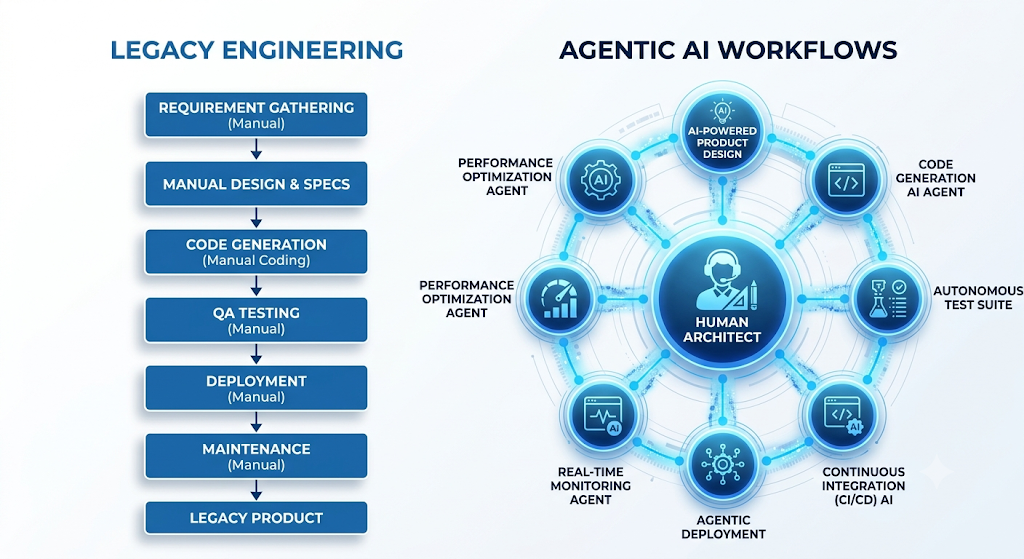
    To understand the future of software engineering, we must recognize the move toward SE 3.0; a paradigm where development is intent-first and conversational.

    • Automation of Routine SDLC: AI now handles boilerplate code generation, unit testing, and refactoring. This allows engineers to move up the value chain toward system architecture and domain logic.
    • Accelerated Product Cycles: According to industry benchmarks, an AI-enabled SDLC significantly increases velocity. In India’s competitive outsourcing market and Europe’s high-precision product sectors, speed-to-market is becoming the primary KPI.
    • Human-in-the-Loop Oversight: As generative AI handles the “how,” humans focus on the “why” prioritizing AI governance, security compliance, and ethical AI integration.

    Emerging Roles: What’s Growing vs. Shifting

    The job market is bifurcating. While traditional “syntax-heavy” roles are consolidating, new specialized positions are exploding in demand.

    The Shift in Traditional Roles

    Current RoleAI ImpactEvolution / New Title
    Junior DeveloperHigh automation of CRUD/BoilerplateAI-Supervised Associate
    Manual QA TesterAI-generated test suites & self-healing codeAI Test Strategist
    Maintenance EngineerAutomated refactoring & migration toolsLegacy-to-AI Migration Expert

    High-Growth “Future-Ready” Roles

    • AI Prompt Architect: Designing complex, multi-step “chained” prompts to orchestrate AI agents.
    • AI Code Auditor & Security Engineer: With AI-generated code comes the risk of “hallucinated” vulnerabilities. Auditors ensure AI-generated code security and compliance.
    • Agent Orchestrator: Managing a fleet of autonomous AI agents that handle deployment, monitoring, and rollback.
    • AI Ethics & Governance Lead: Particularly critical in the European market due to the EU AI Act, ensuring transparency and accountability.

    Critical Skills for the Modern Developer

    To remain a “top-tier” engineer in a world of LLM-based development, you need a blend of technical depth and “AI-native” fluencies.

    Technical Skills

    • Prompt Engineering & Agentic Workflows: Mastering the interaction between human intent and AI output.
    • Systems Thinking & Architecture: Designing modular systems that AI can easily navigate and assist in.
    • Model Introspection: Understanding AI hallucinations, bias, and how to fine-tune models on domain-specific data.
    • Cybersecurity & AIBOM Management: Managing the “AI Bill of Materials” to ensure software supply chain security.

    Soft Skills (The Human Advantage)

    • Critical Skepticism: The ability to audit and challenge AI outputs rather than blindly accepting them.
    • Domain Expertise: Deep knowledge of specific verticals like FinTech, HealthTech, or IoT where business logic is too complex for general AI.

    How to Future-Proof Your Career (Action Plan)

    Don’t wait for your organization to mandate change. Be the driver of AI transformation.

    • Adopt the Tools Early: Integrate Cursor, Qodo, or GitHub Copilot into your daily workflow now.
    • Build an “AI Portfolio”: Document how you use AI to solve complex architectural problems, not just small snippets.
    • Specialize in a Vertical: Whether it’s embedded systems in Germany or digital public infrastructure in India, domain-specific context is your greatest moat.
    • Master AI Oversight: Learn the basics of MLOps and AI security auditing.
    • Stay “Hands-On” with Fundamentals: AI is a co-pilot, not the captain. You still need to understand data structures, algorithms, and debugging to catch AI errors.

    Challenges: The Ethical and Professional Risks

    The transition to AI-native engineering isn’t without friction:

    • Deskilling: The risk of losing core debugging intuition through over-reliance.
    • Accountability: In an “AI-wrote-it” world, the human engineer remains the legal and ethical point of responsibility.
    • Data Sovereignty: Especially relevant for European enterprises, ensuring AI tools respect strict data privacy and GDPR standards.

    Conclusion: The Era of the “10x Architect”

    The future of software jobs is not about extinction; it is about empowerment. By 2030, 70% of coding will likely be AI-assisted, turning the modern developer into an “Agent Boss” – a strategist who orchestrates AI power to solve human problems.

    GitHub (The New Stack): How GitHub Copilot Reshapes Developer Collaboration (2026 Study)

    Latest Blog Highlights: https://embarkingonvoyage.com/blog/blazor-server-production-checklist/