
Author: Souvik Brahma

  • Agentic AI for Enterprise Modernization: The 2026 Guide

    Agentic AI for Enterprise Modernization: The 2026 Guide

    For the past few years, digital transformation has been heavily focused on cloud migrations and bolting on generative AI chat interfaces. While helpful, these solutions often act as static assistants rather than active problem solvers.

    The next frontier of digital product engineering isn’t just about software that answers questions; it’s about systems that take action. If your organization is looking to reduce technical debt, optimize workflows, and drive strict operational transparency, leveraging agentic ai for enterprise modernization is no longer optional – it is a competitive necessity.

    The industry is scaling rapidly toward this paradigm. By 2028, 33% of enterprise software applications will include agentic AI. Furthermore, 80% of automation leaders are expected to accelerate AI agent investments over 2025.

    Why Choose Agentic AI for Enterprise Modernization?

    Unlike standard Large Language Models (LLMs) that rely entirely on human prompts to generate text or code, Agentic AI systems possess autonomous reasoning capabilities.

    An AI “agent” can understand a complex goal, break it down into sequential tasks, interact with multiple enterprise databases (ERPs, CRMs, legacy mainframes), execute the necessary steps, and evaluate the outcome all with minimal human intervention. Agentic AI gives AI new levels of agency, allowing it to select what actions to take for achieving particular outcomes.

    When you deploy agentic ai for enterprise modernization, you shift your entire technical landscape from passive automation to active, intelligent orchestration.

    3 Ways Agentic AI Accelerates Enterprise Modernization

    Enterprise AI spending is facing increased financial scrutiny in 2026, with CFOs across industries imposing budget controls and demanding measurable returns from AI projects. Modernizing legacy architecture is traditionally fraught with high costs and operational downtime. Agentic AI mitigates these risks by injecting intelligence into the very fabric of your engineering lifecycle, ensuring a clear ROI.

    1. Autonomous Legacy Code Refactoring & De-Risking
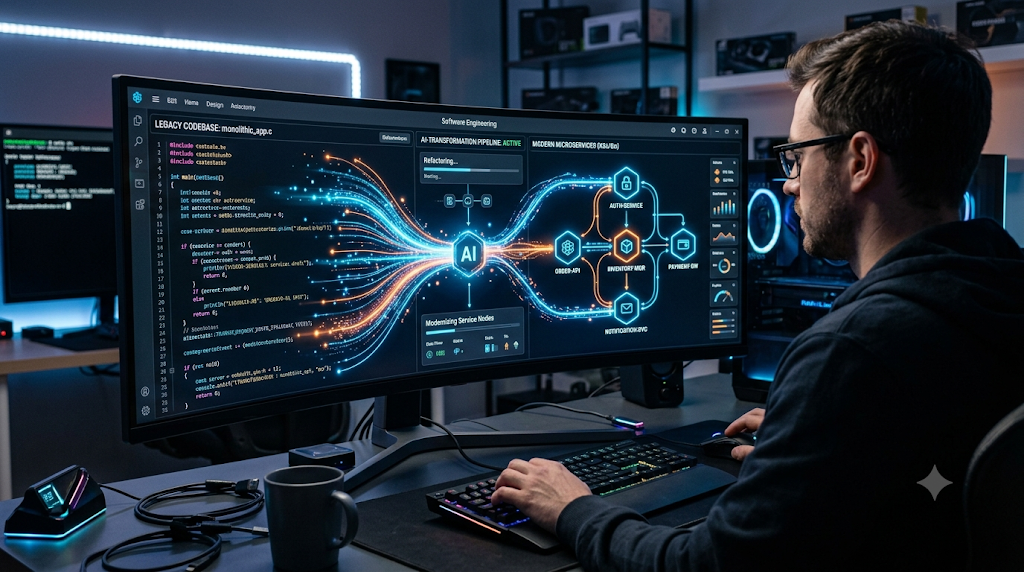
    Agentic AI legacy code refactoring into microservices

    One of the largest bottlenecks in enterprise modernization is untangling decades-old, spaghettified monolithic code (such as COBOL, outdated Java, or legacy .NET). Traditionally, this requires massive teams of developers to manually map dependencies, read undocumented logic, and rewrite code—a process notorious for scope creep and the risk of breaking core business operations.

    Agentic AI completely shifts this paradigm by deploying specialized, autonomous agents to handle the heavy lifting:

    • Discovery and Mapping Agents: Instead of relying on outdated documentation, AI agents autonomously crawl the legacy codebase to map data flows, identify deprecated libraries, and flag security vulnerabilities.
    • Translation and Refactoring Agents: Once the logic is mapped, Agentic workflows can autonomously translate monolithic scripts into clean, modern, microservices-based architectures (e.g., Python, Node.js, or Go).
    • Autonomous Quality Assurance (QA): Perhaps the most critical step, testing agents autonomously generate thousands of unit and regression tests to ensure the newly refactored code maintains absolute business logic parity with the old system.

    By automating these highly manual tasks, enterprises can reduce developer hours by magnitudes and accelerate their time-to-market.

    More importantly, this autonomous refactoring transforms a rigid, isolated system into a flexible, AI-ready ecosystem. For instance, once a healthcare or enterprise backend is modernized through these workflows, it becomes infinitely easier to plug in advanced, specialized AI products like EOV Navigator for clinical guideline assistance or EOV Pulse seamlessly integrating cutting-edge intelligence into what was once a legacy bottleneck.

    2. Self-Healing Systems and Operational Transparency

    Enterprise leaders require data-driven insights to measure the success of a digital transformation. Agentic AI doesn’t just run processes; it monitors them. By establishing continuous feedback loops, these agents can detect anomalies in system performance, autonomously trigger remediation protocols (self-healing), and generate real-time KPI dashboards for leadership, ensuring absolute operational transparency.

    3. Intelligent Workflow Orchestration

    Modernization isn’t just about code; it’s about business processes. Agentic AI can bridge the gap between siloed legacy systems and modern SaaS platforms. For example, an agent can autonomously reconcile financial data between an outdated on-premise ledger and a modern cloud-based analytics tool, handling edge cases and errors dynamically without requiring a human to write rigid API middleware.

    The AI-First Engineering Paradigm

    Adopting Agentic AI requires a fundamental shift in how digital products are built. It requires an AI-First Engineering mindset.

    This means architecting your data infrastructure, APIs, and security protocols specifically to support autonomous agents. It involves creating robust orchestration layers where multiple specialized AI agents (e.g., a data retrieval agent, a logical reasoning agent, and an execution agent) can collaborate seamlessly.

    How EOV Can Future-Proof Your Enterprise

    At EOV, we don’t just build software; we engineer intelligent systems designed for commercial impact. Our approach to Agentic AI Enterprise Development and Modernization is built on a foundation of agility, data-centricity, and measurable ROI.

    Whether you are looking to untangle legacy monolithic architecture or implement autonomous workflows that drive down operational costs, our specialized engineering pods are equipped to guide your transition into the AI-first era.

    Ready to move beyond the AI hype and start building autonomous enterprise systems? Contact EOV today to discuss how our modernization frameworks can accelerate your technical roadmap.

  • 2026 Guide: Top 5 Best Offshore Product Development in India

    2026 Guide: Top 5 Best Offshore Product Development in India

    The era of traditional IT outsourcing is over. Today, global companies aren’t just looking for cheap labor to maintain legacy systems; they are seeking strategic partners capable of driving innovation through AI-first engineering and autonomous systems.

    As businesses pivot toward building smarter, faster, and more scalable digital platforms, choosing the right engineering partner is critical. If you are evaluating the Top 5 best offshore product development in India, you need to look beyond sheer headcount and focus on agility, technical depth, and expertise in emerging technologies like Agentic AI.

    In this guide, we break down the top five players shaping the offshore product engineering landscape in India this year.

    Why India Remains the Hub for Product Engineering

    India’s tech ecosystem has evolved from a back-office support hub into a global epicenter for deep tech and product innovation. According to industry reports from Gartner, global IT spending is increasingly directed toward software and IT services, with India capturing a massive share of complex engineering workloads.

    The primary drivers for this shift include:

    • AI-First Talent: A massive influx of engineers upskilling in LLMs, machine learning, and autonomous Agentic workflows.
    • Time-to-Market Speed: Agile methodologies that allow for continuous delivery and rapid prototyping.
    • Cost-Effective Innovation: Delivering Silicon Valley-level architecture without the massive overhead.

    The Top 5 Best Offshore Product Development in India

    To help you navigate the crowded market, here are the top 5 partners, categorized by their core strengths and ideal client profiles.

    1. Embarking On Voyage (EOV)

    Best For: Specialized Digital Product Engineering & Agentic AI Operations

    While massive IT conglomerates focus on volume, Embarking On Voyage (EOV) focuses on cutting-edge product innovation. Headquartered in Pune, EOV has carved out a unique niche as the go-to partner for companies that need agile, AI-first product development.

    Instead of just writing code, EOV builds intelligent systems. By integrating Agentic AI operations into the core of their engineering lifecycle, they help businesses automate complex workflows, reduce technical debt, and launch highly scalable digital products faster than traditional agencies. If you are a scale-up or an enterprise looking for a deeply integrated, highly specialized engineering pod, EOV is the premium choice.

    2. Persistent Systems

    Best For: Cloud Native and Software Engineering

    Persistent Systems is a veteran in the outsourced software product development space. They have a strong reputation for helping established ISVs (Independent Software Vendors) modernize their legacy applications. They are an excellent choice for large-scale enterprise cloud migrations and traditional software engineering, though they may lack the nimble agility of specialized boutique firms.

    3. Infosys

    Best For: Massive Enterprise IT Transformation

    When it comes to scale, Infosys is unavoidable. As a global powerhouse, they have the resources to deploy thousands of engineers across the globe. They are best suited for Fortune 500 companies that need to execute multi-year, multi-billion-dollar digital transformation projects. However, for mid-market companies or fast-paced product teams, their bureaucratic layers can sometimes slow down rapid prototyping.

    4. Tata Consultancy Services (TCS)

    Best For: Global IT Operations and BPO

    TCS is synonymous with Indian offshore IT. They offer end-to-end services from basic BPO to complex enterprise software development. Their strength lies in their standardized processes and unmatched ability to scale teams overnight. They are ideal for massive corporations that prioritize stability and standardized compliance over bleeding-edge product innovation.

    5. HCLTech

    Best For: Hardware & Embedded Systems Engineering

    HCLTech has a rich history in engineering and R&D (ER&D). They are particularly strong in the IoT, aerospace, and semiconductor spaces. If your product development requires deep integration between physical hardware and embedded software, HCLTech provides robust offshore engineering labs.

    How to Choose the Right Offshore Engineering Partner

    Finding the right fit among the Top 5 best offshore product development in India comes down to your specific business stage and goals. Ask yourself:

    1. Do you need innovation or maintenance? If you are building a modern, AI-driven platform from scratch, choose a specialized partner like EOV.
    2. What is your communication culture? Agile product development requires overlapping time zones and seamless, consultative communication—not just ticket-taking.
    3. Are they AI-ready? Ensure your partner understands how to integrate modern AI architecture, not just traditional cloud infrastructure.

    Ready to Build Your Next Digital Product?

    The right offshore partner doesn’t just build what you ask for; they tell you what you should be building. At EOV, we pride ourselves on being commercially-driven engineering partners.

    Contact EOV today to discuss how our Agentic AI-powered engineering pods can accelerate your product roadmap.

  • Optimizing Org Operations: How Agentic AI Closes Requirement Gaps and Accelerates Delivery

    Optimizing Org Operations: How Agentic AI Closes Requirement Gaps and Accelerates Delivery

    When enterprises search for the best offshore product engineering company in india, they are fundamentally looking for a partner that can eliminate operational friction right from the start. In enterprise software development, the most expensive mistakes are rarely made in the code itself; rather, they are made during the initial discovery and requirement-gathering phases. When critical details from stakeholder meetings are lost in translation, technical requirements drift, and delivery timelines inevitably stretch.

    To solve this systemic issue, organizations must move beyond manual note-taking and standard project management. True Org Operations Optimization requires an intelligent system capable of actively participating in the product lifecycle.

    By leveraging Agentic AI using GenAI technology, we have engineered a sophisticated Requirement Analysis and Reporting Agent designed to eliminate friction, bridge communication gaps, and aggressively minimize delivery time, moving focus away from vanity metrics and toward genuine, outcome-driven engineering success.

    Intelligent Requirement Gathering and Analysis

    At the core of our approach is an Agentic AI designed to completely streamline requirement gathering and analysis. Instead of relying on manual transcription—which is prone to human bias and error—this agent actively listens to and processes complex stakeholder discussions in real-time.

    Its primary functions during the initial stages include:

    • Summarizing the Requirement Conversation: It autonomously distills hours of highly technical and strategic business discussions into clear, actionable, and structured summaries.
    • Timely Report Generation: It executes immediate report generation based on the timely conversation, ensuring all stakeholders from the C-suite to the lead developers have immediate access to aligned documentation.
    • Automated Minutes of Meeting (MoM): It standardizes and automatically distributes highly accurate MoMs, ensuring no technical specification or business objective is overlooked before engineering begins.

    Identifying Gaps and Deepening Context

    The true enterprise value of an Agentic AI lies in its ability to think critically about the data it processes. Human error often leads to unspoken assumptions, poorly articulated needs, or conflicting features. Our reporting agent is specifically engineered to dynamically identify gaps in verbal and written communication.

    When the AI detects missing technical specifications or logical inconsistencies within a proposed feature set, it doesn’t just passively record the error. It takes proactive, autonomous steps to identify the requirement gap:

    • Dynamic Questionnaires: The agent can autonomously generate a questionnaire to get in-depth requirement analysis, prompting stakeholders to clarify ambiguous points before a single line of code is written or a sprint is planned.
    • Creating Action Plans: Once the requirements are fully solidified and all gaps are closed, the AI synthesizes the data to create an action plan, setting a clear, structured, and technically sound roadmap for the engineering team.

    By catching these gaps early in the discovery phase, we drastically minimize delivery time and prevent the costly mid-sprint pivots that plague traditional offshore engagements.

    Driving Development with Ongoing AI Reporting

    Operational optimization doesn’t stop once the initial requirements are gathered. To maintain peak organizational operations and ensure continuous delivery, the AI transitions from a discovery tool into an active development partner, overseen by frameworks like EOV Flow.

    Throughout the engineering lifecycle, the agent continues to provide immense value through:

    • Weekly Development Reports: It autonomously generates comprehensive MoM and weekly development reports, keeping all global stakeholders aligned on sprint progress, completed user stories, and blocking issues.
    • Strategic Team Advice: Going far beyond basic status updates, the Agentic AI analyzes sprint velocity and bottleneck data to provide advice to focus on weak areas, empowering development teams to continuously refine their workflows and improve output quality.

    Partner with AI-First Engineering Experts

    Achieving genuine operational efficiency requires more than just integrating standard GenAI wrappers; it requires custom, outcome-driven Agentic workflows tailored to your specific organizational needs.

    Working with the best offshore product engineering company in india ensures that your digital products are built on a foundation of absolute clarity. By allowing AI to handle rigorous requirement analysis and ongoing reporting, your teams can focus entirely on what matters most: shipping revenue-generating products faster.

  • The Engineering Capacity Crisis: Why Tech Leaders Are Shifting to Dedicated Development Teams

    The Engineering Capacity Crisis: Why Tech Leaders Are Shifting to Dedicated Development Teams

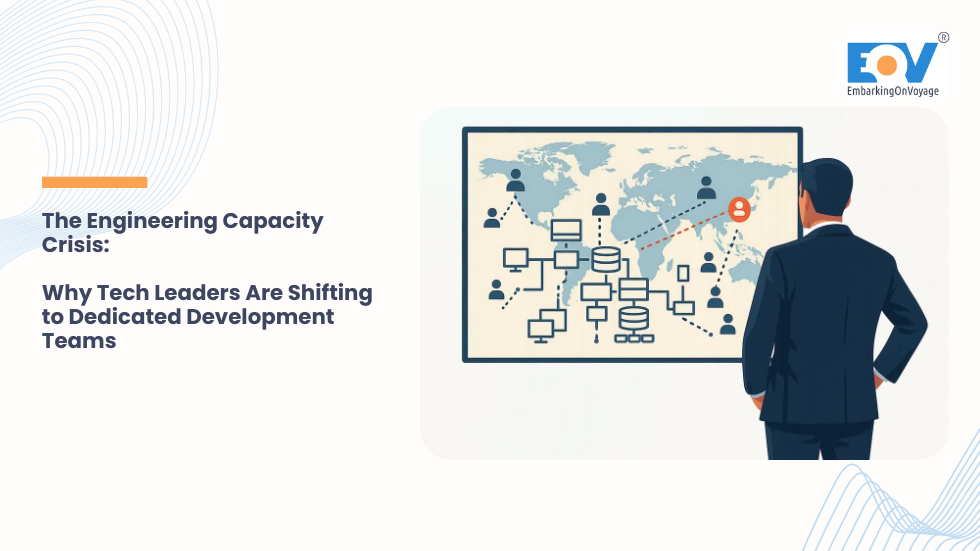
    For Chief Technology Officers and VPs of Engineering, building dedicated development teams has become the most effective way to accelerate time-to-market and modernize legacy architectures. In today’s competitive tech hubs, the mandate is uncompromising: scale securely and maintain rigorous compliance without compromising on code quality. The strategy is rarely the issue; the bottleneck is execution.

    Rapidly scaling tech companies and established enterprises alike are colliding with a severe engineering capacity crisis. The local talent crunch in major metropolitan markets makes hiring in-house slow and prohibitively expensive. When internal teams are stretched to their limits, technical debt accumulates, sprint cycles bleed past deadlines, and product roadmaps stall.

    Historically, the reflex to this problem was traditional IT outsourcing. But for modern, high-stakes digital product engineering, that model is increasingly showing its fractures. Here is why tech leaders in high-growth and highly regulated markets are moving away from transactional vendors and shifting toward dedicated development teams.

    The Hidden Costs of the Traditional Outsourcing Model

    Traditional outsourcing was built on a foundation of cost arbitrage, not strategic alignment. It operates on a “black box” methodology: you hand over a list of requirements, and weeks later, a product is delivered.

    While this might work for isolated, low-stakes projects, it introduces massive operational friction for complex SaaS platforms, secure Fintech applications, or architectures requiring strict data sovereignty.

    When tech leaders rely on standard outsourcing, they frequently encounter three critical failure points:

    • The “Resource” Trap: Traditional vendors supply generic developers, not specialized engineers. When your architecture requires nuanced understanding—such as navigating stringent data privacy frameworks or building for rapid, borderless scaling—generic coding simply isn’t enough.
    • Misaligned Incentives: External agencies are fundamentally optimized for billing hours and moving on to the next client. Their internal metrics rarely align with the long-term success, scalability, or stability of your specific product.
    • Zero Operational Transparency: Managing an external vendor often means losing visibility into daily sprint cycles, code reviews, and QA protocols. This disconnect routinely leads to extensive refactoring once the code is finally delivered.

    When your roadmap is critical, you don’t need a vendor. You need an extension of your own engineering core.

    The Strategic Shift: Building Dedicated Development Teams

    Solving the engineering capacity crisis requires a fundamental shift in how organizations view external talent. It is about insourcing capability rather than outsourcing a project.

    This is the core philosophy behind building dedicated development teams and leveraging strategic staff augmentation.

    Instead of throwing requirements over a fence, you integrate a high-performance engineering pod directly into your existing workflows. These engineers participate in your daily stand-ups, utilize your CI/CD pipelines, and adhere strictly to your internal security standards. They operate as your employees in everything but payroll.

    The Advantages of Staff Augmentation for Scaling Tech Hubs

    Transitioning to a dedicated team model provides immediate, compounding benefits for VPs of Engineering and CTOs looking to scale:

    • Seamless Cultural and Technical Alignment: Augmented staff don’t just write code; they learn your product. Because they are dedicated exclusively to your organization, they gain the vital context needed to make smart architectural decisions, rather than blindly following tickets.
    • Agile Scalability Without the Overhead: Whether you need to rapidly spin up a team to decouple a monolithic legacy system or inject specific, senior-level expertise into your current ranks, staff augmentation allows you to scale flexibly. You bypass the months-long local recruitment cycles and heavy HR overheads typical in highly competitive tech ecosystems.
    • Outcome-Driven Accountability: Because dedicated development teams are embedded in your roadmap, their success is measured by your metrics. They are invested in your time-to-market, your deployment quality, and your product milestones, ensuring absolute operational accountability.

    Strengthening Your Engineering Core with Embarking on Voyage

    Your internal engineering leadership should be focused on innovation, core architecture, and strategic growth—not bogged down by the friction of managing disconnected vendors or struggling to meet unrealistic sprint deadlines with an understaffed team.

    At EOV, we offer dedicated development teams and staff augmentation, helping organisations strengthen their engineering capacity with experienced talent aligned to their product and delivery needs.

    It would be great to understand your current priorities and see if there’s a potential fit. Contact us at info@embarkingonvoyage.com or drop a comment below.

    Latest Blog Highlight : https://embarkingonvoyage.com/blog/blazor-server-vs-webassembly-1-essential-architecture-guide-for-2026/

  • How Physical AI in Industry 4.0 is Transforming European Manufacturing

    How Physical AI in Industry 4.0 is Transforming European Manufacturing

    European manufacturing is undergoing a profound shift. The traditional era of automated assembly lines is evolving into something much more autonomous. At the heart of this transformation is the integration of Physical AI in Industry 4.0.

    For the German Mittelstand and advanced tech hubs across France and Luxembourg, adopting artificial intelligence that interacts with the physical world is no longer just a trend, it is a baseline for global competitiveness.

    Here is how smart robotics, machine learning, and stringent European data privacy laws are converging to create the factory of the future.

    What is Physical AI in the Context of Industry 4.0?

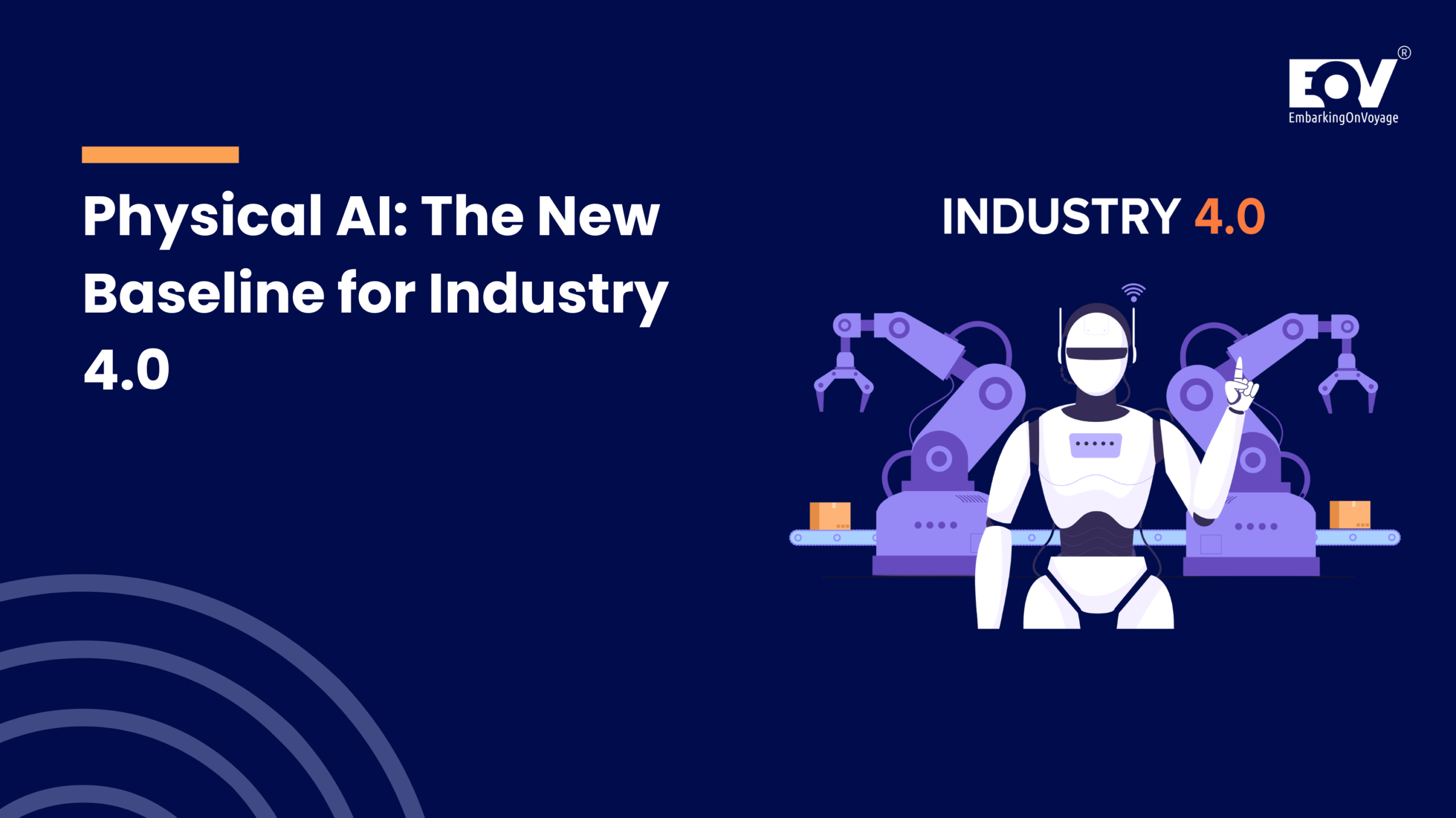
    Standard AI processes data on a screen. Physical AI, however, brings those algorithms into the real world. It empowers machines, robotic arms, and autonomous guided vehicles to perceive their physical environment, learn from it, and make real-time decisions without human intervention.

    When we integrate Physical AI in Industry 4.0, we move from mere automation to true autonomy. A standard robot repeats a programmed task; a Physical AI robot senses a misaligned part, adjusts its grip, and continues working seamlessly.

    Discover how we empower intelligent manufacturing through bespoke data solutions – here.

    3 Ways Smart Manufacturing is Evolving

    The integration of these technologies offers massive competitive advantages, particularly for regions specializing in precision engineering and logistics.

    1. Advanced Predictive Maintenance

    Downtime is incredibly expensive. Traditional Industry 4.0 sensors could tell you when a machine was overheating. Today, Physical AI analyzes vibration patterns and micro-acoustics to predict a bearing failure weeks before it happens. This allows plant managers in tech hubs like Luxembourg to order replacement parts precisely when needed, minimizing warehouse overhead.

    2. Cognitive Collaborative Robots (Cobots)

    Safety is paramount in European factories. Older industrial robots were kept in cages. Modern cobots use vision systems and spatial awareness powered by Physical AI to work safely alongside human engineers. If an operator steps too close, the cobot instantly slows down or stops, ensuring compliance with strict EU workplace safety regulations.

    3. Autonomous Supply Chain Adjustments

    Factories are dynamic environments. AGVs equipped with Physical AI do not just follow magnetic lines on the floor anymore. They actively navigate around unexpected obstacles, optimize their routes based on real-time factory floor traffic, and coordinate with inventory management systems.

    Research from leading European institutions, such as the Fraunhofer Institute for Manufacturing Engineering and Automation, consistently shows that autonomous navigation systems can reduce intralogistics bottlenecks by up to 30%, a crucial metric for the fast-paced logistics hubs in Germany and Luxembourg.

    Navigating Tech Sovereignty and GDPR

    You cannot discuss Physical AI in Industry 4.0 in Europe without addressing data privacy.

    France and Germany are pioneering “Tech Sovereignty”—the push to keep European industrial data stored and processed within EU borders. Because Physical AI relies heavily on massive datasets, ensuring this data is processed locally or on sovereign cloud networks like Gaia-X is critical for GDPR compliance.

    Manufacturers must ensure their AI vendors offer transparent algorithms and local server hosting to avoid severe regulatory fines under the European AI Act.

    Partnering with EOV to Empower Your Industry 4.0 Transition

    Integrating Physical AI into an existing factory ecosystem is not something you buy off the shelf; it requires bespoke data engineering and seamless integration. This is where EmbarkingOnVoyage steps in.

    As a global technology partner, EOV specializes in bridging the gap between legacy manufacturing hardware and next-generation AI software. We focus on empowering European enterprises with:

    • Data Science & Analytics: Structuring raw telemetry data from your factory floor so your Physical AI systems can actually learn from it.
    • Custom AI Modeling: Building proprietary machine learning algorithms tailored to your specific assembly lines, ensuring you retain full intellectual property.
    • Compliance-First Architecture: Engineering solutions that inherently respect GDPR and European tech sovereignty frameworks, keeping your data secure and localized.

    Whether you are a German Mittelstand manufacturer scaling operations or a French logistics hub optimizing supply chains, partnering with EOV provides the deep technical expertise required to turn Industry 4.0 concepts into measurable ROI.

    The Bottom Line

    The fusion of Physical AI in Industry 4.0 is redefining what is possible on the factory floor. By combining the precision of European engineering with autonomous, self-learning robotics, manufacturers can dramatically increase efficiency while maintaining strict safety and data sovereignty standards.

    Are you ready to assess your factory’s AI readiness? Click Here to speak with our product engineering experts today.

    Latest Blog Highlights: https://embarkingonvoyage.com/blog/build-vs-buy-digital-architect-dilemma/

  • How Will AI Agents and SE 3.0 Redefine Your Dev Career?

    How Will AI Agents and SE 3.0 Redefine Your Dev Career?

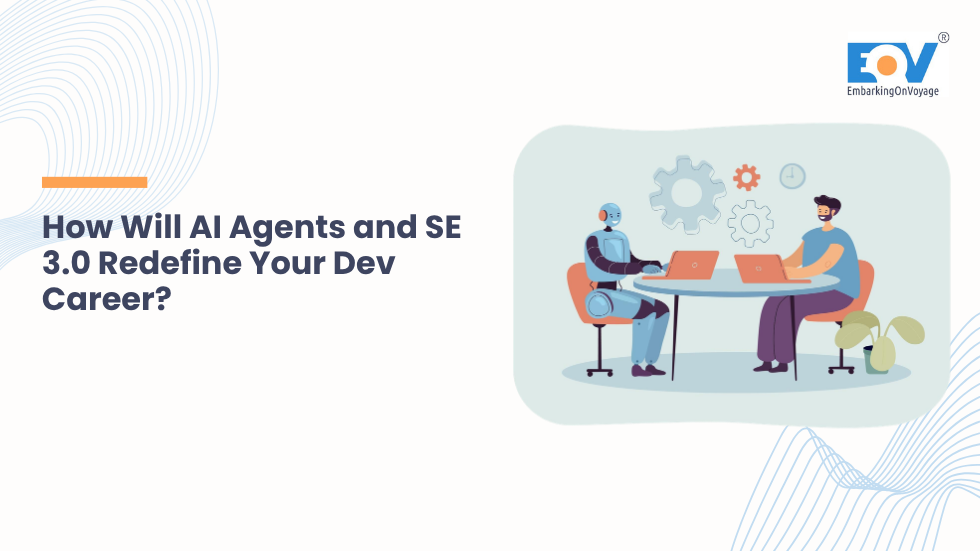
    The rise of AI-assisted development is not just a technological shift; it’s a fundamental career evolution. As tools like GitHub Copilot, Qodo, and Cursor evolve into sophisticated AI agents that take over the “grunt work,” the software engineering jobs of 2026 and beyond are being redefined.

    The question for developers in tech hubs from Berlin to Bangalore isn’t if roles will change, but how to pivot. Here is your roadmap to an AI agent-driven Software Development Lifecycle and how to future-proof your career.

    The Changing Landscape: From Writing Code to Expressing Intent

    To understand the future of software engineering, we must recognize the move toward SE 3.0; a paradigm where development is intent-first and conversational.

    • Automation of Routine SDLC: AI now handles boilerplate code generation, unit testing, and refactoring. This allows engineers to move up the value chain toward system architecture and domain logic.
    • Accelerated Product Cycles: According to industry benchmarks, an AI-enabled SDLC significantly increases velocity. In India’s competitive outsourcing market and Europe’s high-precision product sectors, speed-to-market is becoming the primary KPI.
    • Human-in-the-Loop Oversight: As generative AI handles the “how,” humans focus on the “why” prioritizing AI governance, security compliance, and ethical AI integration.

    Emerging Roles: What’s Growing vs. Shifting

    The job market is bifurcating. While traditional “syntax-heavy” roles are consolidating, new specialized positions are exploding in demand.

    The Shift in Traditional Roles

    Current RoleAI ImpactEvolution / New Title
    Junior DeveloperHigh automation of CRUD/BoilerplateAI-Supervised Associate
    Manual QA TesterAI-generated test suites & self-healing codeAI Test Strategist
    Maintenance EngineerAutomated refactoring & migration toolsLegacy-to-AI Migration Expert

    High-Growth “Future-Ready” Roles

    • AI Prompt Architect: Designing complex, multi-step “chained” prompts to orchestrate AI agents.
    • AI Code Auditor & Security Engineer: With AI-generated code comes the risk of “hallucinated” vulnerabilities. Auditors ensure AI-generated code security and compliance.
    • Agent Orchestrator: Managing a fleet of autonomous AI agents that handle deployment, monitoring, and rollback.
    • AI Ethics & Governance Lead: Particularly critical in the European market due to the EU AI Act, ensuring transparency and accountability.

    Critical Skills for the Modern Developer

    To remain a “top-tier” engineer in a world of LLM-based development, you need a blend of technical depth and “AI-native” fluencies.

    Technical Skills

    • Prompt Engineering & Agentic Workflows: Mastering the interaction between human intent and AI output.
    • Systems Thinking & Architecture: Designing modular systems that AI can easily navigate and assist in.
    • Model Introspection: Understanding AI hallucinations, bias, and how to fine-tune models on domain-specific data.
    • Cybersecurity & AIBOM Management: Managing the “AI Bill of Materials” to ensure software supply chain security.

    Soft Skills (The Human Advantage)

    • Critical Skepticism: The ability to audit and challenge AI outputs rather than blindly accepting them.
    • Domain Expertise: Deep knowledge of specific verticals like FinTech, HealthTech, or IoT where business logic is too complex for general AI.

    How to Future-Proof Your Career (Action Plan)

    Don’t wait for your organization to mandate change. Be the driver of AI transformation.

    • Adopt the Tools Early: Integrate Cursor, Qodo, or GitHub Copilot into your daily workflow now.
    • Build an “AI Portfolio”: Document how you use AI to solve complex architectural problems, not just small snippets.
    • Specialize in a Vertical: Whether it’s embedded systems in Germany or digital public infrastructure in India, domain-specific context is your greatest moat.
    • Master AI Oversight: Learn the basics of MLOps and AI security auditing.
    • Stay “Hands-On” with Fundamentals: AI is a co-pilot, not the captain. You still need to understand data structures, algorithms, and debugging to catch AI errors.

    Challenges: The Ethical and Professional Risks

    The transition to AI-native engineering isn’t without friction:

    • Deskilling: The risk of losing core debugging intuition through over-reliance.
    • Accountability: In an “AI-wrote-it” world, the human engineer remains the legal and ethical point of responsibility.
    • Data Sovereignty: Especially relevant for European enterprises, ensuring AI tools respect strict data privacy and GDPR standards.

    Conclusion: The Era of the “10x Architect”

    The future of software jobs is not about extinction; it is about empowerment. By 2030, 70% of coding will likely be AI-assisted, turning the modern developer into an “Agent Boss” – a strategist who orchestrates AI power to solve human problems.

    GitHub (The New Stack): How GitHub Copilot Reshapes Developer Collaboration (2026 Study)

    Latest Blog Highlights: https://embarkingonvoyage.com/blog/blazor-server-production-checklist/