



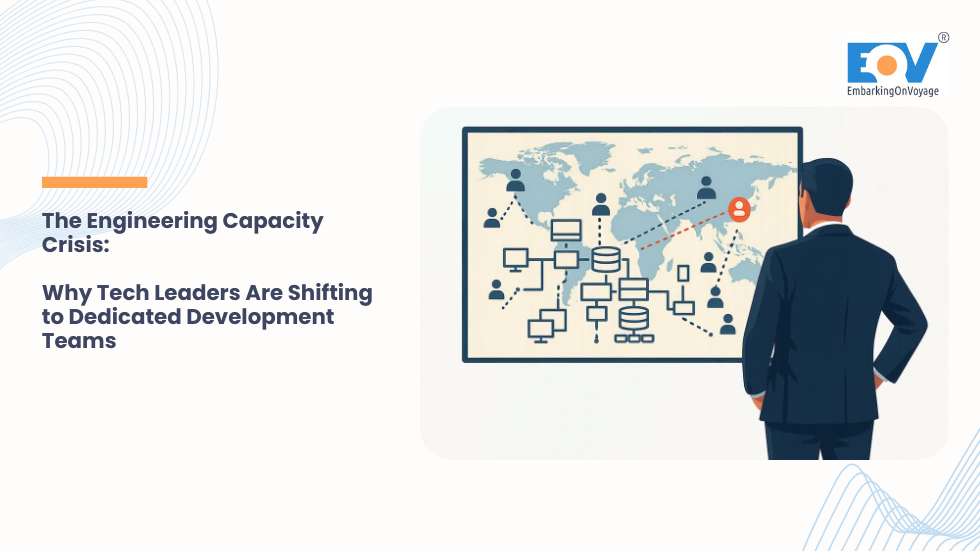
For Chief Technology Officers and VPs of Engineering, building dedicated development teams has become the most effective way to accelerate time-to-market and modernize legacy architectures. In today’s competitive tech hubs, the mandate is uncompromising: scale securely and maintain rigorous compliance without compromising on code quality. The strategy is rarely the issue; the bottleneck is execution.
Rapidly scaling tech companies and established enterprises alike are colliding with a severe engineering capacity crisis. The local talent crunch in major metropolitan markets makes hiring in-house slow and prohibitively expensive. When internal teams are stretched to their limits, technical debt accumulates, sprint cycles bleed past deadlines, and product roadmaps stall.
Historically, the reflex to this problem was traditional IT outsourcing. But for modern, high-stakes digital product engineering, that model is increasingly showing its fractures. Here is why tech leaders in high-growth and highly regulated markets are moving away from transactional vendors and shifting toward dedicated development teams.
The Hidden Costs of the Traditional Outsourcing Model
Traditional outsourcing was built on a foundation of cost arbitrage, not strategic alignment. It operates on a “black box” methodology: you hand over a list of requirements, and weeks later, a product is delivered.
While this might work for isolated, low-stakes projects, it introduces massive operational friction for complex SaaS platforms, secure Fintech applications, or architectures requiring strict data sovereignty.
When tech leaders rely on standard outsourcing, they frequently encounter three critical failure points:
- The “Resource” Trap: Traditional vendors supply generic developers, not specialized engineers. When your architecture requires nuanced understanding—such as navigating stringent data privacy frameworks or building for rapid, borderless scaling—generic coding simply isn’t enough.
- Misaligned Incentives: External agencies are fundamentally optimized for billing hours and moving on to the next client. Their internal metrics rarely align with the long-term success, scalability, or stability of your specific product.
- Zero Operational Transparency: Managing an external vendor often means losing visibility into daily sprint cycles, code reviews, and QA protocols. This disconnect routinely leads to extensive refactoring once the code is finally delivered.
When your roadmap is critical, you don’t need a vendor. You need an extension of your own engineering core.
The Strategic Shift: Building Dedicated Development Teams
Solving the engineering capacity crisis requires a fundamental shift in how organizations view external talent. It is about insourcing capability rather than outsourcing a project.
This is the core philosophy behind building dedicated development teams and leveraging strategic staff augmentation.
Instead of throwing requirements over a fence, you integrate a high-performance engineering pod directly into your existing workflows. These engineers participate in your daily stand-ups, utilize your CI/CD pipelines, and adhere strictly to your internal security standards. They operate as your employees in everything but payroll.
The Advantages of Staff Augmentation for Scaling Tech Hubs
Transitioning to a dedicated team model provides immediate, compounding benefits for VPs of Engineering and CTOs looking to scale:
- Seamless Cultural and Technical Alignment: Augmented staff don’t just write code; they learn your product. Because they are dedicated exclusively to your organization, they gain the vital context needed to make smart architectural decisions, rather than blindly following tickets.
- Agile Scalability Without the Overhead: Whether you need to rapidly spin up a team to decouple a monolithic legacy system or inject specific, senior-level expertise into your current ranks, staff augmentation allows you to scale flexibly. You bypass the months-long local recruitment cycles and heavy HR overheads typical in highly competitive tech ecosystems.
- Outcome-Driven Accountability: Because dedicated development teams are embedded in your roadmap, their success is measured by your metrics. They are invested in your time-to-market, your deployment quality, and your product milestones, ensuring absolute operational accountability.
Strengthening Your Engineering Core with Embarking on Voyage
Your internal engineering leadership should be focused on innovation, core architecture, and strategic growth—not bogged down by the friction of managing disconnected vendors or struggling to meet unrealistic sprint deadlines with an understaffed team.
At EOV, we offer dedicated development teams and staff augmentation, helping organisations strengthen their engineering capacity with experienced talent aligned to their product and delivery needs.
It would be great to understand your current priorities and see if there’s a potential fit. Contact us at info@embarkingonvoyage.com or drop a comment below.
Latest Blog Highlight : https://embarkingonvoyage.com/blog/blazor-server-vs-webassembly-1-essential-architecture-guide-for-2026/
Leave a Reply