


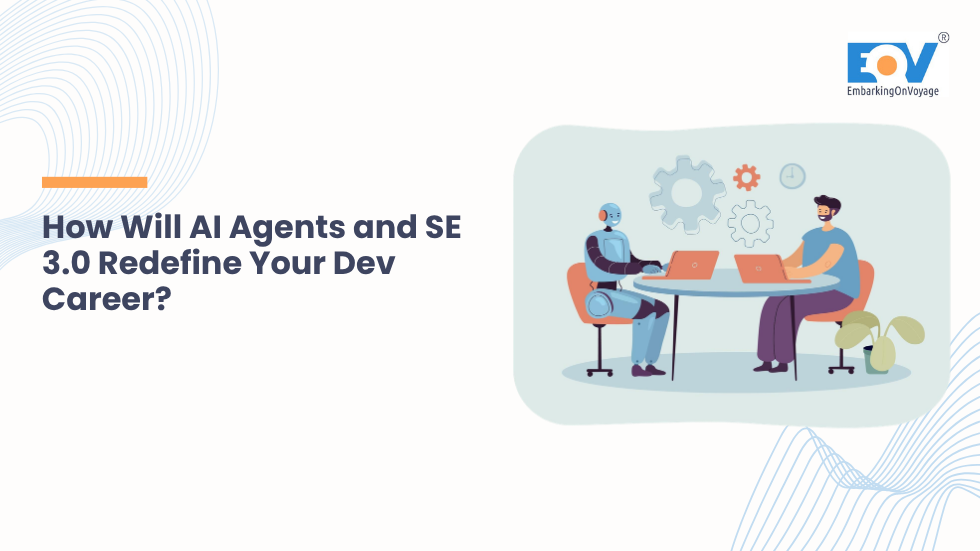
The rise of AI-assisted development is not just a technological shift; it’s a fundamental career evolution. As tools like GitHub Copilot, Qodo, and Cursor evolve into sophisticated AI agents that take over the “grunt work,” the software engineering jobs of 2026 and beyond are being redefined.
The question for developers in tech hubs from Berlin to Bangalore isn’t if roles will change, but how to pivot. Here is your roadmap to an AI agent-driven Software Development Lifecycle and how to future-proof your career.
The Changing Landscape: From Writing Code to Expressing Intent
To understand the future of software engineering, we must recognize the move toward SE 3.0; a paradigm where development is intent-first and conversational.
- Automation of Routine SDLC: AI now handles boilerplate code generation, unit testing, and refactoring. This allows engineers to move up the value chain toward system architecture and domain logic.
- Accelerated Product Cycles: According to industry benchmarks, an AI-enabled SDLC significantly increases velocity. In India’s competitive outsourcing market and Europe’s high-precision product sectors, speed-to-market is becoming the primary KPI.
- Human-in-the-Loop Oversight: As generative AI handles the “how,” humans focus on the “why” prioritizing AI governance, security compliance, and ethical AI integration.
Emerging Roles: What’s Growing vs. Shifting
The job market is bifurcating. While traditional “syntax-heavy” roles are consolidating, new specialized positions are exploding in demand.
The Shift in Traditional Roles
| Current Role | AI Impact | Evolution / New Title |
| Junior Developer | High automation of CRUD/Boilerplate | AI-Supervised Associate |
| Manual QA Tester | AI-generated test suites & self-healing code | AI Test Strategist |
| Maintenance Engineer | Automated refactoring & migration tools | Legacy-to-AI Migration Expert |
High-Growth “Future-Ready” Roles
- AI Prompt Architect: Designing complex, multi-step “chained” prompts to orchestrate AI agents.
- AI Code Auditor & Security Engineer: With AI-generated code comes the risk of “hallucinated” vulnerabilities. Auditors ensure AI-generated code security and compliance.
- Agent Orchestrator: Managing a fleet of autonomous AI agents that handle deployment, monitoring, and rollback.
- AI Ethics & Governance Lead: Particularly critical in the European market due to the EU AI Act, ensuring transparency and accountability.
Critical Skills for the Modern Developer
To remain a “top-tier” engineer in a world of LLM-based development, you need a blend of technical depth and “AI-native” fluencies.
Technical Skills
- Prompt Engineering & Agentic Workflows: Mastering the interaction between human intent and AI output.
- Systems Thinking & Architecture: Designing modular systems that AI can easily navigate and assist in.
- Model Introspection: Understanding AI hallucinations, bias, and how to fine-tune models on domain-specific data.
- Cybersecurity & AIBOM Management: Managing the “AI Bill of Materials” to ensure software supply chain security.
Soft Skills (The Human Advantage)
- Critical Skepticism: The ability to audit and challenge AI outputs rather than blindly accepting them.
- Domain Expertise: Deep knowledge of specific verticals like FinTech, HealthTech, or IoT where business logic is too complex for general AI.
How to Future-Proof Your Career (Action Plan)
Don’t wait for your organization to mandate change. Be the driver of AI transformation.
- Adopt the Tools Early: Integrate Cursor, Qodo, or GitHub Copilot into your daily workflow now.
- Build an “AI Portfolio”: Document how you use AI to solve complex architectural problems, not just small snippets.
- Specialize in a Vertical: Whether it’s embedded systems in Germany or digital public infrastructure in India, domain-specific context is your greatest moat.
- Master AI Oversight: Learn the basics of MLOps and AI security auditing.
- Stay “Hands-On” with Fundamentals: AI is a co-pilot, not the captain. You still need to understand data structures, algorithms, and debugging to catch AI errors.
Challenges: The Ethical and Professional Risks
The transition to AI-native engineering isn’t without friction:
- Deskilling: The risk of losing core debugging intuition through over-reliance.
- Accountability: In an “AI-wrote-it” world, the human engineer remains the legal and ethical point of responsibility.
- Data Sovereignty: Especially relevant for European enterprises, ensuring AI tools respect strict data privacy and GDPR standards.
Conclusion: The Era of the “10x Architect”
The future of software jobs is not about extinction; it is about empowerment. By 2030, 70% of coding will likely be AI-assisted, turning the modern developer into an “Agent Boss” – a strategist who orchestrates AI power to solve human problems.
The engineers who thrive will be those who view AI not as a replacement, but as the ultimate force multiplier for human creativity.
Reference
GitHub (The New Stack): How GitHub Copilot Reshapes Developer Collaboration (2026 Study)
Latest Blog Highlights: https://embarkingonvoyage.com/blog/blazor-server-production-checklist/
Leave a Reply