



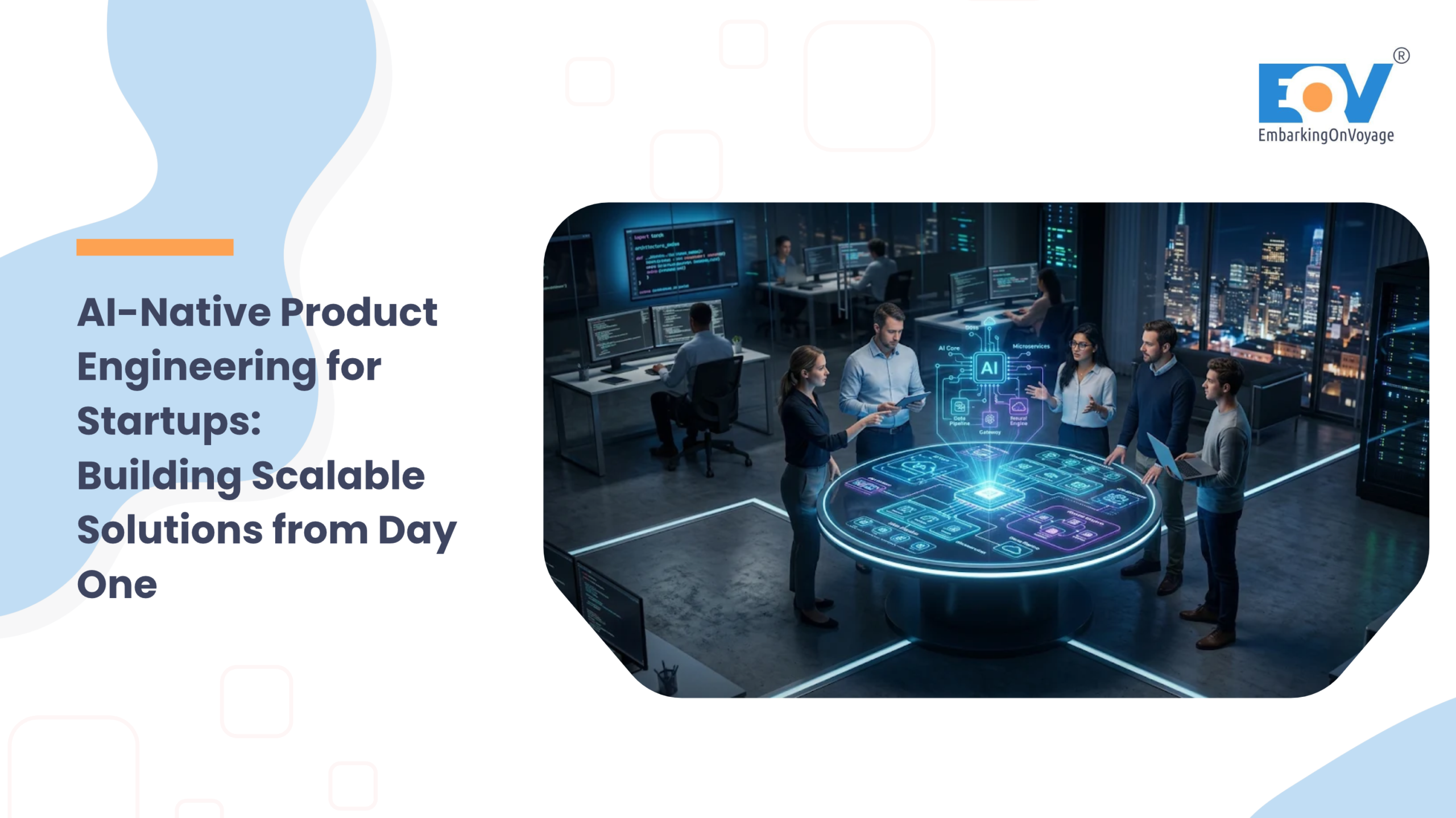
Building a startup in today’s fast-paced tech landscape requires significantly more than just migrating your existing databases to the cloud or slapping a generic chatbot onto a legacy software system. True digital innovation demands a fundamental, foundational shift in how software is conceptualized. AI-native product engineering for startups is the strategic practice of designing, architecting, and deploying digital ecosystems where artificial intelligence serves as the core foundational engine, rather than just an afterthought or a premium add-on feature.
By treating artificial intelligence as the central nervous system of a digital product, ambitious startups can drastically accelerate their time-to-market, seamlessly automate complex data workflows, and deliver hyper-personalized user experiences that traditional legacy software architectures simply cannot replicate.
The Crucial Difference Between AI-Native and AI-Augmented
A common trap for early-stage companies is confusing AI-augmented applications with true AI-native ecosystems. Many businesses loudly claim to use AI by merely bolting a third-party generative API onto a monolithic, decades-old application architecture. This is AI-augmented design, and it often leads to latency issues, data bottlenecks, and high compute costs.
In stark contrast, AI-native applications are built from the ground up to consume, process, and act upon vast amounts of data autonomously.
Defining Characteristics of AI-Native Startups
- Data-Centric Architecture: Relies heavily on automated data workflows, streaming analytics, and modern ELT/ETL pipelines rather than static, isolated database silos.
- Agentic AI Integration: Utilizes sophisticated AI systems and autonomous agents that can execute complex, multi-step workflows without waiting for constant human prompts.
- Predictive Delivery and MLOps: Machine learning models are embedded directly into the continuous integration and continuous deployment pipelines, ensuring the product gets smarter, faster, and more efficient with every single user interaction.

Foundational Pillars of AI-Native Product Engineering
To scale massively without experiencing severe performance trade-offs, startups must carefully architect their products across several fundamental pillars. Skipping any of these steps can result in technical debt that is exceptionally difficult to unravel later.
1. Enterprise-Grade Data Engineering
Artificial intelligence is ultimately only as intelligent and useful as the raw data feeding it. Startups need scalable, highly secure digital ecosystems that seamlessly transform legacy data silos into intelligent, flowing pipelines. Establishing robust foundational data pipelines is an absolute prerequisite to deploying cutting-edge AI models, automating backend workflows, and forecasting market trends with any degree of reliability. Engaging in Enterprise Data Engineering & AI Infrastructure Services ensures that your proprietary models are trained on well-governed, clean, and highly actionable data.
2. Scalable Cloud and LLM Infrastructure
Running sophisticated, native AI models requires high-performance computing power and highly strategic infrastructure planning. Leveraging enterprise hyperscalers like AWS Machine Learning or Google Cloud Vertex AI allows agile startups to implement advanced techniques like Retrieval-Augmented Generation and intricately fine-tune large language models. This cloud-first approach allows companies to scale computing power dynamically without absorbing the crippling upfront capital costs of purchasing localized hardware.
3. Continuous Learning and Model Optimization
Unlike traditional software that remains static until the next major update, AI-native products are living entities. Implementing machine learning operations ensures that your models are continuously monitored for data drift, regularly retrained with fresh user interactions, and optimized for lower latency. This continuous feedback loop is what allows startups to maintain a competitive edge as user demands evolve rapidly.
4. Purpose-Driven UX/UI Design
Even the most sophisticated AI backend is completely useless if the frontend product is difficult to navigate. The engineering process must meticulously map user behaviors, proactively identify workflow friction points, and align the overall design architecture directly with the startup’s core business goals. AI-driven personalization must feel entirely intuitive and invisible to the end user, translating incredibly complex technical requirements into smooth, seamless user journeys.
How to Mitigate Risk While Building Fast
Speed is undeniably a startup’s greatest competitive advantage, but rushing an AI-native build introduces significant security, compliance, and scalability risks. The key to moving fast without breaking things is eliminating black-box pipelines. Utilizing highly structured sprint reviews, ensuring transparent data lineage, and sticking to fixed-scope milestones keeps both engineering teams and startup stakeholders perfectly aligned throughout the development lifecycle.
Working with specialized engineering partners can accelerate this complex process safely. Leveraging dedicated AI-Native Digital Product Engineering provides ambitious startups with access to senior-led data architects who consistently deliver compliant, highly scalable, and AI-ready landscapes on time and within strict scopes. From stringent GDPR compliance to robust role-based access controls and dynamic data masking, enterprise-grade security must be woven into the underlying architecture from day one, not patched in prior to a rushed product launch.
Startups that fully embrace AI-native product engineering effortlessly outpace their competitors by rapidly turning unstructured, messy data into clear, actionable intelligence faster than ever before. By maintaining a relentless focus on predictive analytics, autonomous decision-making, and intelligent backend process automation, founders can drastically reduce their operational overhead while exponentially scaling customer value. The technological future undoubtedly belongs to digital products that are built not just to host artificial intelligence, but to be fundamentally powered by it at every level.
Leave a Reply