
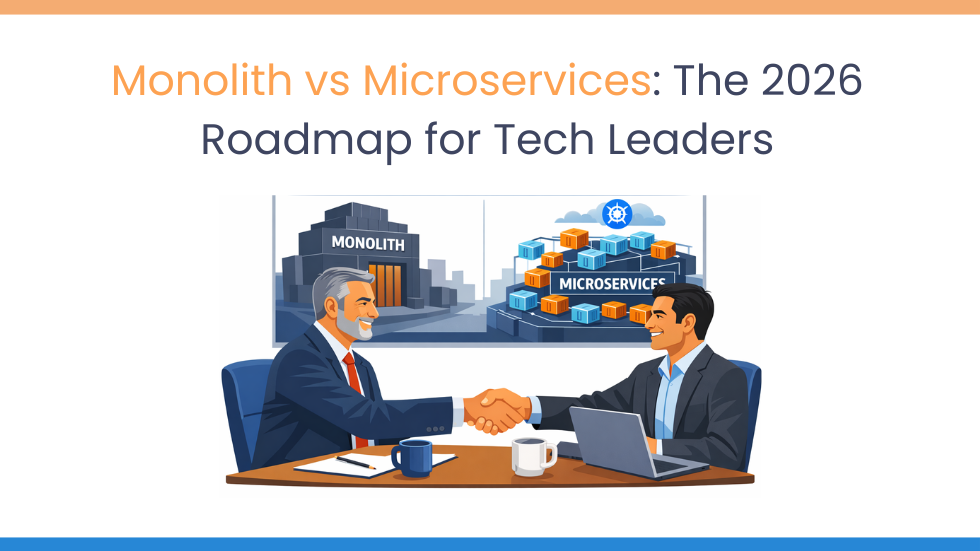
In 2026, most tech leaders aren’t debating whether to modernize anymore. The real question is how to modernize without slowing teams down or inflating cloud costs. That’s why the discussion around Monolith vs Microservices has become more practical and more critical than ever.
For years, microservices were seen as the default path to modernization. But many teams learned the hard way that breaking a monolith without a clear strategy often leads to a distributed monolith more complexity, slower releases, and fragile delivery pipelines
Modernizing an application isn’t about rewriting everything or blindly choosing microservices. It’s about understanding when a monolith still makes sense, when microservices actually help, and how to evolve your architecture incrementally.
This article outlines a 2026-ready roadmap for navigating the Monolith vs Microservices decision focused on real-world delivery, developer velocity, and modernization that actually works.
The Reality Check: When Monolith vs Microservices Stops Working
In the trenches, “velocity” is more difficult to experience than it is to discuss in a boardroom. My team was caught in a cycle that many of you will recognize before we switched to our current roadmap. Although we were proud of our CI/CD setup, it had turned into our largest bottleneck.
Here were our three “silent killers”
When teams debate Monolith vs Microservices, the conversation usually stays at the architecture level. But for us, the real pain showed up in how we shipped code every day.
- The “Security Theatre” bottleneck – Our pipelines looked secure on paper, but in reality, they slowed everything down. During a critical production fix, a deployment would fail—not because of our code, but due to a vulnerability in an external dependency. Under pressure, developers started skipping scans just to get fixes out. What was meant to improve security ended up creating real risk.
- The UAT traffic jam – We were stuck with a shared UAT environment. If one developer needed to rush a hotfix to production, another had to roll back their changes just to unblock the pipeline. It was manual, stressful, and one mistake away from breaking something important. This wasn’t a tooling issue—it was a delivery model that couldn’t scale.
- The maintenance nightmare – Every pipeline was a snowflake. Different base images, different dependencies, different configurations. A simple upgrade meant touching dozens of pipelines. What should have been a routine task turned into a full-blown DevOps exercise every time
That’s when it became clear that Monolith vs Microservices problem wasn’t just about how our applications were structured. It was about how we delivered them. To truly modernize, we had to rethink not only our code but the entire path it took to reach production.
The 2026 Roadmap: A Practical 3-Step Strategy
To move forward, we had to change how we thought about delivery. Instead of obsessing over individual pipelines, we started focusing on two principles that actually scale in immutability and modularity. That mindset shift became the foundation of our Monolith vs Microservices roadmap.
Step 1: Containerization & Orchestration
(The “No-Rollback” Rule)
We moved our entire stack to Docker and Kubernetes, and almost immediately, our UAT chaos disappeared.
- The shift:
Instead of cleaning and reconfiguring servers for every build, we adopted immutable container images. Each release became a self-contained unit, predictable and repeatable.
- The result:
If a build was sitting in UAT and a critical hotfix needed to go live, nothing had to be rolled back. Kubernetes simply deployed a new image and replaced the old one using standard deployment strategies. This is the real backbone of cloud-native architecture and a key enabler when transitioning from monoliths to microservices.
Step 2: “Object-Oriented” Pipelines
Next, we realized our CI/CD setup was working against us.
- The shift:
We stopped maintaining dozens of custom Jenkins files and moved to parameterized pipelines. Our DevOps team created a single source of truth for dependencies, base images, and configurations using Jenkins Shared Libraries.
- The result:
Pipeline logic became reusable and consistent. A library upgrade now happens in one place and automatically flows to every project. Maintenance overhead dropped by nearly 70%, and our delivery process finally felt manageable.
Step 3: The Strangler Fig Pattern
When it came to application code, we avoided the most common mistake in the Monolith vs Microservices debate: the big-bang rewrite.
Instead, we adopted the Strangler Fig Pattern.
We identified one high-value feature at a time, rebuilt it as a microservice, and routed traffic to it through an API Gateway. Gradually, new services took over core functionality until the monolith could be safely retired without disrupting users or the business.

The 2026 Goal: Velocity Over Vanity
In 2026, success isn’t measured by how many microservices you’ve deployed or how modern your architecture diagram looks. It’s measured by developer velocity how quickly and confidently your teams can ship, fix, and improve software.
By moving to a containerized, parameterized delivery model, we didn’t just modernize our tech stack we gave developers their time back. And if your Monolith vs Microservices roadmap ends with faster releases and fewer late-night firefights, you’re on the right path.
Final Thoughts: A Message for Tech Leaders
In 2026, the Monolith vs Microservices debate isn’t about choosing sides. It’s about choosing outcomes. The goal isn’t a perfect architecture diagram or a growing list of services it’s teams that can deliver reliably, respond to change quickly, and sleep better at night.
Modernization works when it’s intentional. When it prioritizes developer velocity over vanity metrics, incremental change over risky rewrites, and resilience over hype. Whether your journey starts with a monolith, microservices, or somewhere in between, the right roadmap is the one that removes friction not adds to it.
If your architecture helps your teams ship faster, recover quicker, and scale without fear, you’re on the right path. And if it doesn’t, that’s not a failure it’s a signal. In 2026, the best tech leaders are the ones who listen to those signals and modernize with purpose.
Latest Blog Highlights: https://embarkingonvoyage.com/blog/ui-ux-laws-shape-user-behavior-2026/