


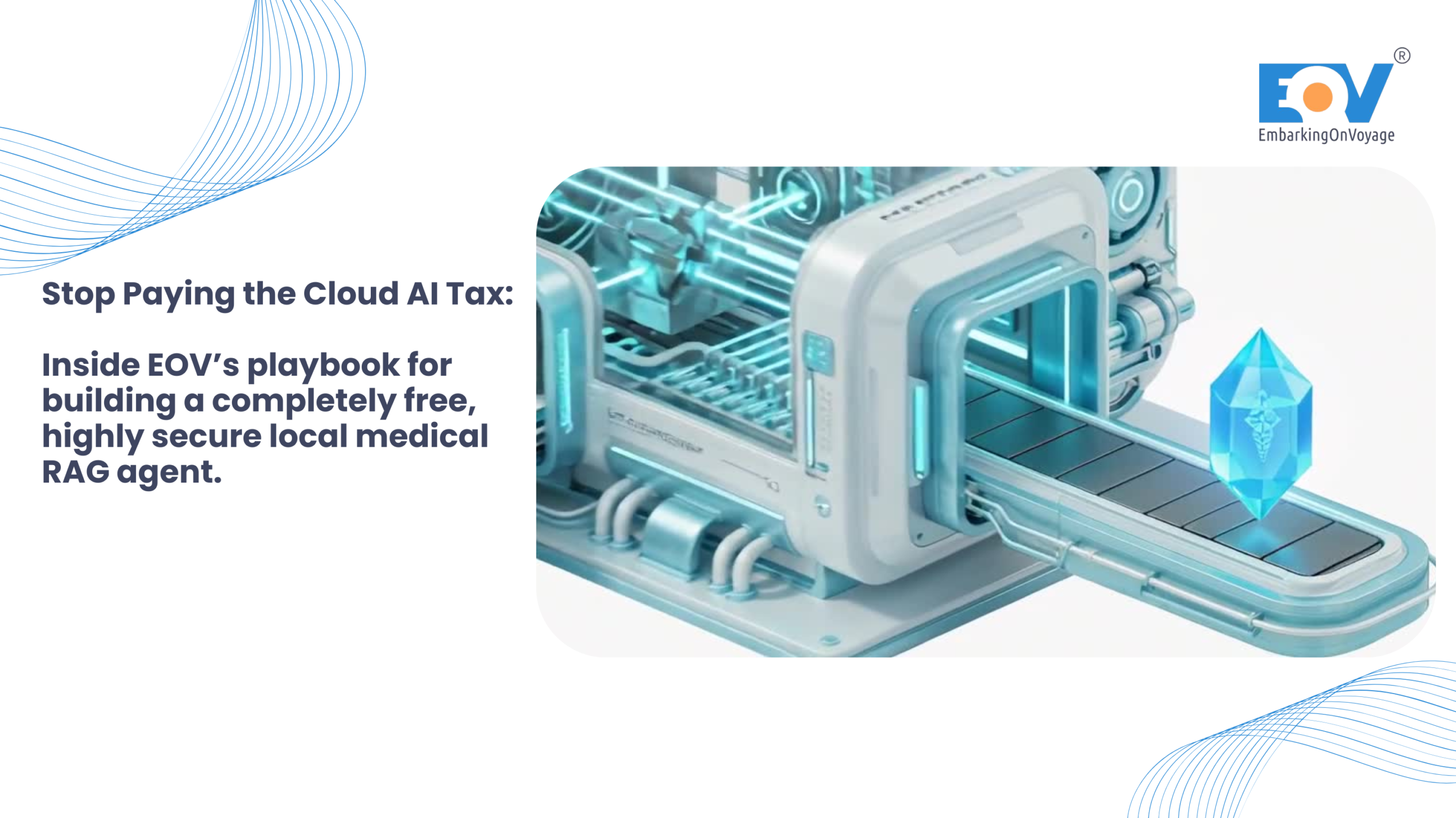
Building an enterprise-grade AI application usually comes with a heavy tax: recurring cloud API token costs and data privacy concerns. This is especially true in healthcare, where patient confidentiality is non-negotiable.
As an AI-native product engineering firm, EOV routinely tackles these infrastructure barriers. In our latest AI Lab initiative, we set out to build a fully local, completely free local medical RAG agent. The goal was straightforward: extract patient lab results from complex PDFs and seamlessly validate them against official World Health Organization (WHO) guidelines.
By hosting the entire ecosystem locally, we proved that enterprises can achieve advanced clinical intelligence without spending a dime on cloud tokens. However, moving from a local proof-of-concept to a resilient, production-ready system requires more than basic scripting. It requires a dedicated engineering framework. Through our internal EOV Pulse; our rigorous framework for diagnostic evaluation and system health checks—we uncovered critical production gaps and engineered the solutions to fix them.
The Architecture of a Local Medical RAG Agent: Zero-Cost, Maximum Privacy
To ensure absolute data isolation and zero operational fees, the core of our Local Medical RAG Agent was built usingusing LangGraph and LangChain, backed by a local ChromaDB vector store.
For core intelligence, we turned to Ollama to run open-source models locally on enterprise hardware. The entire ecosystem was wired through an event-driven graph topology with three core nodes:
- Extraction Node: Uses a local LLM to normalize raw, messy lab PDFs into clean, structured
Lab Name: Valuetext blocks. - Research Node: Performs a semantic similarity search against a local ChromaDB vector store containing the dense WHO guidelines.
- Synthesis Node: Compares the clinical metrics against the retrieved guidelines to draft a clinical tracking plan.
Table of Contents
The Wall: Running the EOV Pulse Check on Silent Failures
The Local Medical RAG Agent worked flawlessly in isolated sandboxes. But when our engineering team initiated an EOV Pulse Check stress-testing the system with complex, highly abnormal, and critical lab reports; the pipeline failed silently.
During stress testing, the Local Medical RAG Agent consistently returned generic, overly reassuring answers like: “Everything is good and under control.” Or it would claim: “Lab values are abnormal, but I didn’t find anything in the WHO guidelines.”
The open-source local model itself wasn’t the bottleneck. Our pulse check diagnosed the true root cause: a fundamental mismatch between the data ingestion strategy and how vector search mathematically evaluates language.
Overcoming the Gaps: The AI-Native Engineering Fixes
1. Eliminating Ingestion Dilution (The Chunk Size Trap)
In the initial architecture setup, a standard text splitter processed the massive WHO guideline PDF:
Python:

text_splitter = RecursiveCharacterTextSplitter(chunk_size=1000, chunk_overlap=100)
chunks = text_splitter.split_documents(docs)
While a chunk_size of 1000 tokens works well for narrative text, medical guidelines are dense. A critical diagnostic threshold (such as HbA1c > 6.5% indicates Diabetes) takes up only a few characters. When buried inside a 1000-token chunk of clinical prose, the mathematical weight of that numeric limit became severely diluted. Consequently, ChromaDB missed it during retrieval.
Our Production Fix: EOV’s data engineers rebuilt the ingestion pipeline, shrinking the semantic chunk size down to 150 tokens. This isolated the critical numbers, giving them immense semantic weight and clarity in the vector space.
2. Resolving the Multi-Variable Query Bottleneck
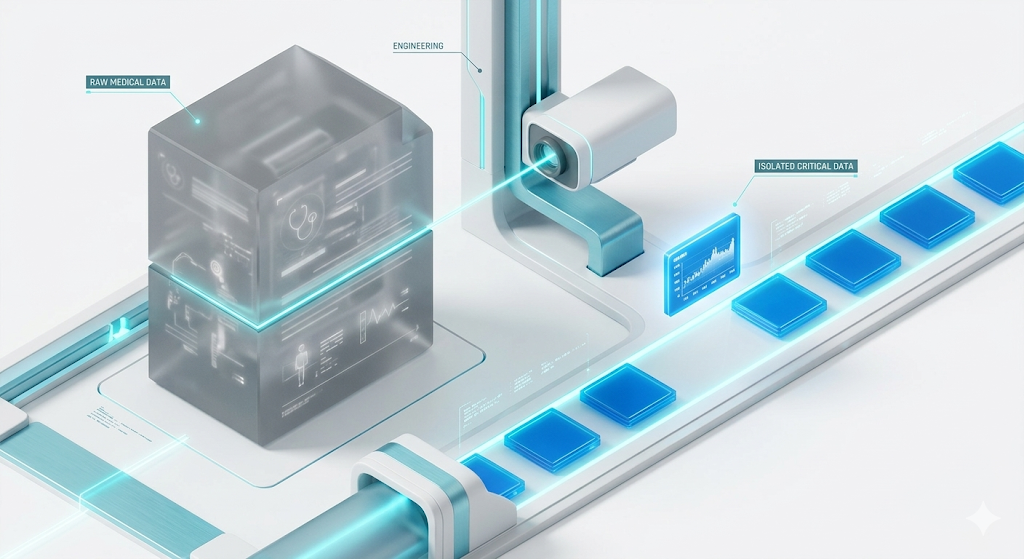
In the initial retrieval node design, the search query was constructed by passing the entire block of extracted lab data at once:
Python:

query = f"WHO guidelines and clinical thresholds for {state['extracted_data']}"
docs = chroma_client.similarity_search(query, k=2)
If a lab report contained five different abnormal tests, embedding the entire text block as a single vector forced ChromaDB to search for a mathematical “average” of all those distinct terms. Instead of returning specific diagnostic threshold tables, it returned generic introductory pages.
Our Production Fix: We redesigned the LangGraph workflow to iterate through the extracted biomarkers individually. The agent now executes distinct, targeted parallel searches for each separate lab test, ensuring precision retrieval.
3. Neutralizing Reassurance Bias in Local LLMs
Without the heavy-handed commercial guardrails of cloud APIs, smaller local models tend to avoid making definitive negative claims. When context is slightly blurry, they default to safe, polite remarks.
Our Production Fix: We updated the system prompt to explicitly ground the model’s behavior. We injected strict constraints: “If the retrieved context does not contain specific threshold values for the test, state ‘Guideline missing’—do not assume the result is normal.”
The AI-Native Product Engineering Impact
Deploying a Local Medical RAG Agent as a zero-cost enterprise AI strategy using Ollama is a highly viable path for sensitive, domain-specific operations. True optimization doesn’t come from throwing capital at massive cloud models; it comes from applying rigorous product engineering to the data layers beneath them.
By applying our signature EOV Pulse framework, we transformed a hallucinating chatbot into a sharp, reliable, enterprise-grade medical intelligence agent.
Accelerate Your AI Transition
Is your infrastructure ready for autonomous deployment? Discover how we turn complex AI theories into scalable business realities. Explore the EOV AI Native Engineering Labtoday and let our team run an AI Pulse Check on your current systems.
Lates Blog Highlights : https://embarkingonvoyage.com/blogs/why-saas-fails-rag-ai-systems/
Visit our AI-Native Engineering Lab :
Leave a Reply