
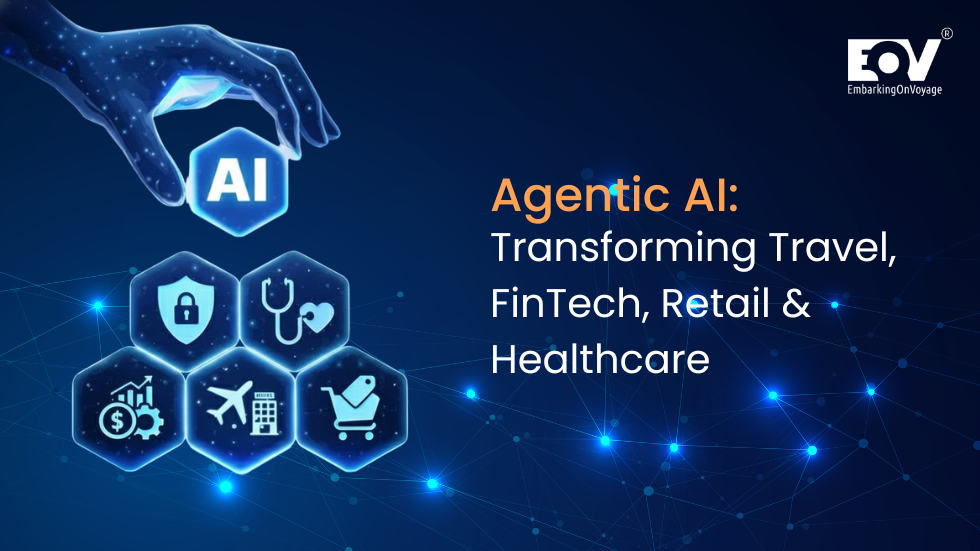
This blog explores how Agentic AI is being adopted across five critical industries like Travel, FinTech, Retail & Healthcare Travel, Hospitality, FinTech, Retail, and Healthcare highlighting real-world goals, outcomes, and why this shift represents a fundamental change in how modern digital platforms are built.
Digital transformation over the last decade has largely been about automation faster systems, cleaner integrations, and smarter analytics. But automation alone is no longer enough. Industries today operate in environments that are highly dynamic, interconnected, and expectation-driven. What’s emerging now is a new intelligence layer: Agentic AI.
Agentic AI doesn’t just respond to commands. It acts with intent. It understands goals, reasons across systems, adapts in real time, and executes multi-step actions with minimal human intervention. Whether it’s rebooking a disrupted flight, resolving a hotel guest issue, detecting financial fraud, optimizing retail fulfillment, or coordinating patient care agentic AI introduces decision-making autonomy into digital systems.
What Is Agentic AI (and Why It’s Different)?
Most AI systems today are reactive. They analyze data, make predictions, give recommendations, or answer questions but only when someone asks. Agentic AI works differently. It’s proactive. Instead of waiting for instructions, it takes initiative and moves things forward on its own.
- Understand high-level goals (e.g., “ensure passenger reaches destination with minimal disruption”)
- Break those goals into tasks and sub-tasks
- Interact with multiple systems via APIs
- Make decisions based on constraints and outcomes
- Learn from feedback and improve future actions
In essence, agentic AI behaves more like a digital operator than a traditional algorithm.
Travel: Agentic AI as the Brain of Modern Travel Platforms
Travel is one of the most complex digital ecosystems in existence. Airlines, hotels, OTAs, payment systems, insurers, airports, and ground transport all operate on separate platforms yet the travel expects a single, seamless experience.
Where Agentic AI Fits in Travel
1. Intelligent Airline & Travel Fulfillment
In modern travel platforms and airline fulfillment ecosystems, agentic AI can:
- Monitor bookings, ticketing, ancillaries, and payments
- Detect disruptions (weather, aircraft change, crew issues)
- Automatically rebook passengers across airlines or routes
- Coordinate refunds, exchanges, or vouchers
- Notify travelers proactively
Outcome:
- Faster disruption recovery
- Reduced call center dependency
- Higher traveler satisfaction
2. End-to-End Travel Orchestration
An agent doesn’t see flights in isolation. It understands the journey:
- Adjusts hotel check-in times if flights are delayed
- Rebooks airport transfers automatically
- Reschedules activities or experiences
Outcome:
- Truly connected travel experiences
- Reduced friction across vendors
3. Personalized Travel Assistants
Agentic AI can act as a personal travel concierge:
- Suggesting better connections
- Recommending lounges or upgrades
- Managing loyalty benefits automatically
Outcome:
- Increased ancillary revenue
- Higher repeat bookings
Hospitality: From Service Automation to Experience Orchestration
Hospitality is no longer about rooms it’s about experiences. Yet hotel operations are fragmented across PMS, CRS, CRM, housekeeping, and F&B systems. Agentic AI becomes the experience orchestrator.
How Agentic AI Transforms Hospitality
1. Proactive Guest Experience Management
Instead of reacting to complaints, AI agents:
- Anticipate guest needs based on preferences
- Detect potential dissatisfaction signals
- Resolve issues before escalation
Example:
A guest checks in late after a delayed flight. The agent:
- Extends checkout time
- Notifies housekeeping
- Offers a complimentary breakfast
Outcome:
- Improved guest satisfaction
- Stronger brand loyalty
2. Dynamic Operations & Pricing
AI agents continuously optimize:
- Room pricing
- Staffing requirements
- Energy consumption
- Upsell packages
Outcome:
- Higher margins
- Lower operational waste
FinTech: Autonomous Financial Decision Systems
FinTech platforms operate in real time, under strict compliance, with zero tolerance for error. Agentic AI introduces intelligent autonomy without compromising control.
Key Agentic AI Use Cases in FinTech
1. Fraud Detection & Prevention
Instead of static rule-based systems, AI agents:
- Monitor behavioral patterns
- Identify anomalies
- Freeze transactions autonomously
- Notify customers and compliance teams
Outcome:
- Reduced fraud losses
- Faster response times
2. Intelligent Payments & Reconciliation
Agentic AI can:
- Monitor settlement failures
- Resolve mismatches automatically
- Coordinate between banks, gateways, and merchants
Outcome:
- Lower operational overhead
- Faster financial closures
3. Personalised Financial Assistants
Agents help users:
- Optimize spending
- Manage credit usage
- Automate investments
- Predict cash-flow risks
Outcome:
- Higher customer engagement
- Increased trust in digital finance platforms
Retail: Intelligent Commerce at Scale
Retail today spans online, offline, quick commerce, and global logistics. Traditional automation struggles with this level of variability. Agentic AI thrives in it.
Agentic AI in Modern Retail
1. Smart Product Discovery & Buying Assistants
Agents:
- Understand shopper intent
- Compare alternatives
- Manage carts across channels
- Execute purchases autonomously
Outcome:
- Higher conversion rates
- Reduced cart abandonment
2. Autonomous Fulfillment & Returns
AI agents decide:
- Where to ship from
- How to route deliveries
- When to initiate replacements or refunds
Outcome:
- Faster delivery times
- Lower logistics costs
3. Dynamic Pricing & Promotion Engines
Agents continuously adjust pricing based on:
- Demand
- Inventory
- Competitor movements
- Customer behavior
Outcome:
- Better margins
- Real-time competitiveness
Healthcare: Coordinated Care Through Intelligent Agents
Healthcare systems are overwhelmed by administrative complexity. Agentic AI helps shift focus back to patient care.
Agentic AI in Healthcare Systems
1. Patient Journey Orchestration
Agents coordinate:
- Appointments
- Diagnostics
- Insurance approvals
- Follow-ups
Outcome:
- Reduced wait times
- Improved care continuity
2. Administrative Automation
AI agents handle:
- Claims processing
- Billing reconciliation
- Documentation verification
Outcome:
- Reduced administrative costs
- Faster reimbursements
3. Proactive Patient Support
Agents monitor patient data and:
- Trigger alerts for anomalies
- Recommend preventive actions
- Coordinate telehealth interventions
Outcome:
- Better health outcomes
- Reduced hospital readmissions
Common Goals Across All Five Industries
Despite different domains, Agentic AI adoption consistently targets:
- Reduced Human Dependency for Routine Decisions
- Faster Response to Real-Time Events
- Better Customer / User Experience
- Operational Scalability Without Linear Cost Growth
- Improved Accuracy and Compliance
Key Challenges to Address
Agentic AI is powerful but not plug-and-play.
Organizations must plan for:
- Data quality and real-time availability
- Clear decision boundaries
- Human-in-the-loop governance
- Security and regulatory compliance
- Transparent AI decision logs
The goal is responsible autonomy, not uncontrolled automation.
The Road Ahead
In the coming years, Agentic AI will:
- Become the decision layer across digital platforms
- Enable cross-industry experiences (travel + payments + insurance + healthcare)
- Shift companies from reactive operations to anticipatory systems
- Redefine how humans collaborate with software
Travel platforms will talk to hotels. FinTech systems will talk to retail engines. Healthcare agents will coordinate with insurance and logistics all through autonomous, goal-driven AI agents.
Conclusion
Agentic AI is not another trend it is a structural shift in how digital systems operate. Across Agentic AI: Transforming Travel, FinTech, Retail & Healthcare, it enables platforms to move from automation to intelligent action.
Organizations that adopt agentic AI thoughtfully with clear goals, strong governance, and measurable outcomes will not just optimize operations. They will reshape experiences, unlock new value, and define the next decade of digital innovation.
Latest Blog Highlights: https://embarkingonvoyage.com/blog/understanding-clean-architecture-in-large-mean-and-mern-codebases/