



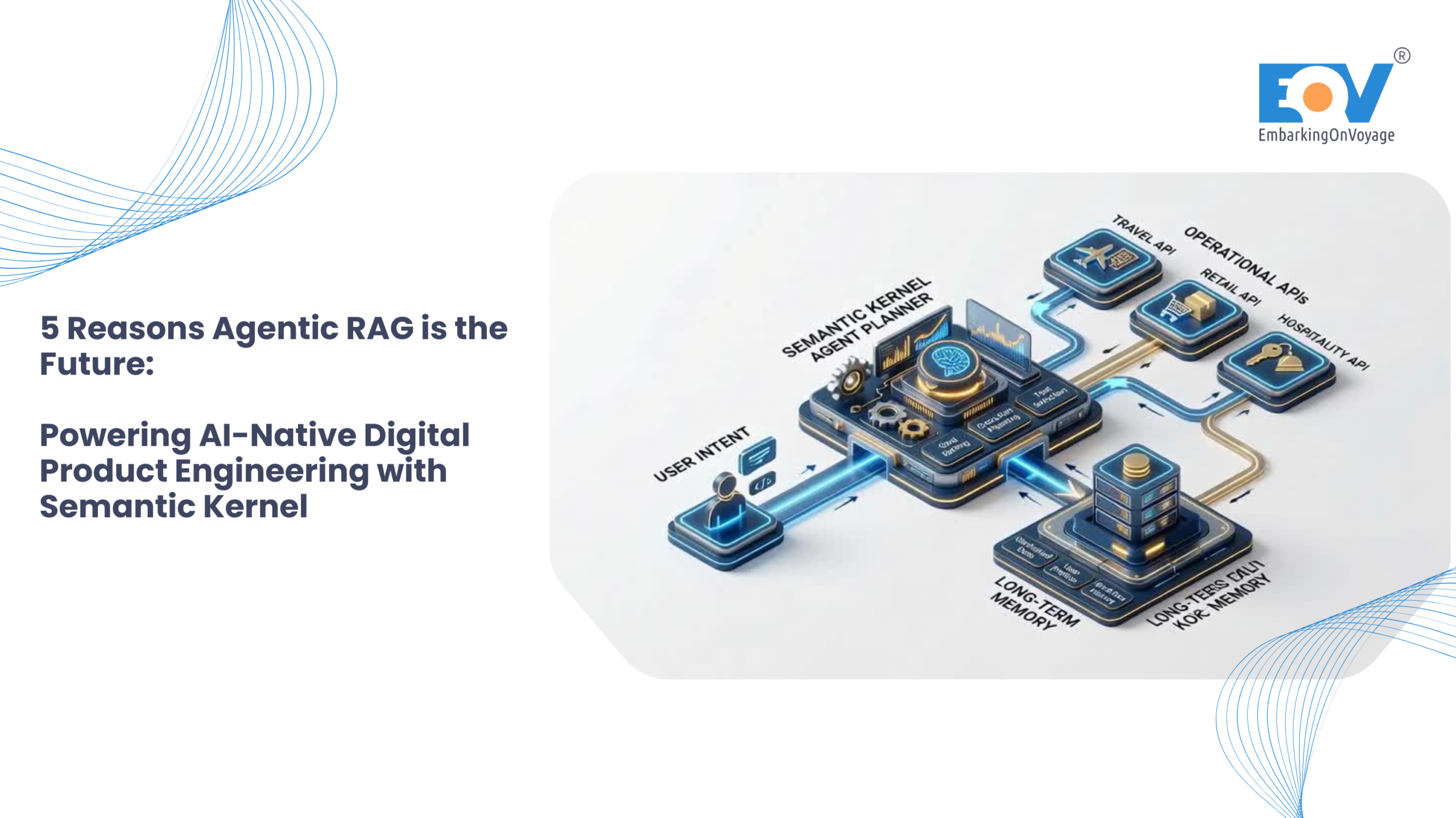
Enterprise AI is rapidly moving beyond simple chatbot implementations. While traditional Retrieval-Augmented Generation (RAG) systems successfully reduced hallucinations and improved contextual responses, modern enterprise workflows demand something significantly more intelligent. Today’s businesses require systems capable of reasoning, planning, memory management, orchestration, and autonomous execution.
This is where Agentic RAG enters the picture, serving as the foundational layer for modern AI-native digital product engineering.
At EOV, we are building next-generation AI solutions for the travel, hospitality, and retail domains using Agentic AI architectures. Powered by Semantic Kernel, Large Language Models (LLMs), workflow automation, and enterprise-grade retrieval pipelines, our approach moves beyond static text generation into actionable, operational intelligence.
Here is an inside look at our Agentic RAG architecture and the powerful reasons why Semantic Kernel enables scalable AI orchestration for enterprise environments.
1. Traditional RAG Cannot Handle Dynamic Workflows
Traditional RAG architectures follow a linear, static pipeline: a user asks a question, the system retrieves relevant chunks from a vector database, and the LLM generates an answer using the retrieved context.
While effective for standard Q&A, this approach struggles in true AI-native digital product engineering environments where complex workflows are the norm. In industries like travel or hospitality, an AI agent must perform operations far beyond simple search.
Key Enterprise AI Requirements:
- Retrieve real-time pricing data
- Validate inventory across suppliers
- Trigger backend business workflows
- Update booking systems dynamically
- Handle complex user personalization
- Maintain accurate conversation memory
A traditional RAG pipeline cannot coordinate these multi-step operations efficiently.
Traditional RAG vs. Agentic RAG
| Feature | Traditional RAG | Agentic RAG |
| Primary Function | Static search and text generation | Task planning and dynamic reasoning |
| Execution | Linear (Retrieve → Generate) | Autonomous (Plan → Retrieve → Act → Validate) |
| Tool Usage | None | API orchestration and tool calling |
| Memory | Isolated to the immediate prompt | Long-term, workflow, and session persistence |
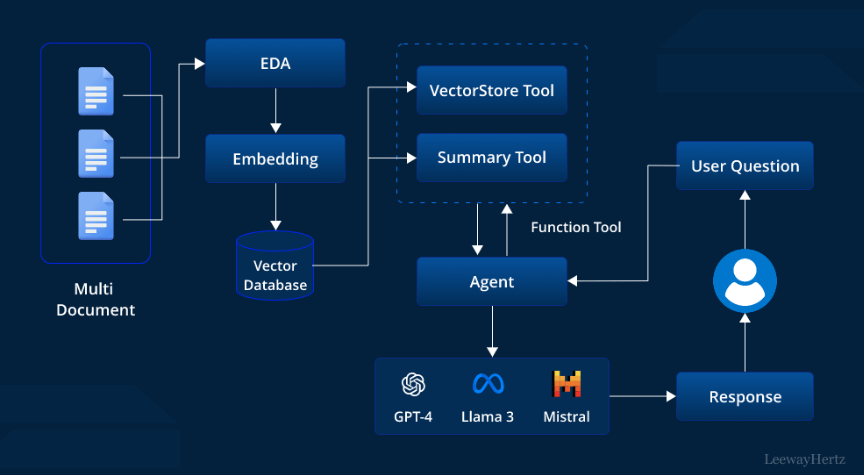
Agentic RAG Architecture (Credit: LeewayHertz). Source: LeewayHertz
2. True Autonomy Through Agentic Architecture
Agentic RAG transforms an AI system from a static search engine into an intelligent digital operator capable of reasoning through complex tasks. It combines Retrieval-Augmented Generation with AI agents, workflow orchestration, tool calling, and long-term memory.
In an AI-native digital product engineering architecture, the flow looks like this:
User → AI Agent → Planning → Retrieval → Tool Usage → Validation → Memory → Response
The major differentiator is the AI’s autonomy. The system can dynamically decide what information to retrieve, which tools to invoke, whether additional reasoning is required, and how to execute multi-step workflows.
3. Native Workflow Orchestration via Semantic Kernel
There are several frameworks available for Agentic AI development, but we selected Semantic Kernel because it perfectly aligns with the rigorous demands of AI-native digital product engineering.
Semantic Kernel provides out-of-the-box orchestration capabilities for planners, plugins, memory, function calling, sequential workflows, and multi-agent coordination. This makes it highly suitable for building enterprise-grade automation systems.
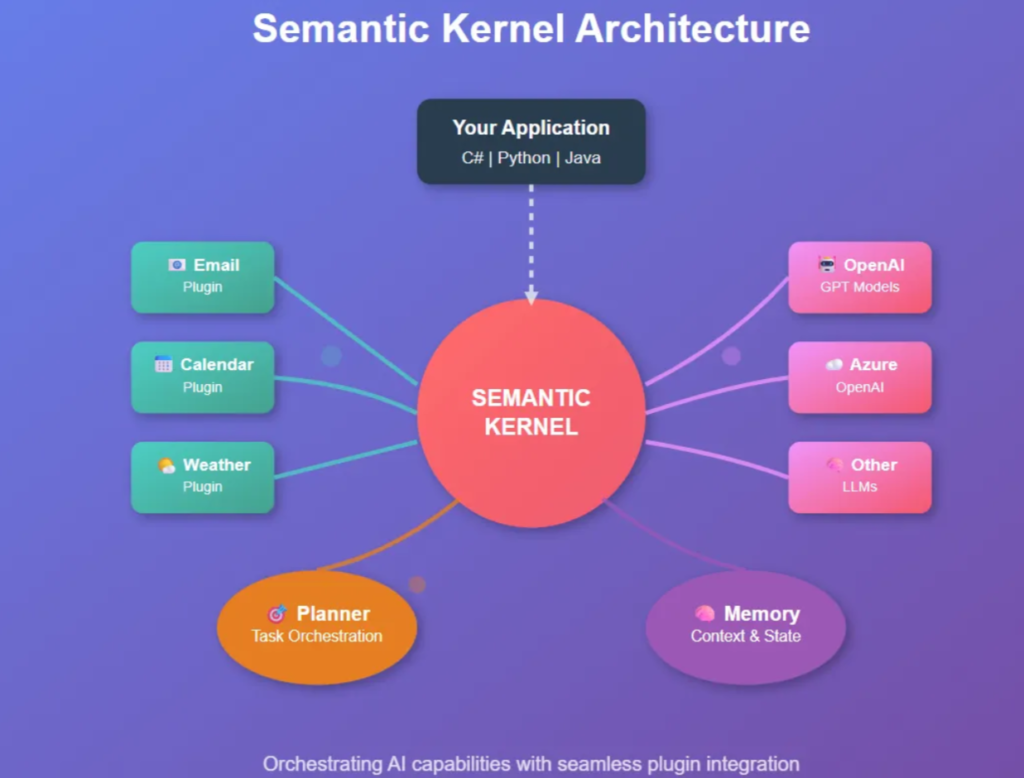
Semantic Kernel connecting AI to enterprise apps (Credit: Sridhar/Medium). Source: Medium
4. Strong Microsoft Ecosystem & Multi-Model Flexibility
Many enterprise customers operate heavily on Azure, .NET, the Microsoft AI stack, and enterprise identity systems. Semantic Kernel integrates natively into these existing ecosystems, adding massive value for governance, observability, and corporate security.
Furthermore, true AI-native digital product engineering requires a model-agnostic approach. Semantic Kernel allows us to standardize workflows while orchestrating across OpenAI GPT models, Anthropic Claude, domain-specific embedding models, and enterprise vector stores.
5. Moving from Conversational to Operational AI
Our high-level architecture is designed to support scalable, operational AI platforms through three core pillars:
The Retrieval Layer
We avoid relying purely on vector similarity, as production enterprise systems require absolute contextual precision. Our robust retrieval pipeline combines vector and semantic search, metadata filtering, and hybrid retrieval across structured enterprise data and operational APIs.
The AI Agent Layer
This is the core intelligence layer where the agent dynamically determines the execution path. The agent handles intent understanding, task decomposition, tool selection, and response synthesis.
Semantic Kernel Plugins & Memory Management
The plugin architecture is one of Semantic Kernel’s strongest assets. We develop plugins for pricing engines, booking APIs, and CRM integrations. Combined with advanced memory management—including session, workflow, and persistent user preferences—the system behaves consistently across interactions.
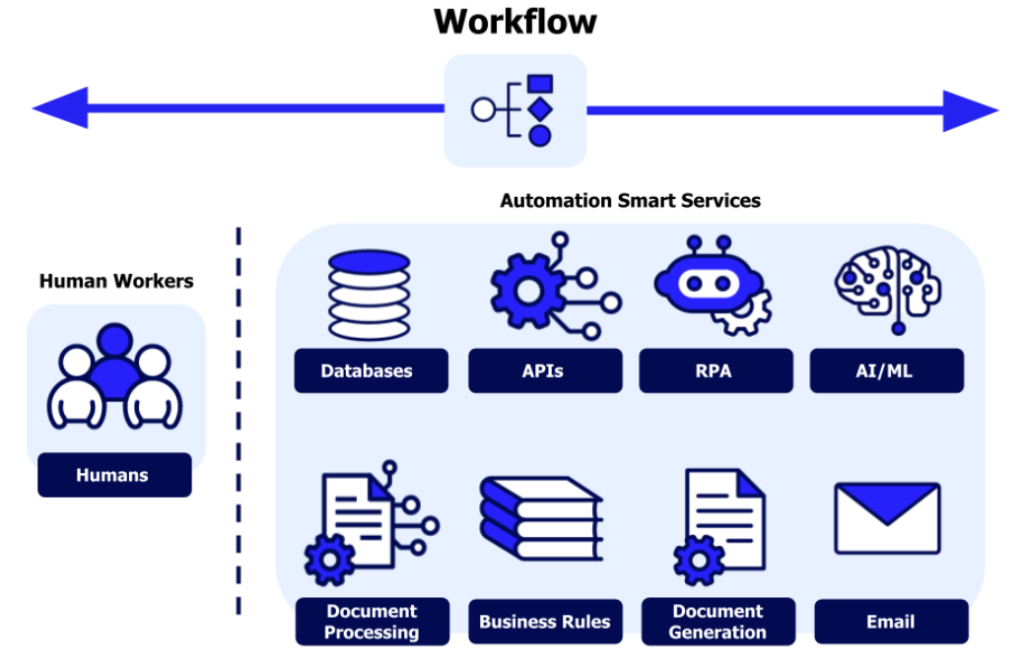
Enterprise Automation Smart Services and Workflows (Credit: Appian). Source: Appian
Real-World Applications in Enterprise Workflows
Our AI-native digital product engineering approach is actively solving complex challenges across major global industries:
- Travel Industry: Intelligent seat mapping, dynamic pricing prediction, and automated, multi-step customer support workflows.
- Hospitality Automation: Guest experience automation, room inventory workflows, and AI-driven support systems for hotel management.
- Retail Intelligence: Personalized, workflow-driven commerce experiences, inventory intelligence, and customer support automation.
The Future of Enterprise AI
The future of enterprise technology is unequivocally tied to AI-native digital product engineering. We are moving rapidly toward autonomous AI workflows, domain-specific agents, memory-aware systems, and multi-agent orchestration.
RAG was merely the first major step; Agentic RAG is the next evolution. Organizations that successfully combine retrieval, orchestration, workflow intelligence, and enterprise governance will build significantly more scalable and powerful systems than those relying on standalone chatbots.
By leveraging Semantic Kernel, we are building intelligent systems capable of reasoning, retrieving, planning, validating, and executing real business operations worldwide. The future belongs to enterprise AI that doesn’t just generate text – it takes action.
External Read : https://www.leewayhertz.com/agentic-rag/
External Read : https://medium.com/@sridharcloud/semantic-kernel-the-bridge-between-ai-and-your-applications-a-beginners-guide-835ea4b53081
Latest Blog Highlight : https://embarkingonvoyage.com/blogs/ai-native-product-engineering-azure/
Leave a Reply