



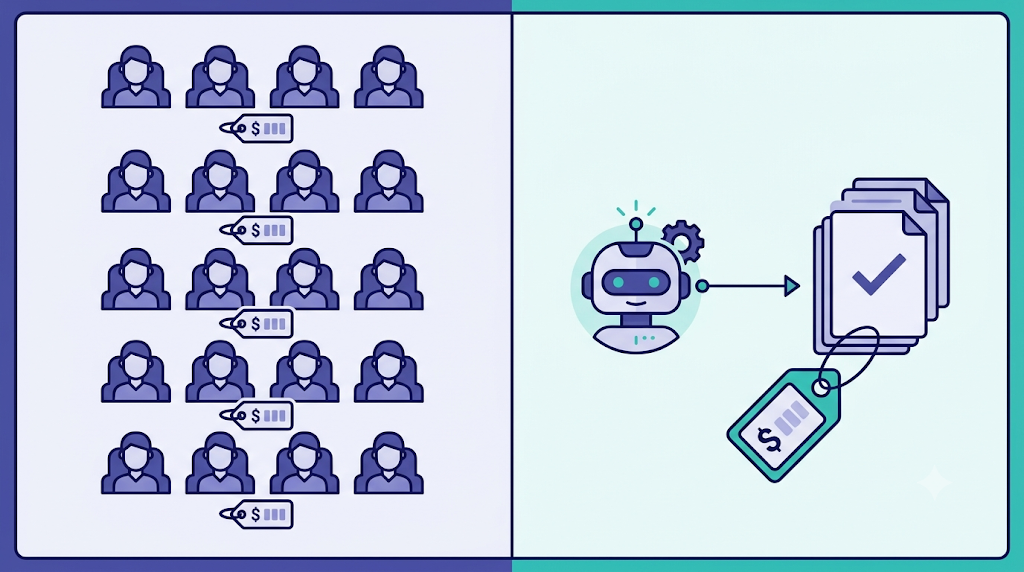
For twenty years, software was priced the same way: you paid for each person who logged in. Then AI agents arrived and quietly broke that logic. If an AI agent can handle thousands of customer conversations without a single human seat, what exactly are you paying for?
That question is reshaping AI agent pricing across the industry. The answer many vendors have landed on is simple and bold: charge only when the agent actually solves the problem. This is pay-per-resolution pricing, and it’s spreading fast.
In this guide, we’ll explain how it works, how the biggest platforms price their agents, where the hidden traps are, and how to pick the right model for your business. It’s a close cousin of the idea we covered in our pillar guide to outcome based billing, now applied to the fastest-moving corner of software.
Why Seat-Based Pricing Doesn’t Fit AI Agents
Seat pricing made sense when software was a tool that humans used. More users meant more value, so more seats meant more revenue.
AI agents flip that. The value comes from work completed, not from people logged in. A single agent can do the work of many, so charging per seat either punishes the customer for using fewer humans or leaves the vendor under-paid for the value delivered.
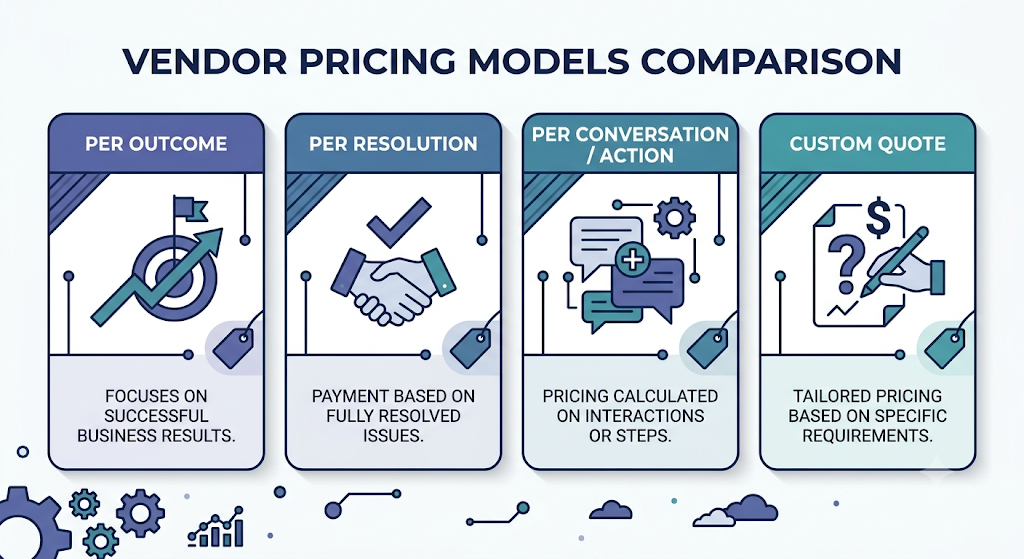
That mismatch is why vendors are experimenting with new AI agent pricing models: per conversation, per action, per resolution, or a blend.
What Is Pay-Per-Resolution Pricing?
Pay-per-resolution pricing means you’re billed each time an AI agent successfully resolves a customer issue on its own. If the agent hands the conversation to a human, or the issue isn’t solved, you generally don’t pay the resolution fee.
Think of it like paying a plumber only when the leak is fixed, instead of paying for the hours they spent staring at the pipe.
Why Pay-Per-Resolution Is Taking Over
1. Budgets finally match results
Finance leaders can tie spend directly to a result they understand: a solved customer problem. That’s far easier to defend than a vague “AI platform” line item.
2. Vendors prove their own confidence
When a vendor only earns money if the agent works, they are betting on their own product. Sierra, for example, describes outcome-based pricing as a model where payment depends on the agent achieving a defined result, and it also admits the model only works where the software is highly autonomous and highly attributable. eesel
3. Lower risk for early adopters
Trying a new AI tool is scary. Paying only for successes lowers the barrier to experimenting, especially for teams without a big AI budget.
4. It compares cleanly with human support
A cost per resolved ticket can be set side by side with the cost of a human-handled ticket. That clear comparison speeds up buying decisions.
5. Competitive pressure
Once a few big players adopted it, others had to respond. Zendesk launched its outcome-based pricing in August 2024, and rivals have been following the trend ever since. idc
How Major Platforms Handle AI Agent Pricing
Here’s a snapshot of how well-known vendors charge for their agents as of October 2026. Always confirm on the vendor’s own page before you budget.
| Platform | Pricing Approach | What the Research Shows |
|---|---|---|
| Intercom Fin | Per outcome | Fin is priced at $0.99 per outcome, and you are charged only once per conversation even if several questions are answered. |
| Zendesk AI Agents | Per automated resolution | Reported rates start at $1.50 for committed volume or $2.00 pay-as-you-go. |
| Salesforce Agentforce | Conversation, action, or user-based | Three models exist: $2 per conversation, Flex Credits at $500 per 100,000 credits, or per-user licenses from $125 per user per month. |
| Sierra | Outcome-based, custom quote | Sierra has no public rate card, and every number is negotiated in a custom sales process. Intercom Pricing +3 |
You can verify the details on each vendor’s own site: Fin pricing, Zendesk’s outcome-based pricing announcement, Salesforce’s Flex Credits explainer on Constellation Research, and Sierra’s post on outcome-based pricing for AI agents.
Notice something interesting: even Salesforce, which started with a per-conversation fee, moved toward a more flexible credit model charged by actions after customer feedback. This shows that AI agent pricing is still being figured out in real time. constellationr
The Fine Print: What Counts as a “Resolution”?
This is where many buyers get surprised. Everything depends on how a resolution is defined.
- Silence can count. On Intercom, an outcome is recorded when a customer confirms the issue is resolved, or simply doesn’t ask for more help after Fin responds. Critics point out that this includes customers who just go quiet, which can make bills spike. intercomaimdoc
- Quiet periods matter. Zendesk explains that a resolution is often defined by a 72-hour quiet period where the ticket stays closed and the customer doesn’t reopen it. zendesk
- Verification is improving. Zendesk says each resolution it charges for is confirmed both by the AI agent and by a separate AI evaluation model, with spam and routine exchanges excluded. zendesk
The takeaway: never accept “resolution” as a word. Ask for the exact definition in writing.
Risks of Pay-Per-Resolution AI Agent Pricing
It’s a great model, but it isn’t perfect. Watch out for these:
- Costs scale with success. Better performance means more billable events. At roughly a dollar each, 1,000 resolutions a month means about $990 in agent fees alone. flowgent
- Thin margins hurt. For low-value, high-volume interactions, a per-resolution fee can be too heavy. One analysis notes it is a poor fit for thin-margin, high-volume operations where the fee can exceed the margin on the thing being discussed. modem
- Forecasting is harder. Some buyers find budgets pricey and unpredictable, which was part of the backlash against early flat per-conversation pricing. aquiva
- Hidden extras. Seat fees, minimums, and platform charges often sit on top of the headline rate.
- Dispute risk. Without clear definitions and audit logs, finance and support teams end up arguing over what counted.
Pay-Per-Resolution vs. Other AI Agent Pricing Models
| Model | Best For | Main Drawback |
|---|---|---|
| Per seat | Teams where humans do most of the work | Poor fit when AI does the work |
| Per conversation | Predictable, simple billing | You pay even when nothing is solved |
| Per action / credits | Complex, variable workflows | Harder to predict at first |
| Per resolution | Clear support results | Needs a tight definition of “resolved” |
| Hybrid | Most growing businesses | More contract complexity |
There’s also a break-even point worth knowing. In Salesforce’s setup, if an average conversation involves more than about 20 actions, the flat $2 conversation rate becomes cheaper than paying per action. The right model depends on your real usage, not the brochure. magicfuse

How to Choose the Right AI Agent Pricing Model
- Count your tickets. Know your monthly volume and the average value of each interaction.
- Estimate the resolution rate. Run a pilot to learn how often the agent really solves issues.
- Define “resolved” in writing. Include quiet periods, escalations, reopens, and exclusions.
- Model three scenarios. Calculate costs at low, expected, and high volume.
- Negotiate caps and alerts. Ask for spend limits, usage dashboards, and audit access.
- Start hybrid. A small base fee plus per-resolution pricing keeps budgets calmer while you learn.
How Embarking on Voyage Can Help
Whether you’re buying an AI agent or building one, pricing has to work in practice, not just on a pricing page. Embarking on Voyage helps businesses build the systems behind results-based pricing.
- Custom AI agent development: We design and build agents around your support, sales, or operations workflows.
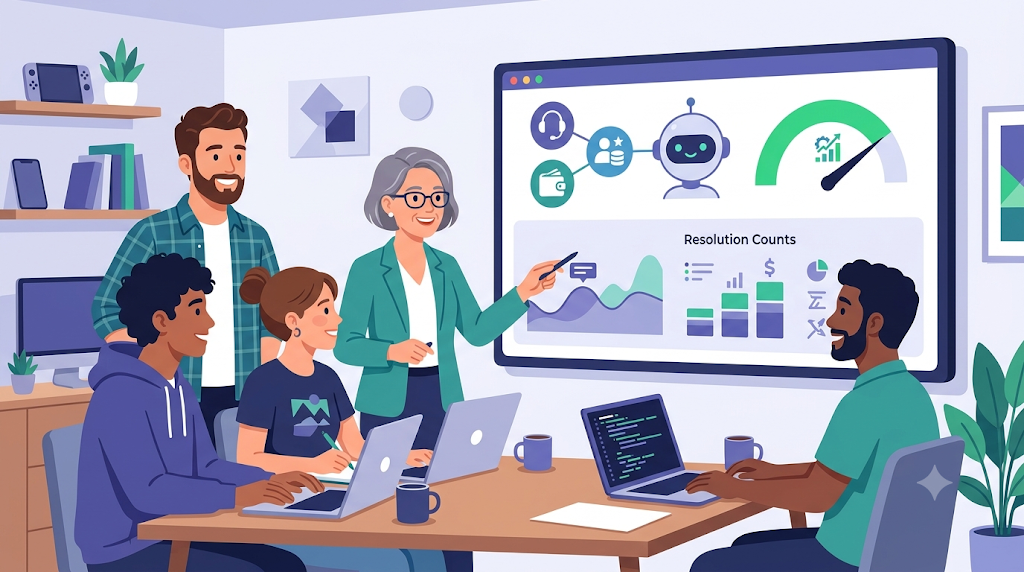
- Resolution tracking dashboards: One shared view of what was resolved, escalated, or reopened, so billing is transparent.
- Billing and usage integrations: We connect your helpdesk, CRM, and payment tools so outcomes flow into invoices automatically.
- Pricing model design: We help you test per-resolution, hybrid, or usage-based structures before you commit.
Explore our custom software development services, or talk to our team about your AI agent plans.
Frequently Asked Questions
What is AI agent pricing?
It’s how vendors charge for AI agents. Common models include per seat, per conversation, per action, per resolution, or a hybrid of these.
What is pay-per-resolution pricing?
You pay a fee each time an AI agent fully resolves a customer issue on its own, and typically nothing when it escalates to a human.
Is pay-per-resolution cheaper than seat-based pricing?
Not always. It can be cheaper at low or moderate volume, but costs rise as the agent resolves more. Model your own numbers before deciding.
Who uses pay-per-resolution pricing?
Intercom, Zendesk, and Sierra are well-known examples, and the model is spreading across AI customer support tools.
What is the biggest risk?
An unclear definition of “resolved.” Always get the exact definition, exclusions, and audit rights in writing.
Can Embarking on Voyage help with AI agent pricing?
Yes. We build AI agents, resolution dashboards, and billing integrations that make results-based pricing accurate and transparent.
Final Thoughts
AI agent pricing is moving from “who logs in” to “what gets done.” Pay-per-resolution pricing makes that shift easy to understand: no solved problem, no charge. But it only works when both sides agree on what “solved” means and can see the data.
Start with a pilot, define success clearly, and keep an eye on costs as your agent improves. If you want a deeper foundation, read our guide to outcome based billing. And if you want a partner to build it, Embarking on Voyage is ready to help.
Leave a Reply