



Winning more clients feels great. But here is the uncomfortable truth many agency founders learn the hard way: digital agency project margins often stay flat, or even shrink, while revenue grows.
You sign bigger projects, hire more people and expand your services. Yet at the end of the quarter, profit looks the same. Scope changes, underestimated complexity, repeated rework and poor resource allocation quietly eat the margin that made the project attractive in the first place.
The good news is that the fix is rarely “charge more” or “cut engineering costs.” Sustainable profitability comes from improving how you estimate, plan, deliver and track work. In this guide, you will learn seven practical ways to increase project margins while protecting the quality your clients trust you for.
Table of Contents
- Stop treating estimates as a number to win the deal
- Control scope without damaging client relationships
- Reduce rework before asking developers to code faster
- Match engineering capacity to real demand
- Improve visibility with the right metrics
- Choose the commercial model that fits the work
- Build a delivery partnership, not a supplier relationship
- Frequently asked questions
Why Digital Agency Project Margins Shrink in the First Place
Before the fixes, it helps to see where the money leaks. In most agencies, margin erosion comes from a few repeating patterns:
- Estimates built to win the deal instead of reflecting real effort
- Small, informal scope additions that never reach the invoice
- Rework caused by unclear requirements or late testing
- Teams that are over-staffed in slow months and stretched in busy ones
- No early warning when a project starts burning more effort than planned
Each of these is fixable, and none of them requires lowering your standards. Let us go through them one by one.
1. Stop Treating Every Estimate as a Number to Win the Deal
Under pressure to close business, agencies sometimes quote what the client wants to hear rather than what delivery will actually need. The problem shows up later: integrations take longer, requirements prove more complex, and testing and deployment get squeezed.
Your delivery team is then left with three poor options: absorb the extra work, renegotiate awkwardly, or compromise on quality.
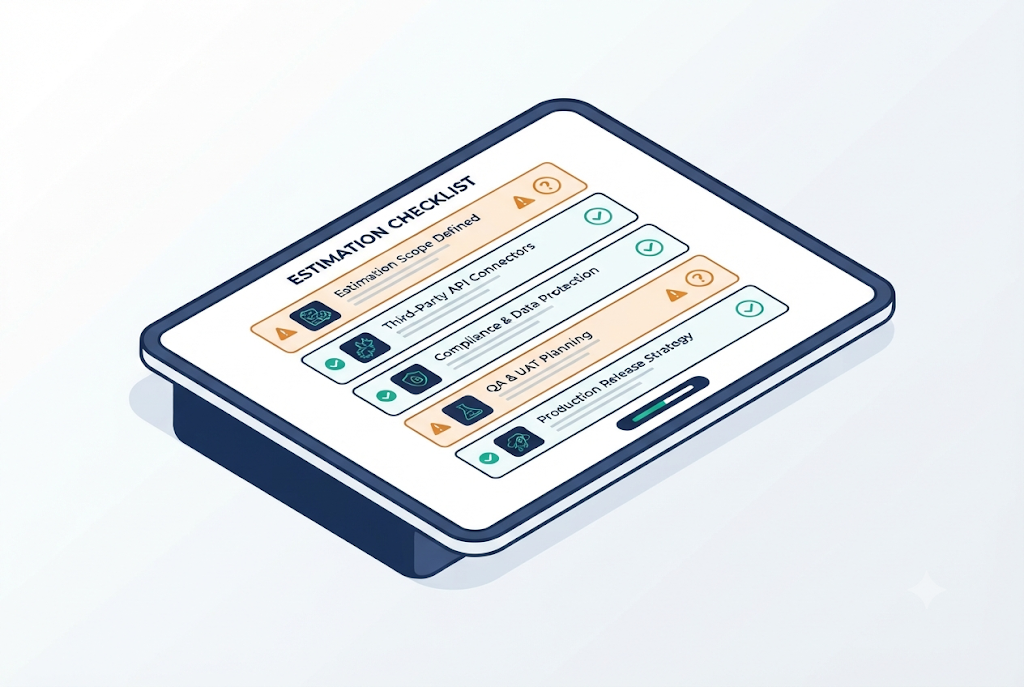
A better approach is to treat software project estimation as a commercial decision backed by technical evidence. Before committing to a price, confirm:
- The business requirements and expected outcomes
- Major features and technical dependencies
- Existing systems and third-party integrations
- Security, compliance and performance requirements
- Testing, deployment and documentation needs
- Assumptions that have not yet been validated
If real uncertainty remains, propose a short discovery phase or technical assessment before you lock in the delivery commitment. Strong digital product consulting at this stage often saves far more than it costs.
A good estimate communicates two things: the expected effort, and the assumptions that effort depends on.
2. Control Scope Without Damaging Client Relationships
Scope creep is not always the client’s fault. It usually happens because expectations were never made explicit.
A request that sounds small can affect architecture, data models, integrations, user permissions and test coverage. When the team says yes informally, the project grows without any matching change to budget or timeline. This is one of the biggest silent killers of scope creep in software projects and, ultimately, of margin.
Create a simple change-control process. Every material change should answer five questions:
- What is changing, and why?
- How does it affect effort, cost and delivery dates?
- Does existing work need to be revisited?
- Which other priorities may need to move?
- Who must approve it?
This does not need to become bureaucracy. A one-page change request is enough. The goal is to make trade-offs visible before the team commits.
Clients almost always prefer an honest conversation about cost and timing to discovering late in the project that the original commitment is no longer realistic.
3. Reduce Rework Before Trying to Make Developers Code Faster
Rework is one of the least visible threats to profitability. It comes from unclear acceptance criteria, incomplete requirements, weak architectural decisions, thin testing or decisions that change after development begins.
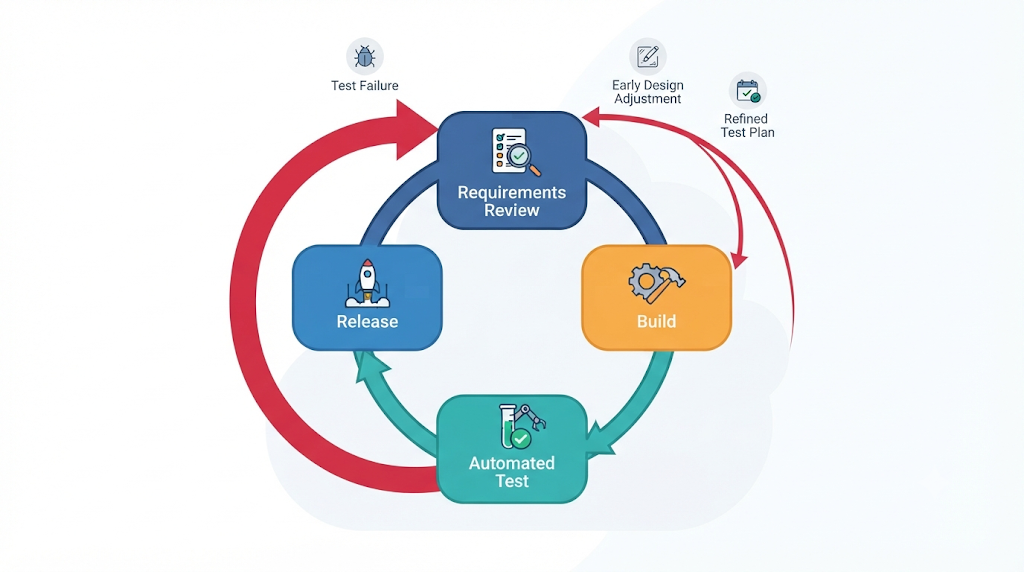
Instead of assuming developers simply need to work faster, measure where rework starts. Then apply practical fixes to reduce rework in software development:
- Review requirements before development starts
- Define acceptance criteria for important features
- Run architecture reviews for complex work
- Use peer reviews and automated testing
- Integrate code frequently instead of waiting until the end
- Test realistic user journeys and failure scenarios
- Track recurring defects and fix their root causes
Investing early in structured quality assurance and testing is one of the most reliable ways to protect both margin and reputation. Industry bodies such as the Consortium for Information & Software Quality (CISQ) have long highlighted the high cost of poor software quality, which is a strong reminder that cutting corners rarely saves money.
AI-assisted tools can speed up coding, testing and documentation. However, faster code generation does not guarantee faster delivery if validation, integration and rework remain unsolved. The aim is to reduce the total effort needed to deliver reliable software, not just to produce more code.
4. Match Engineering Capacity to Actual Demand
Permanent teams bring continuity and institutional knowledge. They can also create financial pressure when project demand rises and falls.
Separate the capabilities you need all year from the extra capacity you need only for peaks or specialist work. Depending on your business model, options include:
- A core in-house engineering team
- Specialists for specific technical challenges
- A dedicated engineering pod to extend capacity
- An external partner for defined delivery streams
- Milestone-based arrangements for clearly scoped work
The right choice depends on how predictable your workload is, which skills you need, onboarding costs and how much control you want to keep.
Do not compare models by hourly rate alone. Include recruitment, management time, knowledge transfer, utilisation, quality assurance and the cost of delays. A flexible model creates value when it matches capacity to demand without adding heavy coordination overhead. Agencies exploring this route can look at how an AI-native digital product engineering team can extend their delivery bench without long hiring cycles.
5. Improve Visibility With the Right Metrics
Revenue and deadlines alone cannot tell you whether a project is profitable. Leaders need early signals that work is consuming more effort than planned, and why.
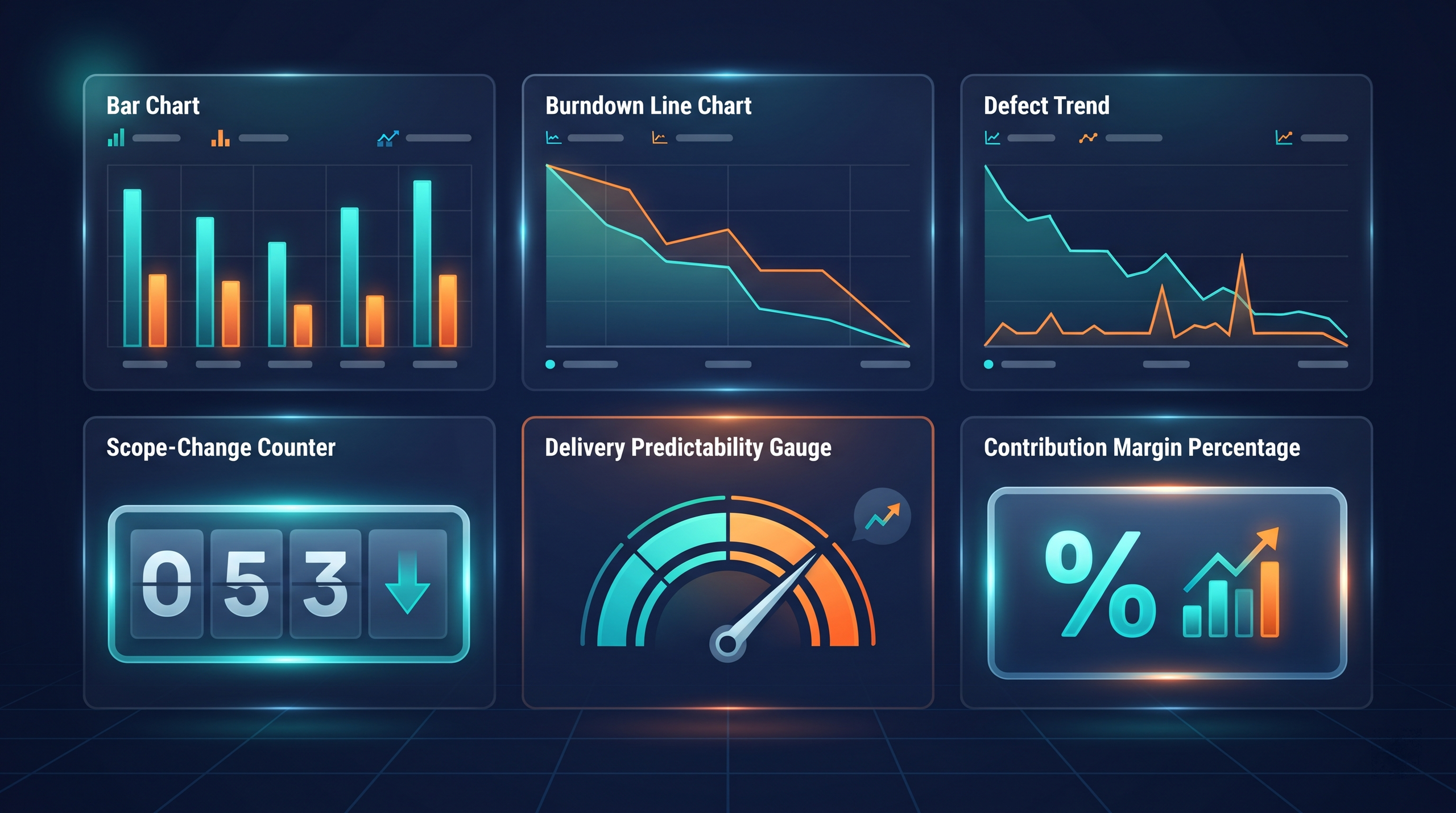
Consider tracking these six measures:
- Estimated vs. actual effort: shows where your estimation assumptions keep failing
- Remaining effort to complete: flags projects likely to overrun before delivery ends
- Rework and defect trends: reveals whether quality issues are eating unplanned capacity
- Scope-change frequency: highlights clients or project types that need tighter management
- Delivery predictability: shows whether the team meets its commitments consistently
- Project contribution margin: shows whether revenue after direct delivery costs can support the wider business
Delivery research programmes such as DORA offer well-known frameworks for measuring software delivery performance and are a useful reference when choosing what to track.
One caution: use metrics to improve systems and decisions, not to pressure individuals. If people feel measured unfairly, they will hide problems, and hidden problems are exactly what destroy margin.
6. Choose the Commercial Model That Fits the Work
The contract shapes the margin as much as the code does.
- Fixed price works when requirements and acceptance criteria are well defined. It becomes risky when uncertainty is high and change control is weak.
- Time and materials handles evolving requirements, but clients need visibility into progress, burn rate and priorities.
- Dedicated teams suit ongoing product roadmaps.
- Milestone or outcome-based models align payment with agreed deliverables when the work is measurable.
The principle is simple: match the contract to the nature of the work. Before agreeing on commercials, define responsibilities, dependencies, acceptance criteria and how changes will be handled. Neither a fixed price nor an outcome-based model removes delivery risk on its own. A sound agreement makes the allocation of responsibility clear to both sides.
If you want an outside view on which model fits your next engagement, you can talk to our product experts for a practical conversation.
7. Build a Delivery Partnership, Not Just a Supplier Relationship
External engineering can add capacity, but it can also add cost if the partner needs constant supervision or delivers work that must be redone.
Judge partners by the results they help you produce:
- Quality and maintainability of delivered software
- Transparency of estimates and progress
- Ability to surface risks early
- Contribution to architecture and technical decisions
- Reliability of milestones and releases
- Quality of documentation and knowledge transfer
A strong partner helps you make better delivery decisions, not just hand you more hours. You can see what this looks like in practice in our client case studies, where long-term collaboration and structured delivery helped businesses scale their products with confidence. Security-minded partners will also follow recognised guidance such as the OWASP Top 10 to keep quality and risk in check.

Profitability and Quality Should Reinforce Each Other
Cutting testing, skipping discovery or choosing a team purely on the lowest rate may help this quarter’s budget, but it raises the odds of expensive failures later.
The more sustainable path is to reduce avoidable effort, make uncertainty visible and match the delivery model to the project. When you do that, digital agency project margins improve naturally, and clients get software they can rely on. Profit and quality stop competing and start supporting each other.
At EOV Digital, we work as a product co-development partner, helping businesses extend engineering capacity through AI-native engineering pods. Our approach supports delivery from roadmap planning through production, with commercial structures aligned to agreed deliverables where appropriate. You can learn more about EOV or explore our other insights on the blog.
Frequently Asked Questions
What is a healthy project margin for a digital agency?
It varies by service mix and region, but many agencies aim for a contribution margin that comfortably covers overheads and leaves room for growth. The more useful habit is tracking your own margin per project and comparing estimate against actual every time.
How can a digital agency increase project margins without raising prices?
Focus on controlling what happens inside the project: realistic estimates, a clear change-control process, less rework, better use of engineering capacity and early visibility into effort overruns.
Does reducing costs always hurt software quality?
No. Cutting testing or skipping discovery does hurt quality, but removing avoidable effort such as rework, idle capacity and unmanaged scope usually improves both profit and quality together.
When should an agency use an external engineering partner?
When demand is uneven, when you need a specialist skill, or when you want to deliver a defined stream of work without the long cost of hiring. Choose a partner on quality, transparency and reliability, not on hourly rate alone.
Which commercial model is best for software projects?
There is no single best option. Fixed price suits well-defined scopes, time and materials suits evolving needs, and dedicated teams suit long-running roadmaps. Match the model to how clear the work really is.
Ready to Improve Your Project Economics?
Start by reviewing where estimates, scope changes and rework are affecting your margins, then pick the one delivery change that will address the biggest cause. If you would like a second pair of eyes, partner with us and let us help you build software your clients can trust, while keeping your margins healthy.
Leave a Reply