


Contents
Implementing a robust Enterprise RAG Architecture has transformed how organizations deploy Large Language Models (LLMs) over the last two years. From intelligent copilots to automated customer support and enterprise search, AI has quickly moved from experimentation into production environments.
But as businesses started deploying AI seriously, they discovered something important: LLMs are impressive, but they are not always reliable.
A foundation model can generate fluent answers, summarize documents, and even write code. Yet, the moment you ask questions specific to your business, customers, operations, or internal systems, the limitations become obvious. The AI starts guessing.
And in enterprise environments, guessing is dangerous. That is exactly why RAG has become one of the most important architectural patterns in modern AI-native product engineering.
The Core Problem with Traditional LLMs (And Why Enterprise RAG Architecture Wins)
LLMs are trained on enormous amounts of internet-scale data. They learn patterns, relationships, and language structures from billions of documents. However, they also come with major limitations:
- Static Knowledge: They only know information available up until their training cutoff point.
- Data Isolation: They cannot access live enterprise data by default.
- Proprietary Blindspots: They struggle with private, internal business information.
- Hallucinations: They may confidently generate incorrect or fabricated answers.
- Lack of Context: They do not inherently understand your specific organizational structure or policies.
For example, an enterprise employee may ask: “What is our latest customer refund policy for European clients?”
A standalone LLM might generate a professional-sounding answer. But it may not reflect current policy changes, regional compliance rules, or internal documentation updates. That creates immense operational risk.
This is where RAG changes the equation.
What Is Retrieval-Augmented Generation (RAG)?
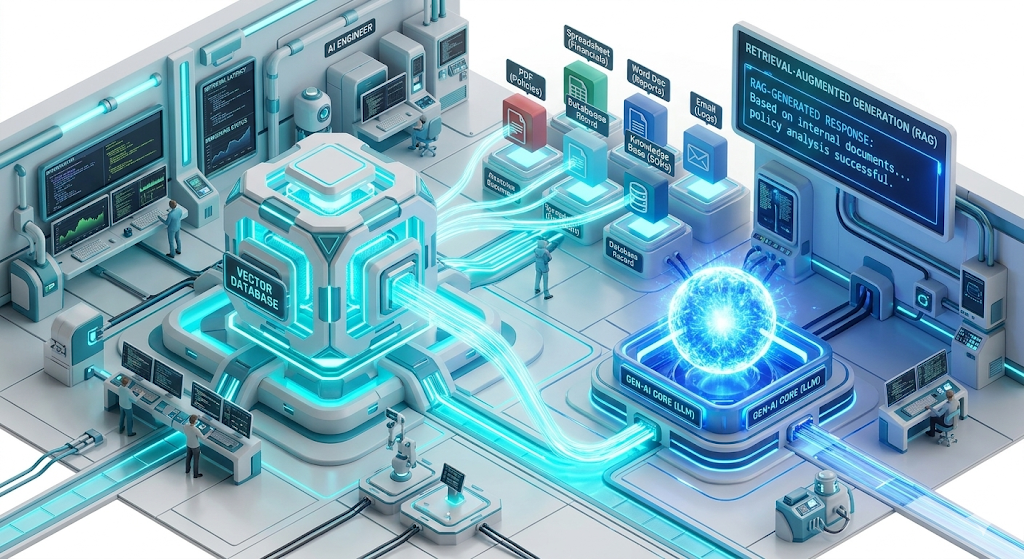
An Enterprise RAG Architecture is a system design that connects an AI model with an external knowledge base that connects an AI model with an external knowledge base to optimize performance. It combines:
- Information retrieval systems
- Vector databases
- Semantic search
- Large Language Models
Instead of relying only on what the LLM learned during training, RAG retrieves relevant business information in real time and provides it as context before generating the response.
In simple terms: Retrieve first → Generate second.
This small architectural shift dramatically improves response quality, contextual accuracy, enterprise trust, and business usability.
Why Enterprises Are Rapidly Adopting RAG
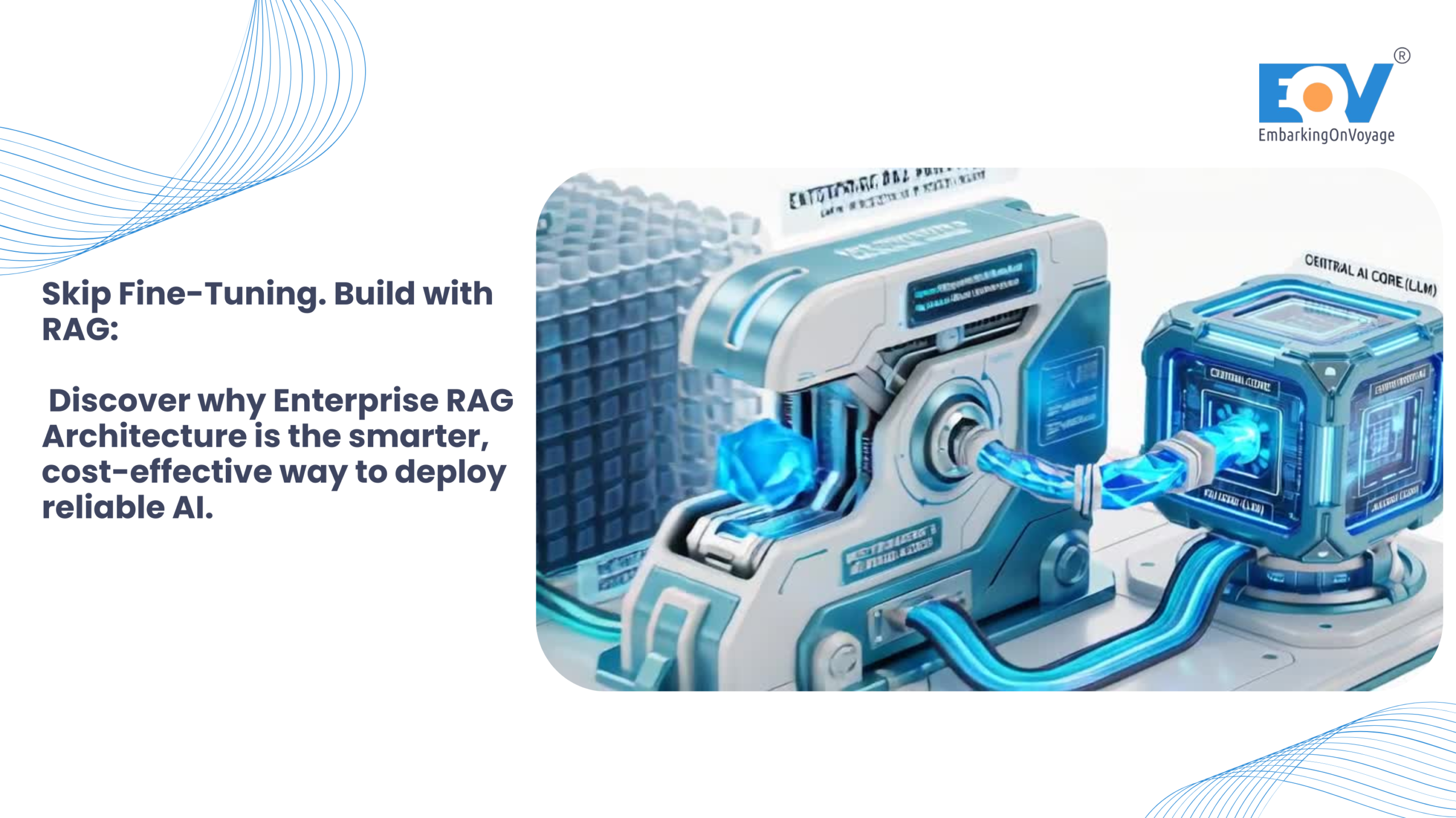
Many organizations initially believed they needed to fine-tune LLMs for every business use case. However, fine-tuning foundation models is highly resource-intensive and computationally expensive. Fine-tuning introduces higher infrastructure costs, retraining complexity, governance challenges, and slower updates.
A modern Enterprise RAG Architecture offers a far more practical, scalable alternative.
Instead of retraining the model every time your data changes, organizations simply update the retrieval layer or knowledge source. By separating the knowledge base from the model weights, systems can access the latest domain-specific data instantly.
Fine-Tuning vs. RAG Architecture
| Feature | Fine-Tuning LLMs | RAG Architecture |
| Data Updates | Requires full model retraining | Instant (Updates vector database) |
| Cost | Extremely high compute costs | Highly cost-efficient |
| Source Transparency | Black box (Cannot cite sources) | High (Can link to retrieved documents) |
| Hallucination Risk | Still prevalent on new data | Significantly reduced via grounding |
his makes AI systems faster to maintain, easier to scale, and significantly more flexible.
How RAG Actually Works
At the EOV AI Native Engineering Lab, we build robust architectures to ensure data flows securely. A production-ready Enterprise RAG Architecture typically follows a clear six-step workflow:
- Data Ingestion: Enterprise documents (PDFs, logs, databases) are converted into vector embeddings.
- Storage: These embeddings are stored in a vector database.
- Querying: A user submits a prompt or query.
- Retrieval: A semantic search retrieves the top relevant information based on mathematical distance.
- Context Injection: The retrieved content is passed directly to the LLM as explicit context.
- Generation: The LLM generates a highly contextual, accurate response.
The result: The AI answers using your business data rather than generic internet knowledge.
A Real Business Example: Healthcare Support
Imagine a healthcare SaaS platform. A hospital administrator asks: “What is the approved workflow for patient insurance escalation in Germany?”
- Without RAG: The AI may provide generic, potentially non-compliant healthcare guidance.
- With RAG: The system securely retrieves internal SOP documents, regional compliance workflows, insurance escalation rules, and enterprise policy documentation before generating the answer.
Now the response becomes accurate, compliant, contextual, and operationally useful. This is the difference between consumer AI and enterprise AI.
Why RAG Reduces Hallucinations
One of the biggest challenges with LLMs is hallucination. The model often generates responses that sound correct even when they are factually wrong, detecting patterns that don’t actually exist.
RAG significantly reduces this risk by anchoring the LLMs in specific, factual, and current data. Instead of guessing, the AI references actual documents, records, knowledge bases, and structured enterprise content.
This becomes especially critical in banking, healthcare, insurance, legal systems, and enterprise SaaS products. In regulated environments, accuracy matters far more than creativity.
The Role of Vector Databases in RAG
Traditional databases search using exact keyword matches. Vector databases search using meaning. This is one of the biggest breakthroughs enabling modern RAG systems.
For example, a customer may search: “Why did my travel reimbursement fail?” The actual document may contain: “Expense claim rejected due to policy validation.”
Traditional keyword search may struggle here. Vector search understands the semantic similarity and retrieves the relevant context anyway.
Popular vector database technologies forming the backbone of these architectures include:
A Simple Technical Example
While production systems—like the ones we validate through our EOV Pulse framework—involve complex vector reranking, access controls, and chunking strategies, the core concept is straightforward.
A simplified .NET-based RAG workflow looks like this:
C#

public async Task<string> GenerateAnswer(string query)
{
    // 1. Retrieve relevant data from the vector database
    var documents = await _vectorDb.SearchAsync(query);

    var context = string.Join("\n", documents);

    // 2. Inject the retrieved enterprise data into the prompt
    var prompt = $@"
    Using this enterprise context:
    {context}

    Answer this question:
    {query}
    ";

    // 3. Generate grounded response
    return await _llm.GenerateAsync(prompt);
}
In heavy production environments, this workflow extends to include frameworks like LangChain, Semantic Kernel, AI observability, and rigorous security controls.
Final Thoughts
Deploying an Enterprise RAG Architecture is quietly becoming one of the foundational layers of modern AI systems one of the foundational layers of enterprise AI. Not because it makes AI more fashionable, but because it makes AI more useful.
RAG helps Large Language Models become contextual, reduce hallucinations, access proprietary enterprise knowledge, and deliver meaningful business outcomes. For organizations building AI-native products or autonomous workflow systems, RAG has rapidly shifted from a “nice to have” to “business critical.”
The future of enterprise AI will not belong to companies using the largest models alone. It will belong to companies that combine strong engineering, intelligent retrieval, contextual business data, and scalable architecture to create trustworthy, operational systems.
Is Your RAG Architecture Production-Ready? Moving from a prototype to an enterprise-grade AI system requires rigorous validation. Discover how we pressure-test and scale AI infrastructure at EOV, or reach out to run an EOV Pulse check on your current retrieval systems today.
Leave a Reply