



Forward Deployment Engineering has rapidly become one of the most critical and sought-after disciplines in enterprise software. While traditional software engineers focus on building products in a vacuum, Forward Deployment Engineers embed deeply within client ecosystems to ensure those products deliver measurable value inside highly complex, heavily regulated environments.
If your organization is scaling rapidly, partnering with a leading forward deployment engineering company in Pune India is a strategic necessity. A successful deployment rarely depends on a single technology. Instead, it requires deep, cross-functional expertise across application development, cloud infrastructure, secure API integration, DevOps, data engineering, and increasingly, Artificial Intelligence.
This article explores the complete technical blueprint every Forward Deployment Engineer and every future-ready AI-native engineering partner must master to successfully deploy enterprise-grade applications.
Understanding the Enterprise Technology Landscape
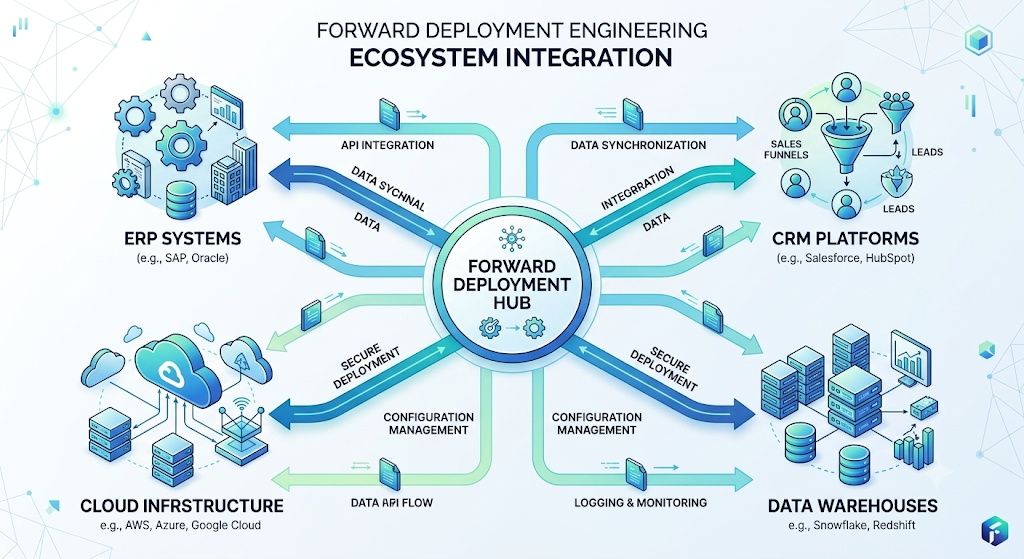
Enterprise software is fundamentally different from lightweight consumer applications. You can rarely assume a “greenfield” environment. A typical enterprise customer deployment may involve integrating:
- Legacy ERP systems such as SAP or Oracle.
- Complex CRM platforms like Salesforce or HubSpot.
- Microsoft Entra ID or legacy Active Directory frameworks.
- Payment gateways and financial clearinghouses.
- Multiple legacy databases developed and patched over decades.
Every enterprise has unique architectures, strict governance models, rigorous security policies, and unyielding operational constraints. Success begins with understanding this ecosystem before writing a single line of code. As an AI-native digital product engineering partner, we approach every deployment with this holistic, co-creation mindset.
Programming Languages: Choose Reliability Over Popularity
Programming languages are simply tools to achieve a business outcome. The best Forward Deployment Engineers select languages based on the customer’s existing ecosystem rather than personal preference or the latest trends.
| Industry / Use Case | Recommended Languages | Why It Fits the Enterprise |
| Financial / Banking | Java, C# (.NET) | Proven stability, high security, and deep legacy system integrations. |
| Enterprise AI & Data | Python | The undisputed leader in LLM orchestration, Agentic AI, and Machine Learning. |
| Modern Web Portals | TypeScript (React, Angular) | Type safety at scale for complex, user-centric interfaces. |
| High-Performance Backend | Go (Golang) | Low latency, excellent concurrency, and lightweight microservices. |
An experienced FDE team is comfortable context-switching between languages depending on specific deployment requirements.
API Integration: The Foundation of Enterprise Connectivity
Very few enterprise products operate independently today. Forward Deployment Engineers spend a significant amount of time integrating disparate systems to ensure seamless data flow.
Typical integrations include REST APIs, GraphQL, SOAP services, Webhooks, Event-driven messaging, and gRPC. However, successful integration goes far beyond simply calling endpoints. A professional FDE must proactively design for failure, as distributed systems fail by design.
Key integration design considerations include:
- Security: Authentication, Authorization, and payload encryption.
- Resilience: Rate limiting, timeout strategies, and exponential backoff retry mechanisms.
- Data Integrity: Idempotency and strict version compatibility.
- Observability: Comprehensive distributed logging and real-time monitoring.
Microservices & Cloud Platforms Every FDE Should Know
Large enterprise applications cannot evolve efficiently as monoliths. FDEs frequently deploy microservice-based architectures because they provide team autonomy, independent deployments, strict fault isolation, and unmatched scalability.
Furthermore, today’s enterprise software is undeniably cloud-first. Top-tier forward deployment teams must understand all major cloud computing platforms:
- Microsoft Azure: Ideal for enterprises deeply invested in the Microsoft ecosystem. Essential services include Azure App Service, Azure SQL, and Azure AI Foundry.
- Amazon Web Services (AWS): The industry pioneer. Common enterprise services include EC2, EKS, Lambda, RDS, and S3.
- Google Cloud Platform (GCP): Highly popular for data-intensive workloads, analytics, and advanced AI modeling.
Kubernetes: The Standard for Enterprise Deployments
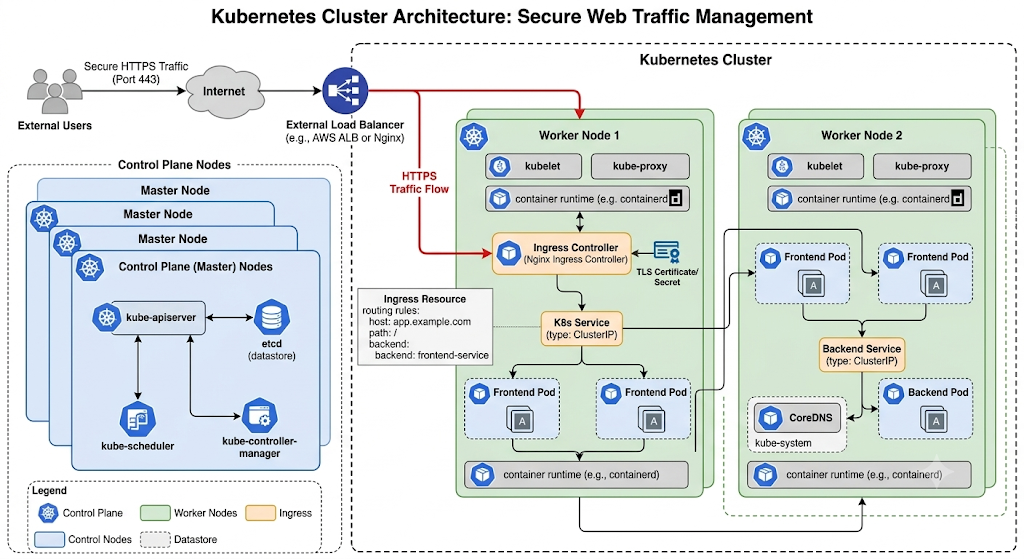
Modern enterprise deployments increasingly rely on Kubernetes (K8s). Containers package applications consistently across development, testing, staging, and production environments, eliminating the “it works on my machine” problem.
Kubernetes empowers engineers with capabilities such as:
- Automated deployments and self-healing infrastructure.
- Auto-scaling based on real-time application traffic.
- Rolling updates with absolute zero downtime.
- Advanced Service discovery and load balancing.
A profound understanding of Pods, Deployments, ConfigMaps, Secrets, Ingress Controllers, and Persistent Volumes is essential for reliable, enterprise-grade delivery.
CI/CD & Infrastructure as Code: Accelerating Delivery
Manual deployments introduce massive, unnecessary risk and human error. Forward Deployment Engineers design robust Continuous Integration and Continuous Deployment (CI/CD) pipelines using platforms like Azure DevOps, GitHub Actions, or GitLab to automate the software delivery lifecycle.
Furthermore, traditional manual server configuration is entirely obsolete. Modern enterprises automate infrastructure using code. Leveraging tools like Terraform enables:
- Strict version control for all infrastructure.
- Repeatable, completely error-free deployments.
- Faster disaster recovery and instant environment replication.
Enterprise Authentication & Data Migration
Authentication is often one of the first and most complex technical hurdles encountered during enterprise onboarding. Customers rarely maintain independent user databases; they integrate with enterprise identity providers (IdPs) like Okta or Microsoft Entra ID. Forward Deployment Engineers must be fluent in OAuth 2.0, OpenID Connect (OIDC), and SAML.
Equally critical is Data Migration. Customers rarely start with empty systems. Petabytes of historical data must be migrated accurately. Migration projects typically involve data profiling, cleansing, transformation, validation, and complex rollback planning. For organizations handling complex legacy systems, our specialized Enterprise Data Engineering Services ensure data is safely migrated and structured for long-term scalability.
Enterprise AI: The Next Frontier
Artificial Intelligence has fundamentally changed the blueprint of enterprise software. Customers no longer ask for isolated AI features – they expect AI seamlessly integrated into their existing workflows to drive autonomous action.
Forward Deployment Engineers are now tasked with deploying:
- Large Language Models and highly optimized Vector Databases.
- Retrieval-Augmented Generation pipelines securely connected to proprietary enterprise data.
- Agentic AI and autonomous workflows that multiply team output.
- Intelligent document processing and semantic search capabilities.
The challenge is not simply making API calls to an LLM provider, but ensuring secure, governed, and context-aware AI that strictly aligns with enterprise compliance requirements. Building these robust systems requires dedicated expertise in AI-Native Digital Product Engineering.
Bringing It All Together: Partnering with an AI-Native Innovator
Consider a real-world enterprise deployment: A global customer wants to modernize their operations with Agentic AI. An FDE must build APIs connecting legacy CRMs, deploy microservices on Kubernetes, configure Azure resources, automate pipelines, migrate millions of secure records, and integrate a governed RAG solution.
Each activity requires deep technical expertise, but true success depends on orchestrating them into a seamless, high-performance experience. Forward Deployment Engineering has evolved into a multidisciplinary practice bridging architecture with execution, and technology with measurable business outcomes.
If you are seeking an agile, global partner capable of navigating this technical complexity, partnering with a premier forward deployment engineering company in Pune India like Embarking On Voyage (EOV) ensures your digital transformation is built to scale, secure by design, and unequivocally ready for the AI-native future.
Leave a Reply