


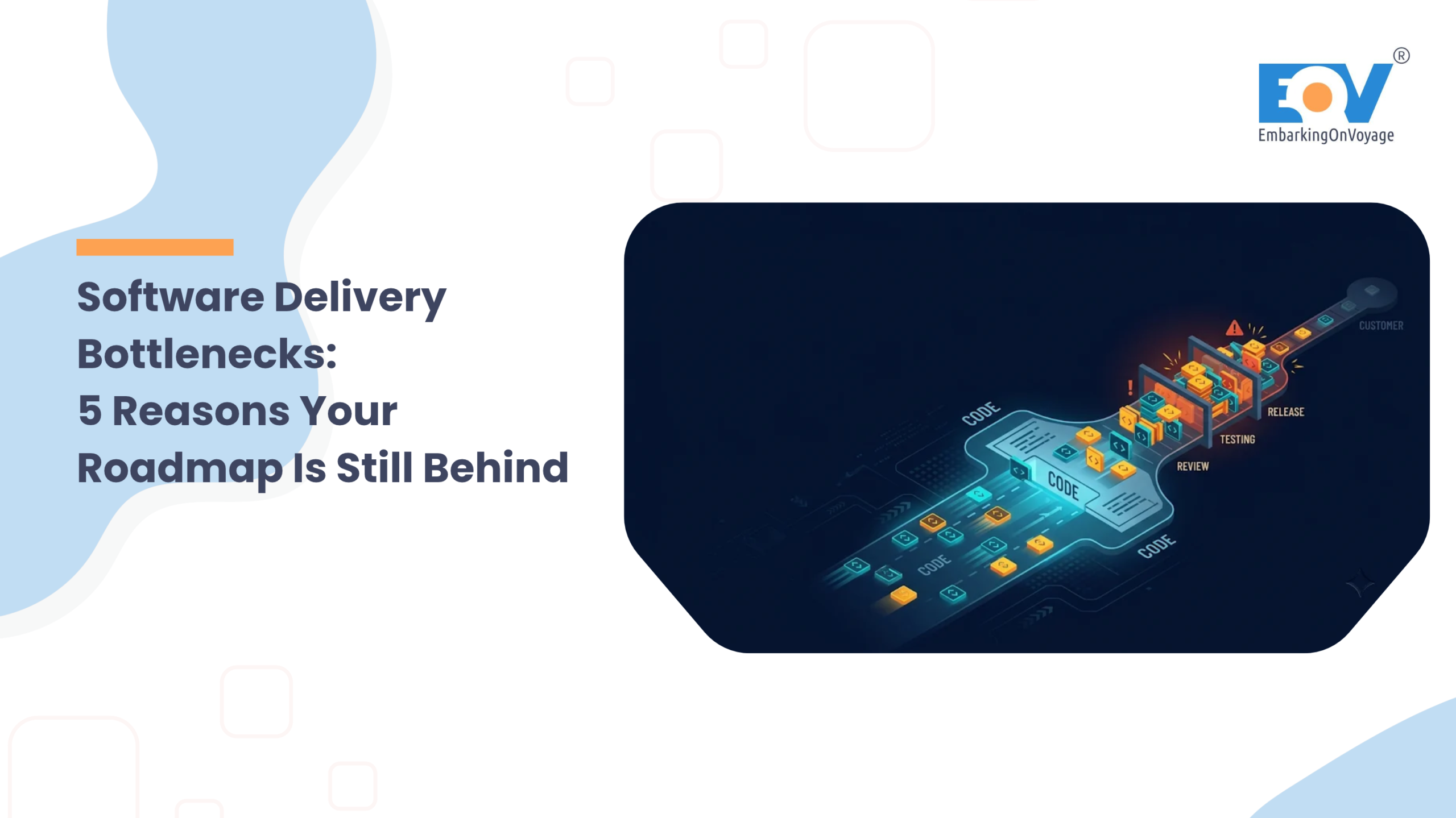
Your engineering team has adopted AI coding assistants. Developers generate code faster, explore solutions sooner and automate routine work every day. Yet the product roadmap is still behind schedule.
Features sit in the backlog. Releases slide from sprint to sprint. Testing queues grow. Product managers cannot predict delivery dates, and business leaders keep waiting for capabilities customers need today.
If that sounds familiar, the problem is probably not coding speed. The real culprits are software delivery bottlenecks: the approvals, handoffs, reviews and unclear requirements that surround the code. This guide explains where they hide and what to do about each one.
Table of Contents
Why Faster Coding Does Not Mean Faster Delivery
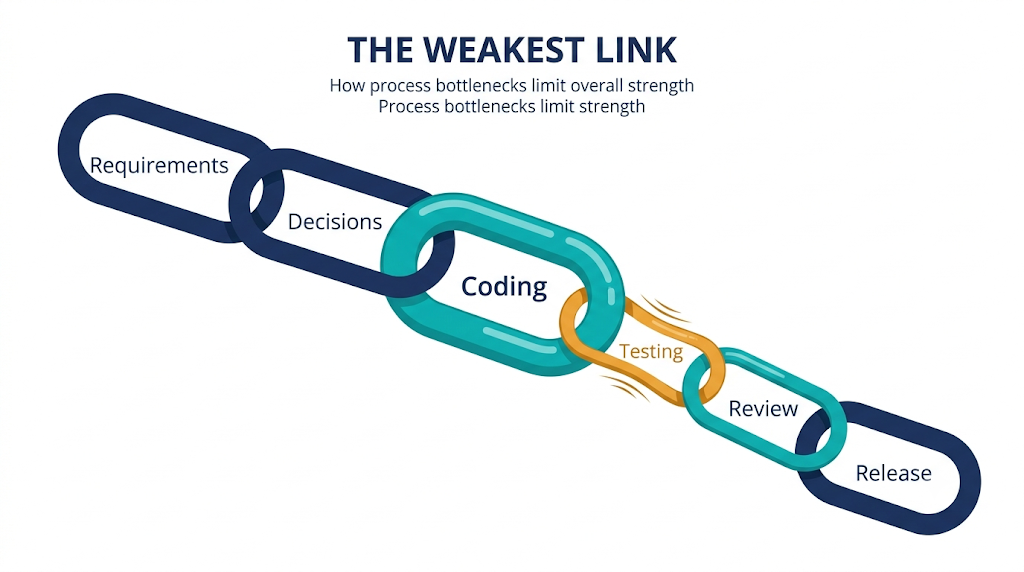
Software delivery is a chain of connected activities. Teams must understand requirements, make technical decisions, resolve dependencies, write code, test it and validate the release. Speeding up one link does not automatically speed up the chain.
Suppose implementation is only one part of the time needed to ship a feature. If AI shortens that part but approvals, integration and testing stay the same, the overall gain is small.
This is the Theory of Constraints at work. Management thinker Eliyahu Goldratt argued that a system’s output is limited by its constraint, much like a chain is only as strong as its weakest link. You can read a clear summary of the idea in Mind Tools’ guide to the Theory of Constraints.
Recent research points the same way. Google’s 2025 DORA report on AI-assisted software development, based on nearly 5,000 technology professionals, found that AI adoption now relates positively to delivery throughput but still relates negatively to delivery stability. The full DORA research describes AI as an amplifier: it magnifies the strengths and the weaknesses of the system it joins.
5 Software Delivery Bottlenecks Stalling Your Product Roadmap
1. Requirements Are Not Ready for Engineering
Unclear acceptance criteria, shifting priorities and incomplete business rules create rework. Developers, with or without AI, build the wrong thing quickly and then rebuild it.
AI can help clarify requirements and spot gaps. Still, product owners and stakeholders must settle the important ambiguities before the team commits to delivery.
What to do: Write clear acceptance criteria, document assumptions and list dependencies before implementation begins.
2. Technical Decisions Take Too Long
Teams often wait on architecture decisions, access approvals, API specifications or alignment between engineering groups. Generating code faster does not remove those waits.
What to do: Name a decision owner for each area, document architectural standards and resolve cross-team dependencies early, not mid-sprint.
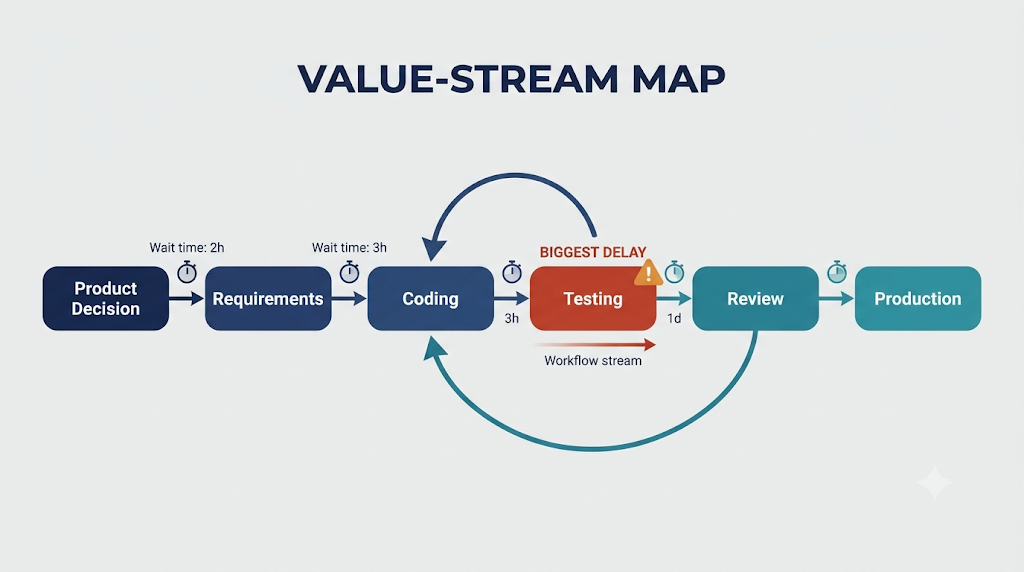
3. Testing Becomes the New Bottleneck
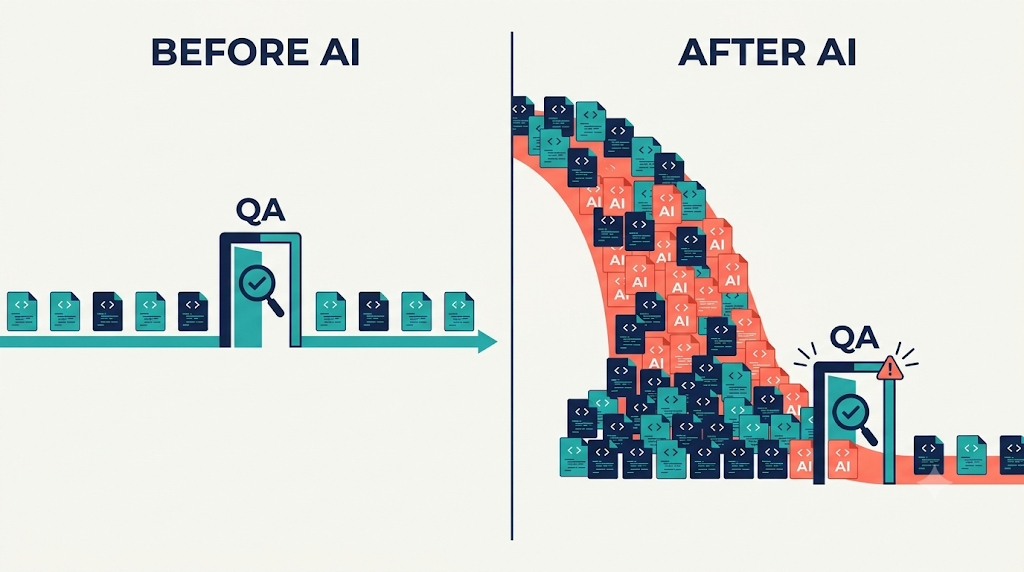
When implementation speeds up, more code arrives that needs validation. If automated testing and code review do not keep pace, work piles up just before release.
What to do: Build testing into the daily development workflow. Use AI to help generate tests where it makes sense, but confirm coverage, behaviour and edge cases through dependable engineering controls such as CI pipelines and peer review.
4. Ownership Is Fragmented
One team owns requirements, another builds, a third tests and a fourth deploys. Each group can finish its tasks while the feature itself stays undelivered, because nobody is accountable for the outcome.
What to do: Give one accountable team ownership of an agreed delivery scope, with explicit dependencies and release criteria.
5. Progress Is Measured by Activity, Not Outcomes
Tasks closed, hours logged and commits pushed show activity. They do not prove that a customer can use a new capability.
What to do: Track work from commitment all the way to production. Measure lead time, delivery predictability, escaped defects and the value of finished roadmap items.
How to Remove Software Delivery Bottlenecks Across the Whole System
Technology leaders should look at the full journey from product decision to production release. A practical way to start:
- Map a typical feature’s path. Note every wait, handoff, approval and rework loop.
- Baseline a handful of metrics. Keep the list short and honest.
- Redesign the workflow. Fix the biggest constraint first, then look for the next one.
Five questions make a strong baseline:
- How long does an approved feature take to reach production?
- How often do teams deliver what they committed to?
- How much work returns because requirements or implementation were incomplete?
- How many defects escape into production?
- Which dependencies repeatedly delay delivery?
AI may help at several stages. Yet the highest-value fix may be clearer requirements, stronger automation, better architecture or more accountable ownership. The goal is not to maximise AI usage. The goal is a better delivery system.
Rethinking Engineering Capacity
When a roadmap slips, the instinct is to hire more developers. Sometimes that is right. But extra capacity does not fix unclear requirements, architectural blockers or fragmented ownership, and it can add coordination overhead.
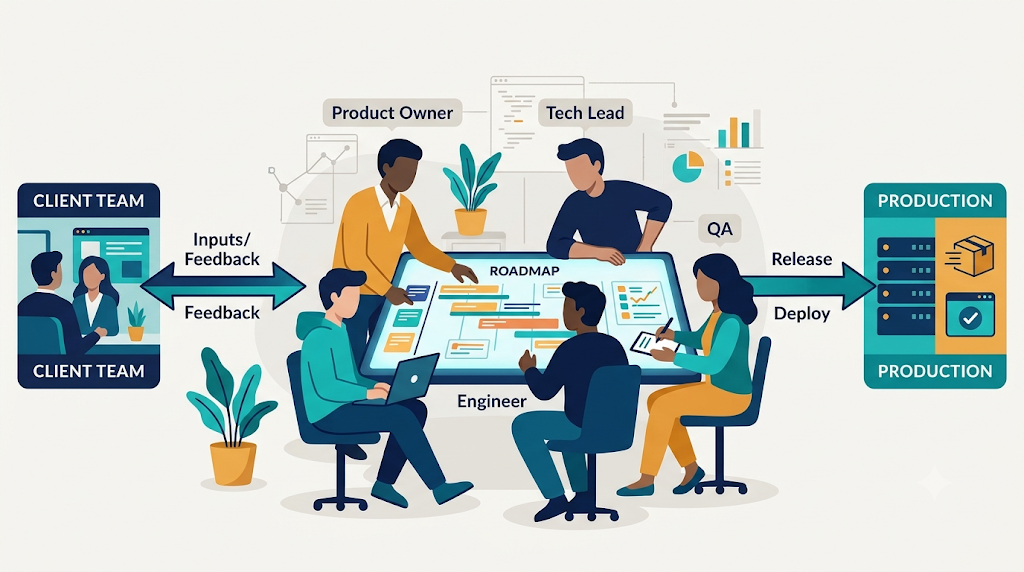
A dedicated engineering pod offers another route when it has a defined scope, strong technical leadership, clear interfaces with your internal team and responsibility for agreed delivery outcomes. AI-native practices can improve implementation workflows, test creation and technical analysis inside such a pod, while delivery discipline makes sure the output is production-ready.
At EOV Digital, we work with technology businesses as a product co-development partner, combining experienced engineering teams, AI-native practices and delivery ownership. You can explore our product engineering services to see how this works in practice, or browse more guides on our engineering blog.
Frequently Asked Questions
Why is my roadmap behind if developers use AI coding assistants?
Because coding is only one stage of delivery. Unclear requirements, slow decisions, testing queues and fragmented ownership still limit how fast finished features reach customers.
What are the most common software delivery bottlenecks?
The five covered here: unready requirements, slow technical decisions, testing and review overload, fragmented ownership and activity-based measurement.
Which metrics show whether delivery is improving?
Track lead time from approval to production, commitment predictability, rework rate, escaped defects and recurring dependency delays.
Should we hire more developers to fix roadmap delays?
Only after you identify the real constraint. If the bottleneck is requirements, architecture or ownership, more developers can add coordination cost instead of speed.
How can AI help without creating new bottlenecks?
Use it for requirement analysis, implementation and test generation, but pair it with automated testing, code review standards and clear acceptance criteria so quality keeps pace with speed.
Conclusion: Faster Coding Is Useful, Faster Delivery Is the Goal
AI gives engineering teams a real chance to improve how software gets built. Yet coding speed should never be the final measure of success. The better question is whether your organisation can turn product priorities into dependable releases with less rework and more predictability.
If your developers are coding faster but your roadmap is not, it is time to examine the entire delivery system.
Talk to EOV Digital about improving your product engineering execution →
Leave a Reply