



AI infrastructure investment is now one of the largest capital commitments in business history. Hyperscalers are pouring hundreds of billions into chips, data centres and foundation models. The big question is whether those who build the rails will keep most of the profit, or whether the winners will be the companies that run the trains.
History gives a clear answer, though not a simple one. Every major technology shift splits into two races: building the foundation, and building profitable businesses on top of it. First-wave pioneers prove what is possible. A second wave then invents the commercial models that capture most of the value.
This guide shows where AI sits in that cycle, what railways and the dot-com crash teach us, and where the next wave of enterprise value is forming. At Embarking on Voyage, we help product-led companies build AI-first products, so these questions shape our daily work.
Table of Contents
The Five-Stage Arc of Technology Cycles
No two eras unfold identically, but major infrastructure shifts follow a recognisable pattern:
- Discovery: A breakthrough unlocks capabilities once thought impossible. Capital funds technical potential well ahead of commercial proof.
- Capital expansion: Confidence accelerates spending. Competitors race to build hardware, networks and platforms to secure early market share.
- Commercial correction: Hype outpaces revenue. Capital turns selective, and unsustainable players fold or consolidate.
- Mainstream adoption: Cheaper infrastructure lets a new wave of companies solve specific, high-value operational problems.
- Commodification: The technology becomes invisible plumbing, an expected baseline across industries.
The core lesson is to separate a technology’s long-term utility from the short-term returns of the companies financing it.
What History Teaches About AI Infrastructure Investment
The 1840s British Railway Mania
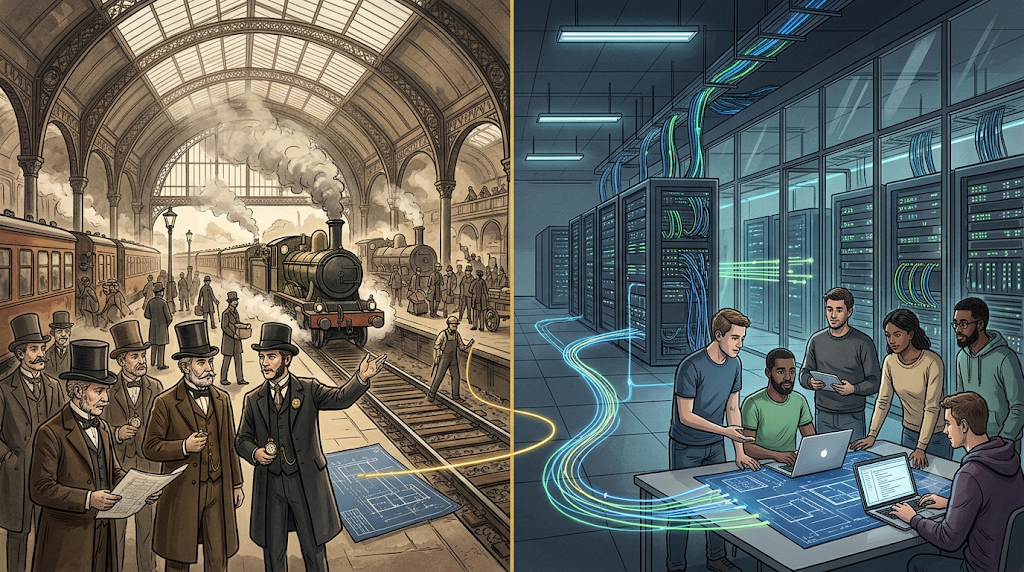
Railways transformed industrial trade and triggered a huge speculative boom in 19th-century Britain. Investors financed redundant lines on inflated demand forecasts. When the bubble burst, fortunes vanished and dozens of rail companies collapsed. You can read the full story of the Railway Mania.
The tracks, however, stayed. Early equity holders took the loss, while the industrial businesses that moved goods over those tracks captured the long-term returns.
The Dot-Com Crash (2000–2001)
The late-1990s internet boom mirrors today’s AI build-out even more closely. Telecoms buried thousands of miles of fibre while startups raised money on traffic instead of revenue. The thesis that the internet would rewire global commerce was right. The market simply mistook a transformative medium for viable unit economics. Here is a good summary of the dot-com bubble.
When the crash came, hundreds of startups folded and telecoms buckled under debt. Yet the fibre networks, data centres and protocols stayed in place, and bandwidth costs fell sharply. Survivors like Amazon, Google and Salesforce became category leaders. A second wave, including Facebook and YouTube, built massive businesses without laying a single metre of cable.
A market correction does not invalidate a technology. It transfers leverage from infrastructure builders to application builders.
Inside AI’s Infrastructure Supercycle
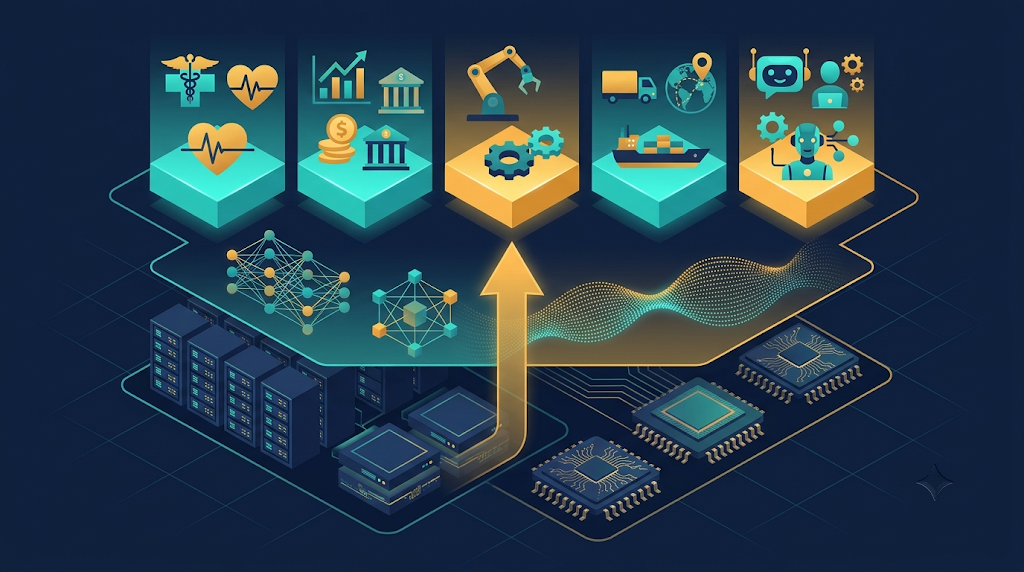
AI is deep in its capital expansion phase. Behind every generative model and enterprise agent sits a heavy physical and digital stack:
- Specialised GPUs and custom silicon
- Hyperscale data centres and energy infrastructure
- High-speed networking and cloud compute
- Foundation models, data pipelines and inference layers
Big Tech is committing historic capital to this stack in anticipation of enterprise demand. As in the late 1990s, AI’s potential is real, but the return on invested capital is a separate equation.
Enterprise AI usage can compound quickly even if individual labs, infrastructure providers or startups miss their revenue targets. A valuation reset would not mean the end of AI. It would mean the start of commercial discipline.
For most enterprises, the practical starting point is not a data centre but a solid data foundation. Our enterprise data engineering and AI infrastructure services show how to prepare pipelines and warehouses for agentic AI.
Where the Next Wave of Enterprise Value Sits
If past cycles hold, the next breakout B2B companies will not train frontier models or build data centres. They will apply existing AI capabilities to complex, high-margin business problems. Five areas offer the clearest upside:
- Vertical AI solutions: Healthcare, financial services, manufacturing, travel and logistics run on entrenched legacy workflows. Vendors with domain expertise, proprietary data and integration depth build far stronger moats than generic wrappers. Travel is a good example, as covered in our travel and hospitality software development work.
- AI-native software architecture: Bolting a chat box onto legacy SaaS rarely delivers structural value. The opportunity is rebuilding software around contextual decisions, adaptive interfaces and automated execution. See our guide to AI-native product engineering for startups.
- Re-engineered operations: Real ROI comes from redesigning whole functions, such as supply chains, procurement and customer operations, rather than saving minutes on isolated tasks.
- Agentic and multi-agent systems: Autonomous workflows that coordinate across enterprise systems are moving from pilot to production. Winners will be defined by reliability, permissioning, security and human-in-the-loop governance, not flashy demos.
- Model-agnostic stacks: Architectures that route work to the best price-performance model reduce vendor lock-in. Teams must still weigh flexibility against latency, switching costs and integration overhead.
These companies avoid the multi-billion-dollar capex of the first wave. They still face incumbents with distribution, enterprise trust and balance-sheet scale. The next phase will mix competition and partnership across the stack. If you are shaping an AI product roadmap, explore our AI-native digital product consulting.
The Regulatory Wildcard
Unlike the early internet, AI is scaling under active government scrutiny. Three models now shape global deployment.
European Union. The EU AI Act uses a strict, risk-based framework. The Digital AI Omnibus moves obligations for Annex III high-risk systems to 2 December 2027, instead of 2 August 2026. Annex I systems follow by 2 August 2028 at the latest. Expect stronger enterprise trust in regulated sectors, paired with higher compliance costs. For the details, see this analysis of the AI Omnibus changes. orrickcms
United States. The US relies on a fragmented mix of federal sector oversight and state-level bills. Federal policy leans toward competitiveness and lighter guardrails, which speeds up experimentation. Multi-state operators are left to navigate legal ambiguity.
India. More than 38,000 GPUs have been onboarded under the IndiaAI Mission. The February 2026 India AI Governance Guidelines adopt a principle-based framework anchored in seven Sutras and prioritise innovation over restraint. India pairs domestic compute and Digital Public Infrastructure with existing IT laws. digitalindiapib
Regulation directly changes unit economics. Heavy compliance regimes favour well-capitalised incumbents who can absorb legal overhead. Lighter frameworks speed up go-to-market, at the risk of unmanaged operational liability.
Three Scenarios for the AI Market
The distribution of long-term value is not predetermined. Three trajectories remain in play:
- The Internet Playbook: Infrastructure capex overshoots near-term ROI and triggers consolidation. Compute and model costs fall, and a second wave of vertical and AI-native software companies captures most of the value.
- Incumbent dominance: Inference economics improve fast enough for hyperscalers to earn strong returns. They use compute, distribution and proprietary models to dominate the application layer too.
- Regulation-driven segmentation: Compliance, data sovereignty and liability rules set adoption speed by region and sector. Advantage shifts to vendors specialising in governance, security and compliant deployment.
In practice, these outcomes will coexist across geographies, regulated industries and layers of the enterprise stack.
The Real Prize: Utility Over Scale
The railway bust did not kill rail transport, and the dot-com crash did not slow the internet. Even if parts of the AI market correct sharply, the shift in how software and businesses operate is permanent.
The first generation proves what is possible. The next makes it reliable, affordable and profitable. Whether the biggest returns from AI infrastructure investment go to hyperscalers or to the operators building AI-native businesses on top remains open. What is clear is that the next chapter of AI will not be won by whoever builds the largest model. It will be won by whoever turns it into measurable business value.
Want more analysis like this? Browse the Embarking on Voyage blog for more on technology and innovation.
Leave a Reply